It is fitting to begin this article by recalling a sentence from my previous Daily Sabah column, which anticipated the logic of a self-fulfilling prophecy: “The next expected step from Pashinyan will be to confront the construct of the so-called Armenian genocide narrative.”
Our region is leaving behind a phase in which we have witnessed this very confrontation. What paved the way for it was Israel’s attempt to bring the so-called “Armenian genocide” issue back onto the agenda, resorting to various political ploys to overshadow the genocide it has been carrying out in Gaza.
The ministers of the genocidal Netanyahu government, which has brutally massacred more than 73,000 Palestinians in Gaza since Oct. 7, 2023, have been attempting to manufacture various artificial agendas to make the world forget the Palestinian question. One of these was Israeli Foreign Minister Gideon Sa’ar’s announcement that Israel had unanimously recognized the Ottoman Empire’s treatment of the Armenians as a so-called “genocide.”
This statement is particularly concerning not only for Türkiye but also for Armenia, the other direct party to the matter. That Israel, which is currently facing genocide proceedings before the International Court of Justice, claims to have “fulfilled a moral duty by recognizing a historical truth” is, to put it mildly, tragicomic.
The statement issued by the Ministry of Foreign Affairs of the Republic of Türkiye reflected precisely this interpretation and did so with considerable prudence: “It lays bare the predicament in which Netanyahu and his accomplices find themselves, given the arrest warrants issued against them within the scope of the investigation conducted by the International Criminal Court into the crimes committed against the Palestinians.”
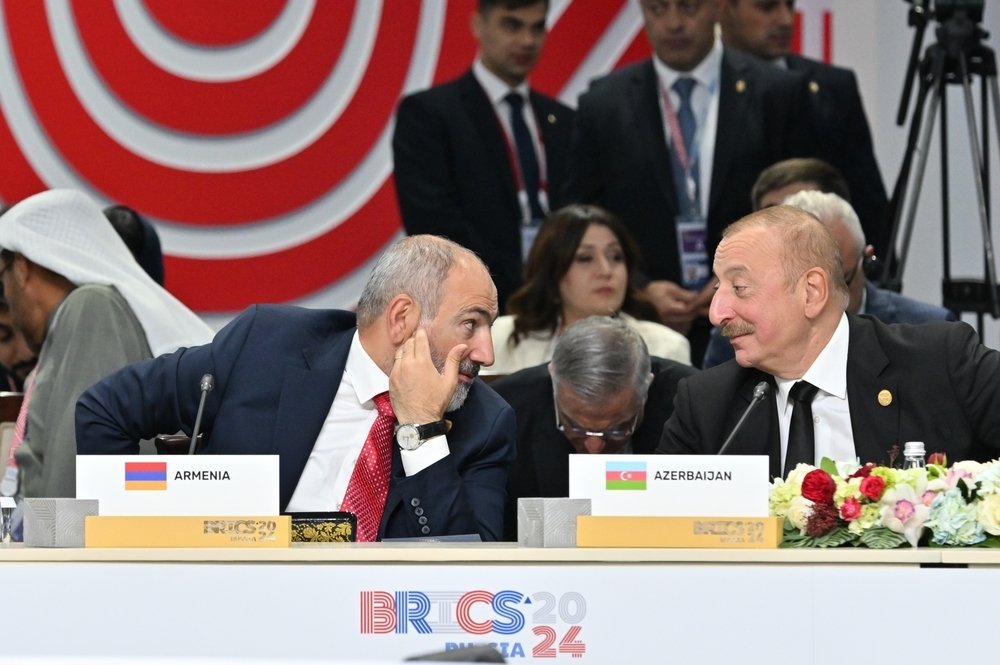
The fact that Armenian Prime Minister Nikol Pashinyan, who, particularly in recent months, has appeared genuinely willing to contribute to peace in the Caucasus through his realist turn in foreign policy, has all but ignored this stance by Tel Aviv lends the entire tragicomedy an air reminiscent of Bertolt Brecht’s remark: “I laugh off the things that fail to make me laugh.”
On the other hand, it should also be emphasized that Pashinyan’s realist transformation rests on strong popular support. Indeed, having reconsolidated his hold on power by winning nearly 50% of the vote in the election held roughly a month ago, it can be said that his stance has also found acceptance among the public.
The Yerevan government, which responded to Israel’s decision at the highest level by stating, “We see no need to respond,” has demonstrated a positive instinct in interpreting the regional dynamics, one of the tangible outcomes of the shuttle diplomacy Türkiye has pursued in recent months. The channels of dialogue that Ankara has patiently kept open have begun to resonate in Yerevan not merely at the level of rhetoric, but also in its responses during moments of crisis.
Indeed, Pashinyan’s principled statement that he “believes it is in Armenia’s interest not to become part of a process in which the so-called genocide card is used as a weapon” does not merely mark a turning point in Türkiye-Armenia relations.
The statement amounts to a declaration by the prime minister of Armenia himself that a narrative that had, for decades, served as a constitutive element of Armenian foreign-policy identity will no longer be allowed to be instrumentalized by third-party actors.
This development also constitutes a blow to what it portrays as Israel’s efforts to keep the states of the region locked in conflict in order to weaken Ankara’s influence in the Caucasus. Tel Aviv’s expectation was that this move would derail the Türkiye-Armenia normalization process and drag the region back into a spiral of tension. Yet Yerevan’s strategic silence thwarted that calculation from the very outset.
Another actor whose stance on this development was keenly awaited was Azerbaijan, the co-architect of the lasting peace being sought in the Caucasus. Baku occupies a delicate position in this equation, owing both to its strategic partnership with Türkiye, embodied in the motto “two states, one nation”, and to its energy and defense cooperation with Israel.
While Baku shares an approach similar to Yerevan’s on this matter, it chose to respond, stating that “reducing the issue to a political decision devoid of any legal or scholarly basis is unacceptable.”
In contrast to Yerevan’s strategic silence, Baku’s decision to adopt an explicit position can be read as a reflection of Azerbaijan’s determination to make its solidarity with Türkiye visible. The statement issued by the Azerbaijani Ministry of Foreign Affairs underscored that Israel’s decision deepens existing divisions and undermines efforts to establish lasting peace and stability in the region.
This move is all the more striking because it demonstrates that Baku places the regional peace architecture and its shared destiny with Ankara above all conjunctural calculations. Thus, Israel’s attempt to sow discord among the capitals of the region by instrumentalizing historical issues has been rendered ineffective in the face of both Yerevan’s composure and Baku’s open objection.
When assessed as a whole, this episode lays bare, in all its starkness, what Israel seeks to achieve: Tel Aviv is turning historical issues into political weapons in order to suppress the international repercussions of the alleged crimes against humanity committed in Gaza. Furthermore, not content with that, it is attempting to undermine the foundations of peace being built through arduous negotiations among Türkiye, Azerbaijan and Armenia. The aim is to turn the Caucasus back into a geography of tension and conflict, thereby both weakening Ankara’s growing influence in the region and diverting attention from the Gaza issue that remains at the center of the international agenda.
Yet this attempt at sedition has come to naught in the face of the prudent posture displayed by the region’s three actors. Ankara, reading the matter with diplomatic maturity, exposed Israel’s predicament before international public opinion; Yerevan, through its strategic silence, turned away the poisoned hand extended to it; and Baku, with its open objection, demonstrated that regional solidarity remains unshakable.
Here, as everywhere, the most powerful response to those who seek to sow discord through sedition has been precisely this trilateral harmony: the fact that three capitals with different sensitivities and distinct networks of relations responded to the same maneuver with the same common sense marks a turning point in the region’s diplomacy.