Daily Sabah logo

Politics
Diplomacy Legislation War On Terror EU Affairs Elections News Analysis
TÜRKİYE
Istanbul Education Investigations Minorities Expat Corner Diaspora
World
Mid-East Europe Americas Asia Pacific Africa Syrian Crisis Islamophobia
Business
Automotive Economy Energy Finance Tourism Tech Defense Transportation News Analysis
Lifestyle
Health Environment Travel Food Fashion Science Religion History Feature Expat Corner
Arts
Cinema Music Events Portrait Reviews Performing Arts
Sports
Football Basketball Motorsports Tennis
Opinion
Columns Op-Ed Reader's Corner Editorial
PHOTO GALLERY
JOBS ABOUT US RSS PRIVACY CONTACT US
© Turkuvaz Haberleşme ve Yayıncılık 2026

Daily Sabah - Latest & Breaking News from Turkey | Istanbul

  • Politics
    • Diplomacy
    • Legislation
    • War On Terror
    • EU Affairs
    • Elections
    • News Analysis
  • TÜRKİYE
    • Istanbul
    • Education
    • Investigations
    • Minorities
    • Expat Corner
    • Diaspora
  • World
    • Mid-East
    • Europe
    • Americas
    • Asia Pacific
    • Africa
    • Syrian Crisis
    • Islamophobia
  • Business
    • Automotive
    • Economy
    • Energy
    • Finance
    • Tourism
    • Tech
    • Defense
    • Transportation
    • News Analysis
  • Lifestyle
    • Health
    • Environment
    • Travel
    • Food
    • Fashion
    • Science
    • Religion
    • History
    • Feature
    • Expat Corner
  • Arts
    • Cinema
    • Music
    • Events
    • Portrait
    • Reviews
    • Performing Arts
  • Sports
    • Football
    • Basketball
    • Motorsports
    • Tennis
  • Gallery
  • Opinion
    • Columns
    • Op-Ed
    • Reader's Corner
    • Editorial
  • TV
  • Opinion
  • Columns
  • Op-Ed
  • Reader's Corner
  • Editorial

Pashinyan’s victory: Armenia chooses peace, regional integration

by Hazel Çağan Elbir

Jun 08, 2026 - 2:31 pm GMT+3
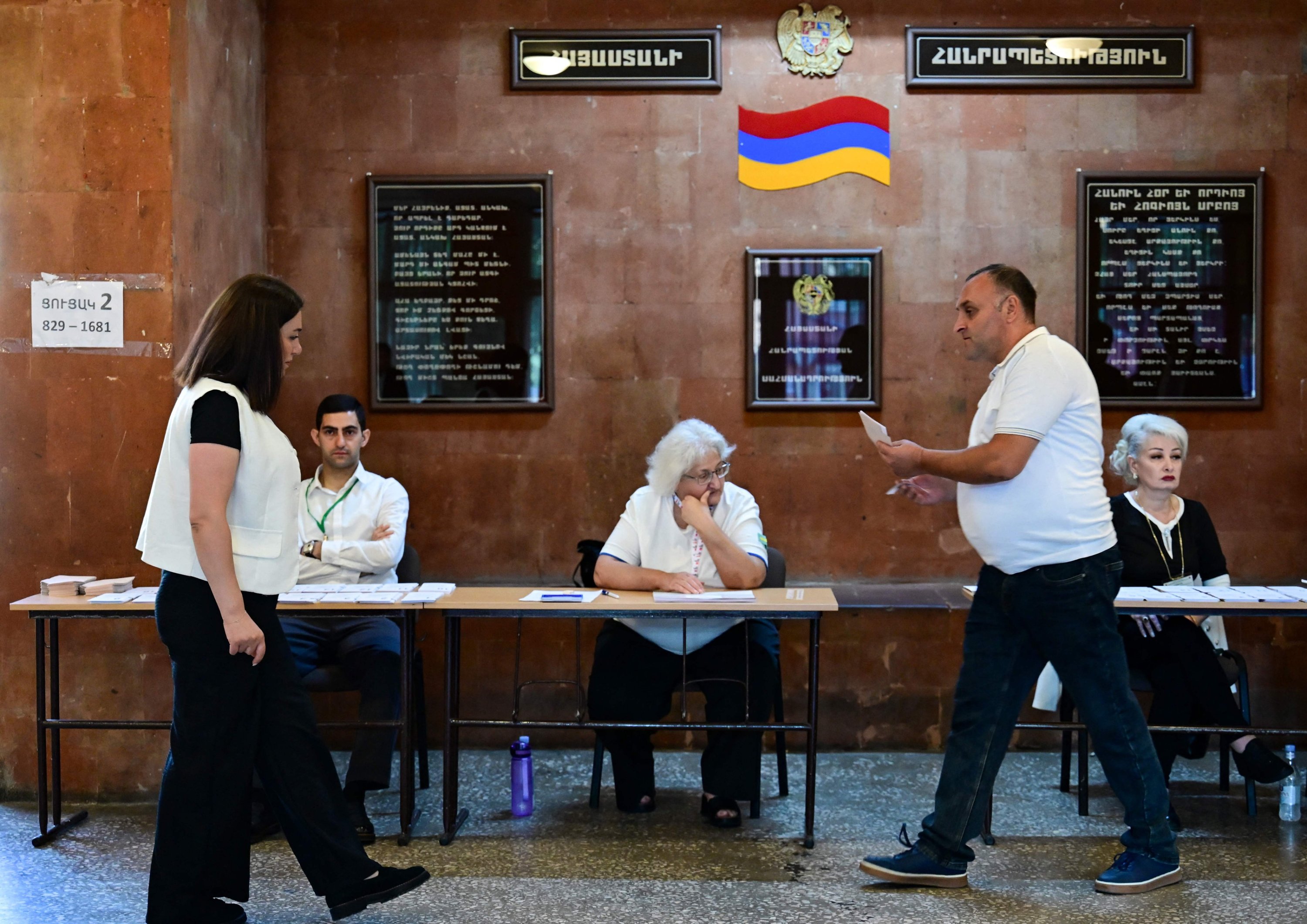
Armenians vote in the parliamentary election at a polling station, Yerevan, Armenia, June 7, 2026. (AFP Photo)
by Hazel Çağan Elbir Jun 08, 2026 2:31 pm

Pashinyan’s third victory signals Armenia’s turn toward peace, reform and regional normalization amid declining Russian influence

The parliamentary elections held in Armenia yesterday represent a critical threshold that will shape not only the country’s domestic politics but also the broader geopolitical future of the South Caucasus. According to preliminary results released by the Central Election Commission (CEC), Prime Minister Nikol Pashinyan’s Civil Contract Party secured approximately 49.81% of the vote, winning 64 seats in the 105-member National Assembly and thereby obtaining a clear parliamentary majority.

Its closest rival, businessman Samvel Karapetyan’s Strong Armenia Alliance, which consists of Strong Armenia, New Era, and United Armenians parties, was widely regarded as Russia-oriented and received 23.3% and 29 seats. Former President Robert Kocharyan’s Armenia Alliance, which includes the Armenian Revolutionary Federation and the center-right Forward Party, obtained around 9.9% and 12 seats.

On election night, Pashinyan described the outcome as a “historic victory” and announced that his party would form the government alone. These results are particularly noteworthy given that pre-election polls had projected Civil Contract support in the 30-32% range, given that voter turnout stood at 58.97% according to CEC data.

Voter behavior reflects the complex preferences of Armenian society and a search for the “least bad” option. In a population still grappling with the deep trauma of the Nagorno-Karabakh defeat, economic hardships, and a significant loss of trust in Russia, the fragmented and unconvincing nature of the opposition led many to place their hopes for stability and peace in Pashinyan. A large share of undecided voters either abstained or ultimately supported the incumbent’s Western-oriented opening despite Russia’s heavy economic pressure.

The voter turnout in the 2026 elections represents an increase of approximately %9.6 over the 49.4% recorded in the 2021 parliamentary elections and constitutes the highest level in recent years. Turnout stood at around 48.6% in 2018 and 60.8–60.9% in 2017.

Thus, the 2026 figure markedly exceeds the 2021 and 2018 levels while approaching that of 2017. The rise indicates that the perception of a “critical decision moment” created by post-Karabakh trauma and geopolitical tensions successfully mobilized voters. Participation was notably higher in eastern regions such as Syunik and Vayots Dzor, reaching up to 65%, which underscores the influence of security concerns and border sensitivities.

Despite expectations of low turnout, this level demonstrates that the Armenian public has retained faith in democratic processes and its ability to shape the future, even as it also reveals the depth of societal polarization.

Nevertheless, this victory stems less from unqualified enthusiasm than from the opposition’s shortcomings and the relative rationality attributed to Pashinyan’s “peace and prosperity” narrative.

External pressures, voter priorities

In the pre-election period, Russia exerted intense and multifaceted pressure on Armenia. Moscow employed economic embargoes, import bans and measures harming farmers in an effort to deter Pashinyan’s Western pivot. At the Eurasian Economic Union summit, Armenia faced an “European Union or Eurasia?” ultimatum, while threatening statements by Russian President Vladimir Putin and Secretary of the Security Council Sergei Shoigu carried undertones of a potential coup. In contrast, strong diplomatic backing from the United States, high-level encouragement from the EU, and defense cooperation with France proved vital in sustaining Pashinyan.

As previously highlighted in Daily Sabah, the vote functioned as a de facto referendum on Armenia’s shift from a Russia-centered security architecture toward a Western-oriented path of peace and normalization. Although pro-Russian opposition forces sought to capitalize on these interventions, deep public distrust of Russia ultimately prevailed.

The central question is what the Armenian people sought in this election. The loss of Nagorno-Karabakh and the ensuing mass exodus prompted an existential reassessment. Rather than calls for revenge, the public demanded pragmatic peace, open borders, economic development, and the diversification of security arrangements.

Pashinyan’s realist discourse offered a rational alternative to the maximalist visions of the old security elite. Voters recognized that Russia’s protective umbrella had collapsed and viewed closer ties with the West as more sustainable both economically and militarily. The opposition’s promise of a return to the old order lacked credibility in a society traumatized by defeat. This choice constitutes a concrete expression of Armenia’s search for a “new state mindset.”

Constitutional amendment

Pashinyan’s victory is expected to accelerate peace negotiations with Azerbaijan and the normalization process with Türkiye. However, constitutional reform remains a critical threshold.

Armenia’s current 2015 Constitution references the 1990 Declaration of Independence in its preamble, which includes provisions envisioning the unification of Nagorno-Karabakh with Armenia and the symbolic inclusion of Mount Ağrı in the state coat of arms.

These irredentist elements could obstruct ratification of a comprehensive peace treaty by the Constitutional Court. As detailed in Gözde Kılıç Yaşın’s analysis “Armenia’s Constitutional Change and Regional Dynamics,” these preamble provisions represent the primary legal obstacle to lasting normalization. Without a new constitution or far-reaching amendments, a durable peace will remain elusive.

Armenian Prime Minister and leader of the Civil Contract party Nikol Pashinyan holds a press conference following the parliamentary election at the party's headquarters, Yerevan, Armenia, June 8, 2026. (AFP)

Under Armenian law, a constitutional amendment requires a two-thirds majority (approximately 70 of 105 seats) in the National Assembly, followed by approval in a referendum. The referendum must secure a majority of participating voters and at least one-quarter of all registered voters. With 64 preliminary seats, Civil Contract falls short of the parliamentary threshold on its own, necessitating compromise with the opposition or additional support.

Pashinyan has indicated plans to prepare a new constitutional draft for a 2027 referendum. Successful reform would strengthen Armenia’s international legitimacy, facilitate peace agreements, and bolster regional stability. Yet opposition resistance, risks of low referendum turnout, and societal polarization pose significant hurdles.

The election outcome will exert a decisive influence on peace talks with Azerbaijan and normalization with Türkiye. Pashinyan’s majority signals continued momentum in the existing peace process. Statements such as “an agreement with Azerbaijan is an independent agenda” and U.S.-backed initiatives like the Trump Route for International Peace and Prosperity (TRIPP) agreement demonstrate Armenia’s desire to exercise its own initiative.

Positive signals also exist from Türkiye’s perspective: Pashinyan's meetings with President Recep Tayyip Erdoğan and both leaders' messages of openness to “all forms of cooperation” underscore the priority of stability in the South Caucasus. Pashinyan's victory is likely to facilitate Türkiye-Armenia normalization, including the reopening of borders, revival of trade, and enhanced regional connectivity.

By contrast, a Russia-aligned government would probably have slowed or suspended these processes through maximalist demands. The outlook for regional peace and stability appears more promising, with diminishing Russian influence potentially enabling stronger Western and Turkish-Azerbaijani cooperation and the further development of the Middle Corridor.

Regional implications

Significant challenges persist. As mentioned above, Pashinyan currently lacks the constitutional majority needed for major reforms, constitutional change, or a final peace treaty. Cross-party consensus or additional backing will be essential. Pro-Russian elements may refuse to accept the results, organize street protests, or attempt sabotage. The possibility of renewed Moscow interference cannot be entirely ruled out. Armenia’s internal polarization and economic vulnerability also remain risk factors. Nevertheless, Western support and Pashinyan’s international legitimacy are expected to constrain these threats.

Looking ahead, the most rational path for Armenia lies in successfully completing constitutional transformation alongside policies of peace, normalization, and multi-vector diplomacy. This victory confirms the public’s preference for “prosperity and sovereignty” over “revenge.” For the region, it heralds greater stability, economic integration, and a softening of great-power rivalry. An Armenia aligned with Türkiye’s “peace with Azerbaijan first” approach could become a key pillar of lasting peace in the South Caucasus. These elections mark the beginning of a new order in the Caucasus and Armenia’s redefinition of itself.

Pashinyan’s ability to manage diplomacy, domestic consensus-building, economic reforms, and the constitutional process in the coming period will be decisive. Otherwise, opposition resistance or external pressures could jeopardize progress. The Armenian people have voted at the ballot box for peace and development. The task now is to translate this will into concrete steps.

A wind of peace is beginning to blow across the South Caucasus. Its permanence will depend on the sense of responsibility demonstrated by all parties involved.

About the author
Master’s degree holder in international relations at Middle East Technical University (METU), analyst at the Center for Eurasian Studies (AVIM) with expertise in the Caucasus
The views and opinions expressed in this article are solely those of the author. They do not necessarily reflect the editorial stance, values or position of Daily Sabah. The newspaper provides space for diverse perspectives as part of its commitment to open and informed public discussion.
  • shortlink copied
  • KEYWORDS
    armenia armenia elections nikol pashinyan caucasus azerbaijan-armenia relations civil contract party
    The Daily Sabah Newsletter
    Keep up to date with what’s happening in Turkey, it’s region and the world.
    You can unsubscribe at any time. By signing up you are agreeing to our Terms of Use and Privacy Policy. This site is protected by reCAPTCHA and the Google Privacy Policy and Terms of Service apply.
    No Image
    Gaza on brink of humanitarian disaster: There's no electricity, water, medicine
    PHOTOGALLERY
    • POLITICS
    • Diplomacy
    • Legislation
    • War On Terror
    • EU Affairs
    • News Analysis
    • TÜRKİYE
    • Istanbul
    • Education
    • Investigations
    • Minorities
    • Diaspora
    • World
    • Mid-East
    • Europe
    • Americas
    • Asia Pacific
    • Africa
    • Syrian Crisis
    • İslamophobia
    • Business
    • Automotive
    • Economy
    • Energy
    • Finance
    • Tourism
    • Tech
    • Defense
    • Transportation
    • News Analysis
    • Lifestyle
    • Health
    • Environment
    • Travel
    • Food
    • Fashion
    • Science
    • Religion
    • History
    • Feature
    • Expat Corner
    • Arts
    • Cinema
    • Music
    • Events
    • Portrait
    • Performing Arts
    • Reviews
    • Sports
    • Football
    • Basketball
    • Motorsports
    • Tennis
    • Opinion
    • Columns
    • Op-Ed
    • Reader's Corner
    • Editorial
    • Photo gallery
    • DS TV
    • Jobs
    • privacy
    • about us
    • contact us
    • RSS
    © Turkuvaz Haberleşme ve Yayıncılık 2021