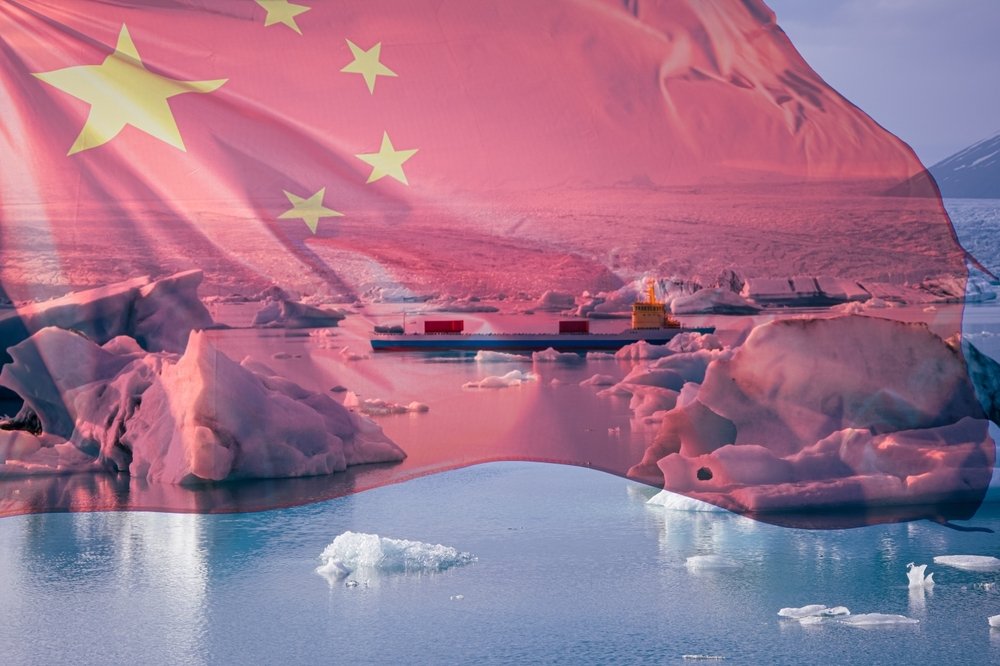
China will deliver its first supplies to the European market using a new Arctic sea route. Instead of the usual journey south, a Chinese cargo ship is sailing north along Russia’s icy coastline on a shortcut that could cut travel times between Asia and Europe nearly in half. If all goes smoothly, the voyage will take just 18 days.
Until now, vessels carrying Chinese goods had to navigate the Strait of Malacca, cross the Indian Ocean, and squeeze through the Suez Canal, a 30 to 40-day haul in good conditions. The Arctic route slashes that nearly in half, linking Chinese ports through Russia’s northern waters to key European hubs. Fewer days at sea mean lower costs, fewer chokepoints and faster deliveries – a potential game-changer for time-sensitive cargo and global trade.
Climate change, normally a global threat, has ironically enabled a faster maritime corridor. This shortcut is only possible because the Arctic is warming nearly four times faster than the worldwide average, opening seasonal windows of reduced ice. But the Northern Sea Route (NSR) remains unpredictable: shifting ice, fierce storms, limited infrastructure and high insurance costs make it a risky bet. Environmental groups warn that increased shipping will accelerate melting through the release of black carbon emissions and increase spill risks in a fragile ecosystem.
To make the Arctic Express work, Beijing needs an ally that knows these waters better than anyone: Russia. The NSR lies along Russian territory, making Moscow the gatekeeper. Russia’s nuclear-powered icebreakers, among the most powerful globally, keep the path open during unpredictable Arctic seasons.
But the cooperation runs deeper. For Moscow, battered by sanctions, Chinese traffic brings revenue and relevance. For Beijing, the route offers an alternative to U.S.-controlled chokepoints and a hedge against disruptions elsewhere.
As Volker Stanzel, former German ambassador to China, noted, Beijing pays the Houthis – an Iran-backed rebel group controlling much of Yemen and attacking commercial ships in the Red Sea – to ensure Chinese container vessels are not targeted. At the same time, Russia is losing transit revenues as Eurasian rail links remain blocked at the Polish border due to drone activity.
Against this backdrop, he said: “Using the Arctic route makes sense for both countries, which have probably found a workable financial arrangement and have decided to postpone the more controversial questions: Russia claiming to be the only owner of the Arctic Sea, and China demanding a part of that ownership. But both, benefiting from the present arrangement, must have decided to leave those questions for another day.”
For decades, the Suez Canal has been the backbone of Asia-Europe trade, carrying 12%-15% of global commerce and about a third of container traffic. The NSR handled just 36 million tonnes in 2023, mostly Russian energy, but even a modest redirection of Asia-Europe traffic could equate to tens of billions of dollars in trade flow.
The first Arctic Express is carrying batteries, energy-storage units and thousands of parcels, exactly the kind of goods where speed matters most.
“Though the volume of cargo is relatively small, this is a fresh sign of China's desire to open up routes for its exports. It also potentially raises the prospects of geo-economic (and, inevitably, geopolitical) rivalries in the Arctic, particularly if the route proves practical for Chinese manufacturers to reach Europe in greater quantity and speed,” said Jonathan Fenby, author of "The Penguin History of Modern China."
China’s timing is no accident. Recent shocks have exposed the fragility of global shipping arteries. In 2021, the Ever Given blocked the Suez Canal for six days, freezing trade worth nearly $60 billion. Since late 2023, Houthi attacks in the Red Sea have forced many ships around Africa, adding up to two weeks to journeys and slashing Egypt’s canal revenues by about 60%.
With the Arctic Express, China stakes a claim in the High North. Its label as a “near-Arctic state,” once doubted, now carries ambition. The route bypasses geopolitical flashpoints, including the Malacca and Suez Straits, granting Beijing and its Russian partner an uncongested lane where they largely set the rules.
The Arctic route is far from guaranteed. Its navigational window is short and unpredictable, storms can still trap vessels, and environmental risks are high. Whether it becomes a seasonal backbone or a niche route depends on climate trends, infrastructure investment, insurance innovation, icebreaker expansion, and sustained collaboration between China and Russia. But even now, it’s a glimpse of how global trade might be redrawn.