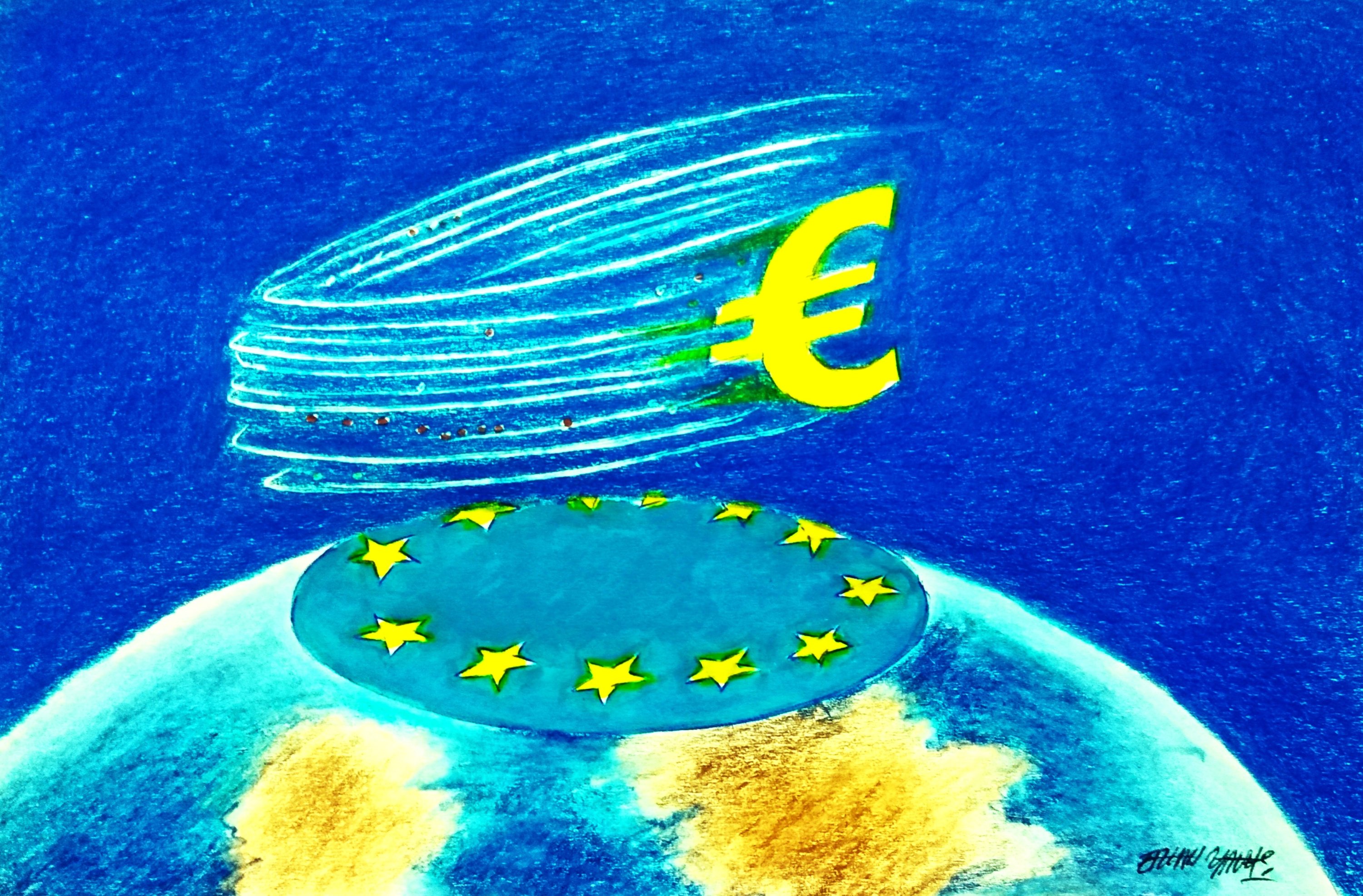
In July 2026, the European Parliament gave the digital euro a clear majority. By 416 votes to 169, lawmakers backed a negotiating mandate, and talks with the European Council and the European Commission are now heading for a deal by the end of the year.
In Frankfurt, the European Central Bank (ECB) has launched "Pontes" (Latin for “bridges”), a new platform that allows banks to settle trades in digital securities and other tokenized assets directly in central bank money, which carries no risk of default. The name says it all: The platform links tokenized markets with central bank money.
A retail pilot is planned for 2027. After years of drift, the project finally has momentum. Yet the European debate remains strangely inward-looking. Privacy, holding limits, bank deposits and merchant fees matter, but they miss the bigger picture. The digital euro is not primarily a consumer product. It is geoeconomic infrastructure, and it should be judged by the standards of a world in which money and payment systems have become instruments of power. By that standard, the project is necessary, but it lacks strategic weight. Europe is building a shield and has forgotten that, in geoeconomics, infrastructure that does not project influence will sooner or later be shaped by those who do.
The past decade has buried a comfortable assumption of the globalization era that financial interdependence is neutral and benefits everyone. It does not. Networks create chokepoints, and whoever controls them holds the leverage. Russia’s exclusion from SWIFT, the freezing of its central bank reserves, the exit of the major card schemes and the global reach of dollar clearing and secondary sanctions have shown how quickly a utility can be turned into a weapon.
Europe has so far experienced this mostly as a co-user of such instruments, alongside Washington. That has hidden an uncomfortable truth. In most euro area countries, card payments at the till depend on non-European schemes, the mobile front end of everyday commerce is controlled by a handful of American tech firms, and Europe’s own attempts at a pan-European card scheme have repeatedly broken apart along national lines. What can be withdrawn from an adversary may, in principle, also be turned against a partner. With transatlantic relations now openly transactional, a once harmless dependency has become a strategic vulnerability. As ECB Executive Board member Piero Cipollone put it in February: “If we lose control of our money, we lose control of our economic destiny.”
Then there are the other two monetary powers.
The United States has ruled out a retail central bank digital currency and backed privately issued dollar stablecoins – privately issued digital tokens pegged one-to-one to a currency such as the dollar – under a federal framework instead. This is not a retreat from monetary ambition but a clever form of it. Stablecoins carry the dollar into every smartphone in the world, bypass foreign banking systems and, because their reserves sit largely in short-term Treasury bills, create extra demand for American public debt. Washington has outsourced the digital globalization of the dollar to the private sector while keeping regulatory control.
China has taken the opposite route. China's digital currency e-CNY, its cross-border interbank payment system and a multi-central-bank platform for wholesale settlement form a state-led architecture designed to reduce exposure to dollar sanctions and to offer partners alternative rails – the payment infrastructure through which transactions are processed and settled. Domestic uptake has been modest, but the logic is clear: whoever builds the rails for cross-border settlement in the Global South will help write the rules of tomorrow’s financial order.
Europe is attempting a third way, based on public money, legal guarantees and the rule of law. It is an attractive model. The risk is that the euro area ends up squeezed between dollar stablecoins at the retail level and Chinese state infrastructure in cross-border settlement, with a digital euro that protects the home market but plays no part in the contest that will shape the coming decades.
This is where the main weakness of the current design shows. Almost every feature of the digital euro looks inward. Individual holdings will be capped, and Council and Parliament still disagree on who should set the limit. Balances will not earn interest. Distribution will run through commercial banks, whose associations put their own implementation costs at around 18 billion euros and remain ambivalent at best. Use by non-residents and links to foreign payment systems have been pushed to a later stage, if they are addressed at all.
Each of these choices makes sense for financial stability. Together, they reveal a defensive mindset. Keeping domestic payments running without anyone else’s permission is necessary, but not enough. However, a currency’s geoeconomic weight comes not from surviving at home but from being attractive abroad: As an invoicing currency, a means of settlement, a reserve asset, and a technological standard that others choose to adopt.
A capped, interest-free euro wallet, designed above all not to disturb domestic banking, cannot compete with dollar tokens available instantly to anyone with an internet connection. If euro-denominated digital money stays marginal on global platforms, the euro’s share of digital trade and remittances will erode by default rather than by decision. Geoeconomic decline rarely announces itself. It builds up quietly in the transactions others no longer route through your currency.
The most promising part of Europe’s digital money agenda lies not in the retail wallet but in wholesale and cross-border infrastructure. Pontes shows the way. It is not a payment tool for citizens but a settlement layer for banks and market infrastructures, allowing transactions in tokenized securities and other digital assets to be settled in central bank money rather than in private tokens. As a first step toward a broader long-term infrastructure, it anchors the emerging tokenized economy in the euro.
The Eurosystem’s work on linking its instant payment system with fast payment systems abroad, including Brazil’s Pix, points in the same direction. If tokenized assets, trade finance and cross-border payments increasingly settle in euro central bank money on European rails, the euro gains exactly the network effects a capped retail wallet cannot generate.
This also opens a foreign policy dimension that Brussels has hardly explored. For the EU’s neighborhood, from the Western Balkans to Türkiye and North Africa, the euro is already the leading currency of trade and investment. Offering these partners interoperable, rules-based public payment rails would fit naturally with the Union’s connectivity strategy and provide a credible alternative to infrastructure packages from other powers. Conceived this way, the digital euro would become a tool of partnership, not just a domestic safeguard.
Any geoeconomic strategy for the euro faces a dilemma Europe has not yet resolved. The euro’s appeal as a global alternative rests on the perception that it is less politicized than the dollar: Governed by law, predictable and not readily used for coercion. The long debate over immobilized Russian central bank assets has shown how quickly that perception can be tested.
If Europe wants third countries to settle in euros, it must show that access to its infrastructure follows transparent rules, while keeping the ability to act decisively against real security threats. That requires clear legal criteria and democratic accountability, not ad hoc crisis decisions.
There is also a structural limit. No digital instrument can turn the euro into a global currency on its own. International monetary weight rests on deep, integrated capital markets and a large supply of safe euro assets. As long as the savings and investments union remains unfinished, the digital euro will be a modern façade on an unfinished building. The internal battles over the project, between the central bank and commercial banks, between member states and Parliament, between technocrats and populist mistrust, send a signal abroad as well. A union that struggles to agree on how to run its own digital money will find it hard to persuade others to use it.
None of this is an argument against the digital euro. A Europe without a public digital means of payment would be more exposed, not less. But the remaining months of the trilogue should be used to give the project a strategic horizon.
First, the digital euro should be governed as critical economic infrastructure, anchored in the Union’s economic security strategy rather than handled as a niche payments issue.
Second, interoperability with European private schemes must be a core design principle, so that public rails strengthen account-to-account solutions and reduce dependence on non-European card networks.
Third, the legislation should set a clear mandate and timeline for the international dimension: Controlled access for non-residents, links with foreign fast payment systems and a priority offer to the EU’s neighborhood and candidate countries.
Fourth, the retail project must be tied to the wholesale agenda and to the rules for euro stablecoins, so that public and private euro tokens reinforce each other on global platforms.
Finally, the digital euro must go hand in hand with completing the capital markets union. Without it, any ambition for the euro’s international role will remain rhetoric.
The digital euro will most likely be adopted. The real question is what role it will play in a world where monetary systems are once again arenas of strategic competition.
Europe can treat its digital currency as a domestic insurance policy: Useful in a crisis, invisible in normal times and irrelevant to the global balance of financial power. Or it can make it the foundation of a geoeconomic strategy that offers partners a rules-based alternative to both privatized dollar dominance and state-controlled Chinese infrastructure.
The first option is safer in the short term. The second is the only one consistent with Europe’s ambition to be a geopolitical actor. Money has never been neutral. The question is whether Europe wants to shape the new monetary order or merely shelter from it.