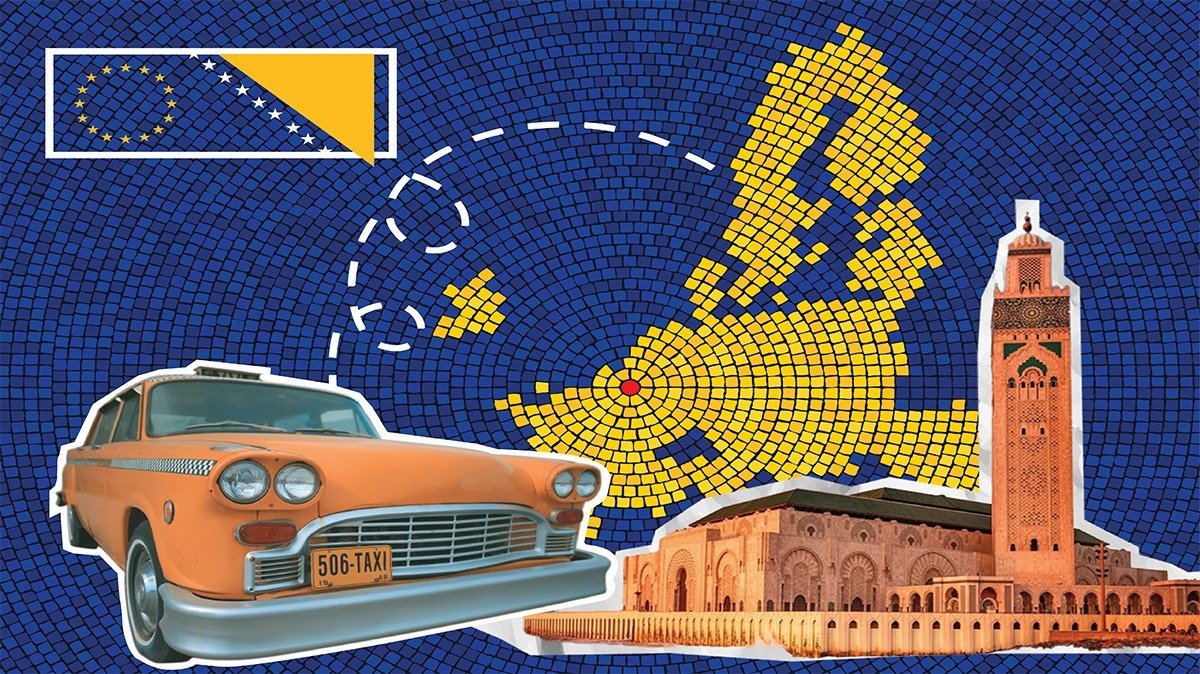
I went to France for the first time this December, more precisely, to a small ski resort near the Swiss border. The taxi driver who took us from Geneva airport was a Tunisian man, born in France to an immigrant family more than four decades ago. As the drive climbed into the Alps and the snow thickened, our conversation drifted from weather to family. When I called my daughter by name, he paused and asked, almost in disbelief: Wait, you are Muslims? You don’t look like Muslims.
It is a question I have heard too many times to count. I told him I am a Bosnian Muslim, blonde, European and my style shaped as much by Paris and London as by Sarajevo. He was genuinely surprised and admitted he knew very little about where I come from.
I had a similar experience once when an Italian police officer stopped me at the Slovenian border. And again in Morocco, where a producer I worked with started playing American pop music in the car, joking that he wanted me to “feel at home” because he said I looked American to him. He was even more confused when I excused myself to pray at the Hassan II Mosque in Casablanca, one of the largest and most beautiful mosques in the world.
Sometimes it feels as if we are treated like a rare species, not fully rejected but constantly questioned. As if our existence is an anomaly that requires an explanation. That feeling stays with you. It teaches you how to adapt, how to read rooms, how to adjust without disappearing, and how to remain yourself, quietly but firmly, with pride. But it’s not easy.
The French mountains were stunning, the village and its people welcoming despite the language barrier. Food was more complicated. In a small alpine resort where guests are mostly French from other parts of the country, pork dominated the menus, with few alternatives beyond foie gras, cheese, jam or crepes. We adjusted easily and accepted the limitations of a place shaped by its geography and traditions. That is something many Bosnian Muslims have long learned to do to adapt, navigate and make space. This continent is our home, and somehow along the way I learned a lot about it, about its Christian history and values and diversities. Milan is six hours by car from Sarajevo, Vienna is a little more. These are places where we Bosnian Muslims, would spend weekends or go on romantic trips like other people in Europe.
What is harder to accept is that the rest of Europe still struggles to do the same in return.
How, exactly, are European Muslims supposed to look? I would often ask my friends. Well, I don’t know, not like Bosnians. They would often answer.
Long before the wars, poverty and instability that drove migration from parts of the Arab world and North Africa, Muslims were already part of Europe. Bosnian Muslims are among them. Before the 2015 refugee crisis, Europe’s Muslim population was largely settled, not newly arrived. It consisted of Indigenous communities who have lived for centuries in southeastern Europe, in Bosnia and Herzegovina, Albania, Kosovo, North Macedonia, Montenegro, Sandzak (part of Serbia), Bulgaria, Greece and Romania.
Islam in Europe is not a temporary presence but part of the continent’s social fabric, one that forces Europe to rethink identity, citizenship and secularism. Muslims are not merely in Europe; they are of Europe. And yet, we still find ourselves explaining this, over and over again.
That questioning shows up in subtle, everyday ways. While moderating international conferences, I have repeatedly had to explain that my country is located in the heart of Europe. Even senior EU officials have joked, casually, but offensively, about the Balkans as Europe’s space of disorder. A colleague who works in Brussels once told me that her co-workers see her as “less European” because she drinks strong Bosnian coffee in the morning and eats later in the day, instead of having an espresso and croissant. “I don’t know, Nafisa,” she wrote to me in an email, “I feel they will always see us as different. Like we are this dark hole in Europe that they don’t know much about, nor do they want to know much about.”
This sense of exclusion is reinforced by broader political changes. We have been witnessing the rise of far-right parties across Europe for years now, from France and Germany to the Netherlands and Austria, bringing anti-immigration and anti-Muslim rhetoric ever closer to the mainstream. Alongside electoral success, incidents such as Quran burnings carried out under the banner of free expression have deepened alienation. Muslims are increasingly framed not as a historical reality of Europe, but as a cultural problem to be managed.
Instead of pushing us aside or failing to learn about us, Europeans should look to Bosnians as an example of how it is possible to be both European and Muslim, without contradiction.
I am tired of explaining how Bosnian Muslims exist, as if we were an exception rather than a consequence of European history itself. Southeastern Europe is not a peripheral or lesser space. It has always been central to the continent’s story, marked by cultural exchange but also by horrific genocide in Srebrenica carried out against Muslims that EU institutions commemorate every 11 July.
Europe’s new generations need to learn that history, honestly. Because adaptation cannot remain a one-way demand. If Muslims have learned, for centuries, how to live with Europe, it is time for Europe to learn how to live with them. Otherwise, the idea that we do not belong here will stop being a misunderstanding and become, once again, a warning.