The ongoing digital transformation and artificial intelligence are surely revolutionizing the field of finance, reshaping how markets run, the way businesses operate and how decisions are made. At the core of this transformation is the integration of advanced technologies into traditional processes, allowing for greater efficiency and enhanced data analysis.
Financial institutions leverage AI algorithms to process substantial data in a timely manner, making it possible to make rational and savvy decisions, manage risks better, and optimize their operations. These technological advancements not only improve transaction speeds but also enhance customer experiences through personalized services, predictive analytics, and automation of routine tasks.
The digitalization of the post-2010s also mostly depends on AI. Yet, the post-COVID accelerating digital and AI transformation and the future of finance surely need to be reassessed, too. Novel IT infrastructures, quantum computing technologies, blockchain bases and mobile computing devices are all revolutionizing finance and helping build a new era together.
AI is indeed the future, a new language but also a technological Renaissance, if you like. The IT infrastructure connected to AI is a crucial aspect to bear in mind! Generative AI tools such as ChatGPT have huge potential in economics, finance, health, and even education. Consider the rise of NVIDIA, which turned into the biggest company in just a year!
As is clear from the rise of likes of these tech giants and the future that they represent (all turning into the only game in town), new chips and new effective uses of graphics processing units (GPUs) or programmable GPUs and new high-performance graphics processors needed for the AI revolution are all reminding of an unusual new era.
Imagine the role AI could play in preventing potential future banking crises! The new era might also mean new opportunities to use AI to achieve price or financial stability (as in run-on-banks), maybe by flagging more noteworthy information much earlier and in a much faster time.
In finance, AI-powered models are increasingly used to predict market trends and consumer behavior, offering insights that help policymakers and businesses navigate complex economic landscapes. And, as AI and digital technologies continue to unfold, they are likely to assume a substantially more crucial part in shaping the financial systems and fostering innovation across various sectors.
The financial sector surely functions within a complex, more decentralized, highly regulated, but sometimes deregulated landscape too. AI, on the other hand, helps process much more information quickly, helps with price comparisons and responds much faster. The intersection of the two could surely mean much more efficiency. AI can ensure that even small companies or insignificant information is taken into account.
Social and digital credit scores instead of conventional ones, smart contracts instead of paper-based contracts (keep in mind that these smart contracts allow doing both sides of the trade together, simultaneously) are all outcomes of this novel AI and digital transformation.
Quantum computers and their contributions toward automation and computation in finance are leading the way forward. Robotic and quantum-based computation and consulting, instead of conventional gild the lily financial consulting... AI-incorporated brokerage, machine learning in finance and similar other avant-garde tools are transforming the economic sciences and finance.
The security, risk and challenge aspects of AI adoption should matter even more! Understanding these aspects could provide a more grounded perspective when discussing the applications in banking, payments, crypto and investments, etc. Seeking new ways to deal with some of the key decision intelligence-related challenges, critical issues and finding potential alternative solutions are all of substance.
Providing a forward-looking perspective, focusing on future trends and strategic implications, and building resilient organizations should all be primary concerns. Discussing emerging trends, potential future applications in finance, and the competence needed to steer this evolving landscape should all be key priorities.
The ongoing Industry 4.0, the digital transformation of the 2010s and the post-COVID acceleration are all moving forward. The fifth industrial revolution comes with unmanned technologies, automation and robotization; along with more digitalization, isolation and automation in almost everything. However, the sixth revolution and digitalization of even the human brain, leading to more automation and AI’s potential takeover and social isolation, should probably be discussed more often nowadays. And of course, the “who should lead this new revolution” question!
The junction of AI and finance is a rapidly evolving and increasingly important area. Looking forward, using AI in decision-making processes will surely matter much more. The deeper impact of AI and digital transformation on finance, its challenges, opportunities, and the risks associated with its integration with finance need to be researched thoroughly, hence the need for more academic work.
In line with this transformation, a special inaugural digital workshop took place at the Ayasofya Campus of Fatih Sultan Mehmet Foundation University (FSMVU). It was, indeed, a timely and to-the-point workshop! The (AI in Finance) workshop was organized by the PERPAL lab and planned as part of the Ayasofya Digital Campus project, aiming at triple integration between theory, business and academia. Hence, it connects theory and practice.
It was organized as part of the Digital Workshops series. The workshop, jointly organized with Hamad Bin Khalifa University (HBKU), Qatar, encompassed over 60 participants and contributions from 7 different countries and 23 institutions. Participants included professionals, academics and executives, who shared current trends and innovative approaches in their fields with the participants.
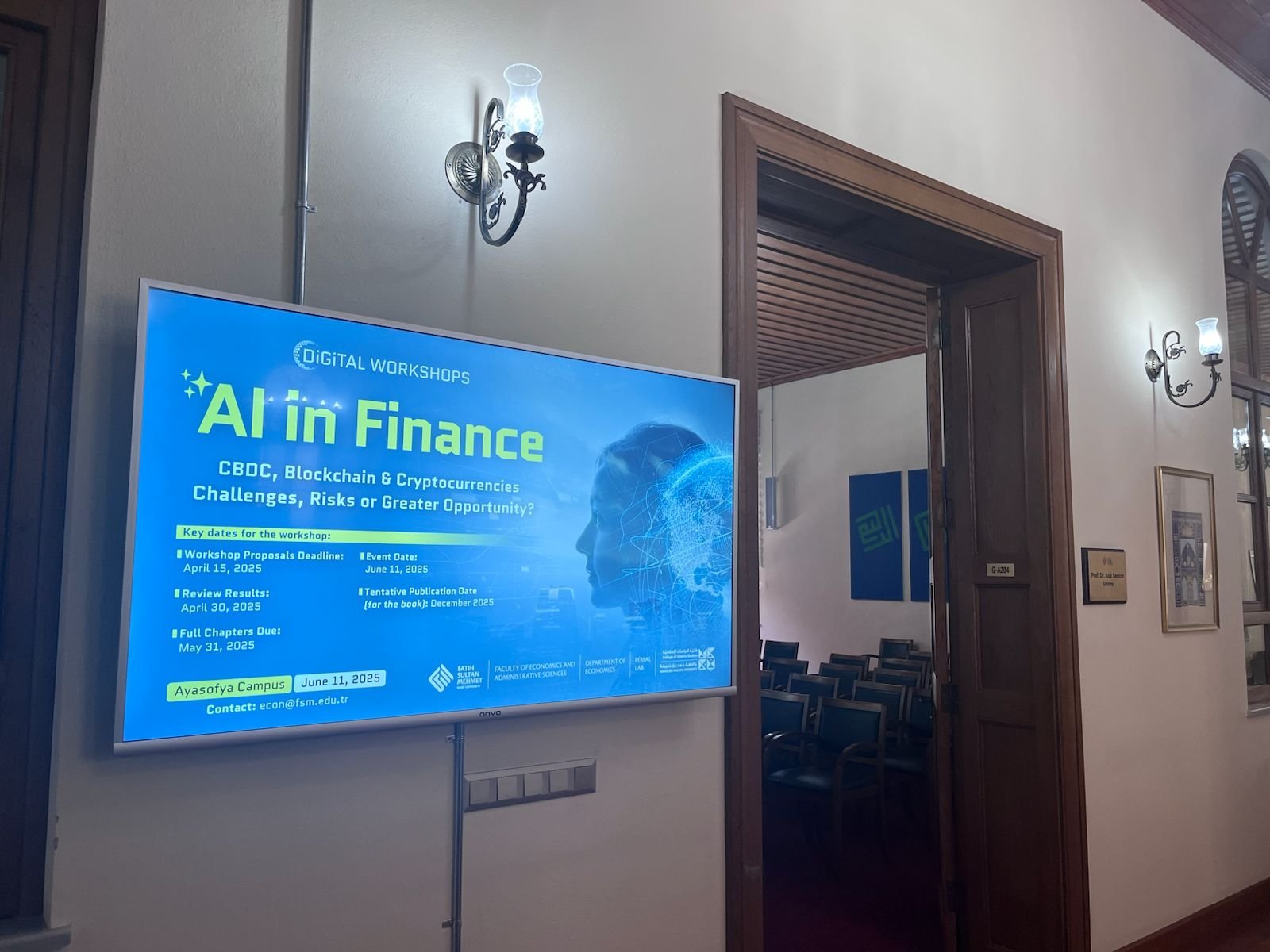
It aimed to provide a new platform to discuss recent trends in digitalization, AI and machine learning, contemporary business practices and technological developments in finance and economics. Also, it aimed to fill in the gap between theory and practice, the missing connectivity with cutting-edge technologies, innovation, AI, and digital transformation. It provided a new environment to discuss, exchange ideas and learn about the latest developments related to broader digital and AI transformation.
AI methodologies and their applications in finance were discussed all day. Challenges, risks and opportunities were analyzed in detail. Overall, it provided a broad-based discussion opportunity on the overarching theme of AI and digitalization in finance, and more specifically on AI-driven decision-making in finance!
It was truly exciting to host and collaborate with such distinguished faculty members, experts, and academics who are deeply engaged with these important topics. It is clear that to fully harness the potential of AI in finance, many more workshops and discussions are needed.