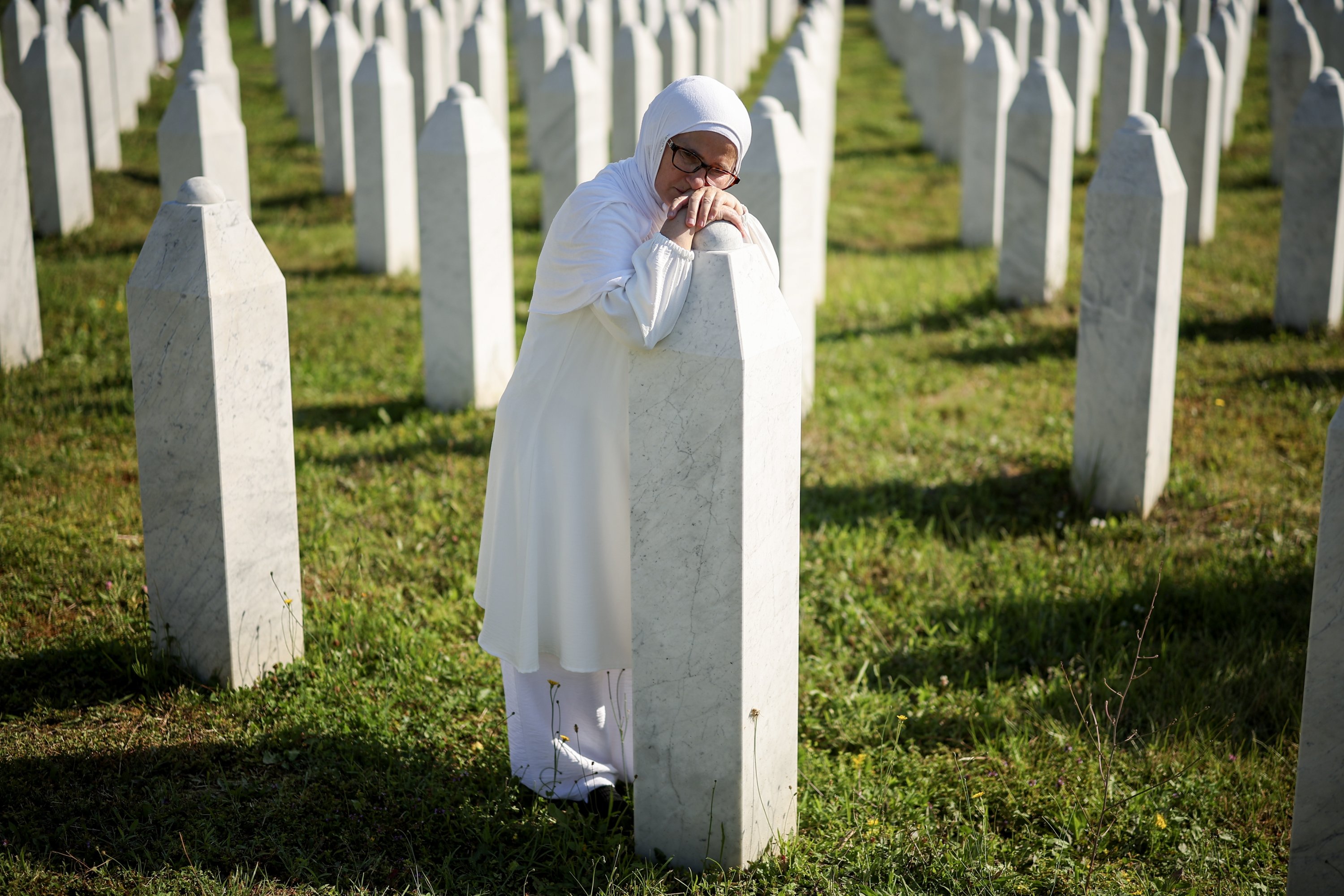
In July 1995, I survived the genocide in Srebrenica. I was 20 years old. More than 8,000 Bosnian Muslim men and boys were murdered.
Thirty-one years later, I manage the institution responsible for preserving the memory and the evidence of what happened. Among my colleagues are survivors, relatives of those murdered, and people who returned to communities from which they had been violently expelled.
Some of them are now being summoned for questioning by the police of Republika Srpska for the mere fact of working at the Srebrenica Memorial Center.
To understand what this means, you need to understand where we work.
The Srebrenica Memorial is an institution of Bosnia-Herzegovina, established under state law. It is located in Potocari, where thousands sought refuge with United Nations peacekeepers in July 1995. From there, Bosnian Serb forces separated men and boys from their families before murdering them.
But Potocari is also part of Republika Srpska, one of Bosnia-Herzegovina's two entities. Its wartime army and police committed the genocide. Its present-day political leadership has repeatedly denied it.
We preserve the evidence of genocide in a territory governed by authorities whose leading political figures reject the judicial findings establishing that genocide.
Our institution receives protection from a state-level police agency. Yet our employees live in surrounding communities where policing is the responsibility of Republika Srpska. Many are Bosniaks who survived the war or returned after being expelled. They are citizens working for a state institution but can find themselves treated as members of a hostile civilian population.
This is the reality behind the current police investigations.
In July, at least 26 current and former employees and associates of the memorial were summoned for questioning by the Zvornik Police Administration. The District Public Prosecutor's Office in Bijeljina confirmed that it had ordered investigative measures. In September, prosecutors sought financial and administrative records relating to the center's operations in 2022, as part of preliminary inquiries into possible tax and contribution evasion.
The Republika Srpska Ministry of the Interior says its officers are acting under prosecutorial supervision. It has also denied my warning that an operation involving special police units was being prepared against the memorial. We have since received confirmation from the prosecutor's office supporting our earlier concerns.
We are a public institution. Our finances are open to lawful scrutiny. I have no objection to legitimate investigations conducted by authorities acting within their powers. There can be no special exemption from accountability simply because an institution deals with genocide.
But neither can accountability require us to ignore the circumstances in which these investigations take place.
When police summon survivors of genocide to answer questions about the institution preserving its evidence, the history of the institutions involved matters.
I know what it means to be questioned by the Republika Srpska police. In 2024, I was summoned following an allegation that I had endangered the security of a Bosnian Serb police officer. In reality, the officer in question was harassing my employees and conducting an off-the-books investigation against me and the memorial. A year before, with the help of state-level law enforcement, we stopped Bosnian Serb police from raiding our premises under the pretext that the memorial holds illegal weapons. In reality, these were exhibits legally donated to us by the Armed Forces of Bosnia-Herzegovina. Last year, the entity's Ministry of the Interior prevented our team from filming inside a building in Pilica used for mass executions during the genocide.
We went there to document a crime. The police stopped us.
In July this year, we published our annual report on genocide denial, documenting 149 instances of denial and relativization, compared with 99 during the previous monitoring period. Literally the day after, Bosnian Serb police began questioning our employees.
The International Criminal Tribunal for the former Yugoslavia established that genocide was committed in Srebrenica. The International Court of Justice confirmed that finding in 2007. Senior Bosnian Serb political and military leaders were convicted for their roles in the crimes.
Yet Milorad Dodik and other senior political figures in Republika Srpska have repeatedly rejected these findings. Genocide denial has been voiced from the entity's highest offices.
For years, I have had the impression that some political leaders would prefer Srebrenica to remain a cemetery.
A place where people come once a year, lay flowers, express their sorrow and leave. A place where the dead are mourned, but the political and institutional responsibility for their deaths is no longer examined.
That is not what we do.
We collect testimonies, preserve documents, investigate sites of mass executions, educate young people and confront the machinery of denial. We connect individual experiences to the decisions, institutions and structures that made genocide possible. Our work does not end with the burial of the dead. It begins with the obligation to establish and preserve the truth about how they were killed.
This makes the memorial more than a place of remembrance. It makes it an institution that insists on accountability.
And accountability is uncomfortable for those who would rather discuss Srebrenica without discussing who committed the crimes.
I do not ask anyone to accept our account on faith. The evidence is available. The judgments are public. The graves exist. The survivors are still here.
What I ask is that the people entrusted with preserving this evidence be allowed to do their jobs without intimidation.
The international community helped establish the memorial. It has supported our work and commemorated the victims alongside us. That commitment cannot be confined to anniversaries. The protection of an institution preserving the evidence of genocide is also a test of whether the lessons so often invoked in speeches mean anything in practice.
I survived Srebrenica. I know the difference between living with a threat and being expected to pretend that it does not exist.
The people buried in Potocari can no longer speak. Those of us who survived have spent three decades making sure that their stories are not forgotten.
We did not survive so that others could decide which parts of our history we are permitted to remember and what story we can tell. We were there when they killed everyone we knew. We will not be erased.