Over the past decade, the orbit of global media has continued to shrink regarding the coverage or analysis of politics in the Arab world. Since the Arab uprising, one has witnessed how the political commentators and reporters on the ground tend to merely focus on the changing geopolitics in the region, the rise or fall of militias, the formation of alliances and counter-alliances, and the growing intervention of regional and global players. But in the race to fill the pages with the news of mayhem across the region, global media has perhaps overlooked the much darker plot of the scene unfolding in the same geographical terrain.
Amid a decade of civil war in Syria, the war-torn nation has emerged as an epicenter of the multibillion-dollar illicit drug trade in the larger Arab world. In the past, the Arab youth could have been addicted to multiple sorts of stimulants, but over the years, a new stimulant known as Captagon has surpassed all other drugs in terms of its reach, usage and desperation among the youth. For the first time, Captagon was manufactured by a German pharmaceutical company in 1962 for treating depression, hypertension and sleep disorders. Its consumption later spread to larger European and Arab markets.
Today, no youth gathering or celebration in wealthy Gulf nations is complete without the consumption of Captagon. Almost 80% of the total global production of Captagon takes place in Syria alone. The rampant production of Captagon in Syria and the subsequent emergence of big drug tycoons and syndicates has turned a devastated nation into the world’s newest narcostate, reminding one of Chile, Colombia and Afghanistan of the past. Amid the peak of the civil war in Syria and the consolidation of Daesh, Syria turned into an axis of Captagon in terms of production, consumption and thoroughfare for its regional and global smuggling.
The demands for Captagon continue to grow in the Arab markets, and the volume of illegal transactions is much bigger than legal transactions. The trade-in Captagon is run by warlords, militias and arms dealers spread across the region. The large-scale involvement of political elites, business oligarchs and military cliches in this illicit trade began only after Syria was put under Western sanctions. The U.S., Britain and the EU have repeatedly accused members of the Syrian ruling family and other regime-supported militias (Hezbollah and other small groups) of being part of the drug syndicates and making huge wealth. The U.S., in September 2022, introduced the Captagon Control Act to punish the export of these illegal drugs by the regime and described the Captagon as a threat to transnational security. The U.N. also imposed a series of sanctions against Syria for its role in supporting illicit drug trade in the region. These moves were welcomed by Jordan because it was directly affected as it shares a 378-kilometer border with Syria.
The Arab militias do not merely help smuggle the drug across the border; it is widely used among them as well to fight their fatigue and elevate their mood, and hence, Captagon is also known as "Captain Courage." In Syria alone, there are around 14 Captagon manufacturing centers, mostly based in regime-controlled areas. In 2021, the Captagon production in Syria was to the tune of $5.7 billion, and this is the value of only the seized substance and not all the produced substance.
Numerous local and global media have reported that given the economic dividends in the manufacturing of Captagon, millions of hectares of agricultural land in Syria are turned into fields for the production of ingredients needed for the manufacturing of Captagon. There are conflicting reports about the confiscations of Captagon consignment in different parts of the Arab world. According to one report, there was a six-fold increase between the years 2018 and 2022 in the confiscation of Captagon.
After Syria, Lebanon is another major center of Captagon production, and it is another major cross point for its trade. In the last few years, the growth of many makeshift industries has been noticed in different Lebanese villages. After Lebanon was hit by the worst economic crisis in 2018, the Bekaa Valley and Lebanese border areas emerged as a new center of Captagon production, which turned the region almost into a Captagon economic zone. After Lebanon joined Syria as a major ally in the production and trade of Captagon, the Kingdom of Saudi Arabia banned Lebanese imports to its country due to the growing cases of the drug being found in packets of food and chemical products. Captagon alone constitutes about 40% of stimulants used by the kingdom’s youths. The youth from the Gulf nations are a special target of drug peddlers because of their paying capacity. Moreover, they have few means of recreation or amusement.
Though this new stimulant is largely produced in Syria and Lebanon, it is easily available in all Arab markets, particularly in rich Gulf nations like Saudi Arabia and the UAE, besides Iraq, Türkiye, Greece, Romania, Italy and Africa. The drug is largely smuggled overland via Jordan, Iraq and Lebanon. In recent years, Jordan has become a gateway for the supply of Captagon to Gulf countries. The peddlers have developed some unique ways of passing the consignment to the Gulf through the porous border of Jordan. They seek the help of donkeys to carry the drugs, and sometimes they attach bags full of Captagon to drones and fly them across Syria’s territory.
Over the months, trade through Jordan has declined because the border security forces intensified the monitoring of its border. Now, Jordan as a transit point has been replaced by Iraq and Türkiye, and in 2022 only, the Iraqi government arrested 16,000 people involved in the illicit drug trade, and half of them were sent to jail. The Anbar province in Iraq, bordering Syria, Jordan and Saudi Arabia, has turned into another epicenter of illegal transactions in the region. In March 2022, a huge consignment worth 12.3 million pills was intercepted at the Ambarlı port in Türkiye. The youth are increasingly becoming addicted to this cheap drug as a source of recreation and to overcome the psychological suffering emanating from a high level of insecurity.
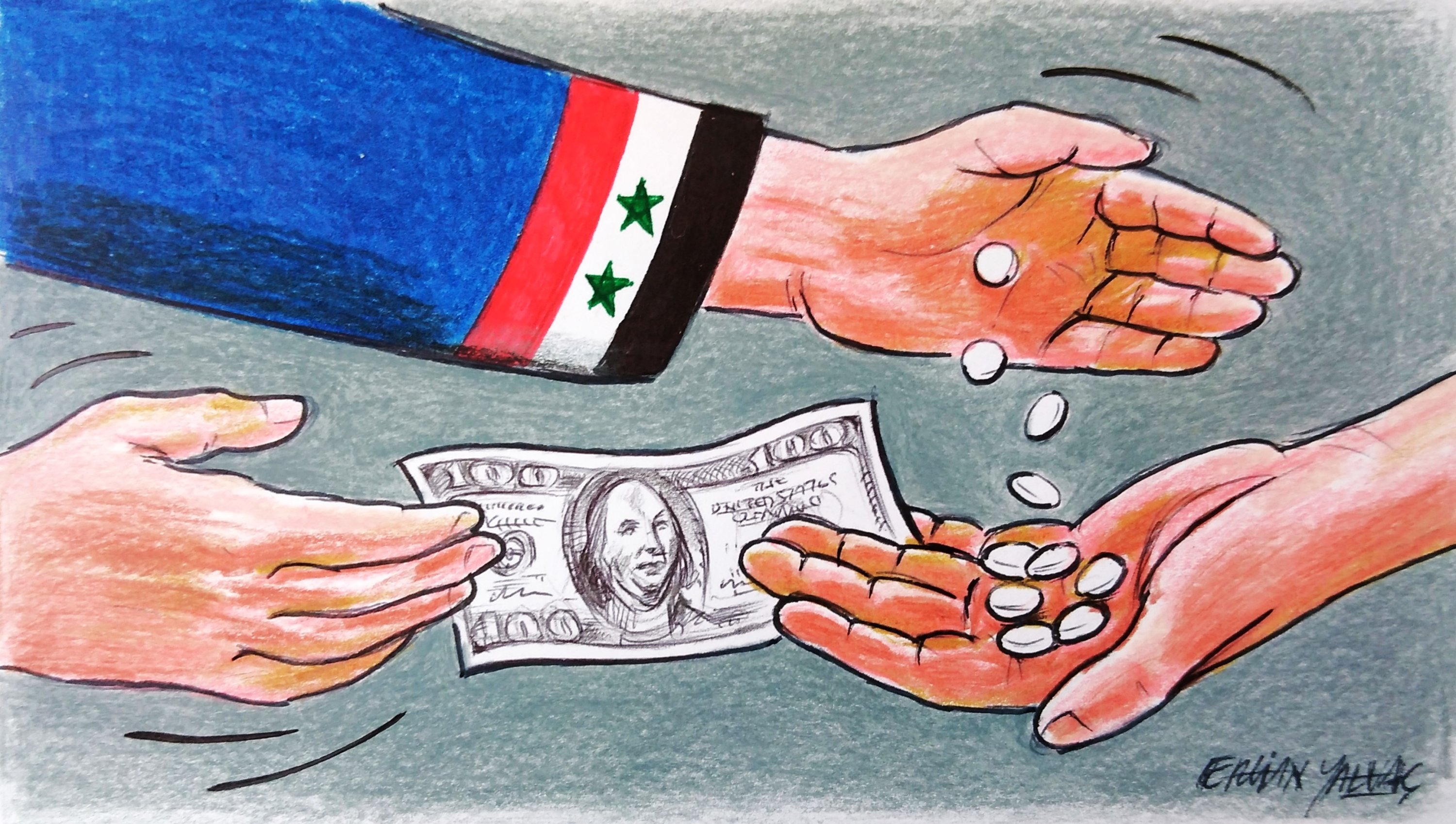
It is not merely a question of production or consumption of Captagon, but over the years, the whole course has morphed into a sort of drug economy. In Syria, it has become a flourishing business where drug oligarchs and extended family members of the regime are working closely to amass huge wealth. Today, the regime has not only joined the larger drug syndicate but also extended full legal protection to the oligarchs to overcome the economic deficit it suffered amidst a decade-old civil war. In 2021, the regime in Syria earned $5 billion, which was not a bad return for its loss of control over its oil wells and agricultural lands. Earnings through trade in Captagon are the biggest source of foreign currency for the regime, as 90% of the foreign currency comes through illicit trade alone. Syrian leader Bashar Assad has also used the Captagon as a strategic tool against his adversaries in the region.
This small pill seems to have given great leverage to Assad with the Gulf monarchs, who took all diplomatic and strategic measures to end his regional isolation with the hope that normalization with him could induce him to combat the growing drug culture in the region. Since the eruption of the civil war in Syria, the consumption of Captagon has witnessed an exponential rise in Syria and particularly in Gulf nations as well. One of the key reasons is the easy access to money for the youth living there. The rich nations remain the target of organized groups of smugglers because of their wealth. What has helped the surge in Captagon production in Syria is the absence of governance for a long and the growing economic stake of the regime in the trade, as for the regime in addition to other stakeholders, it is the easiest and shortest means of earning billions.