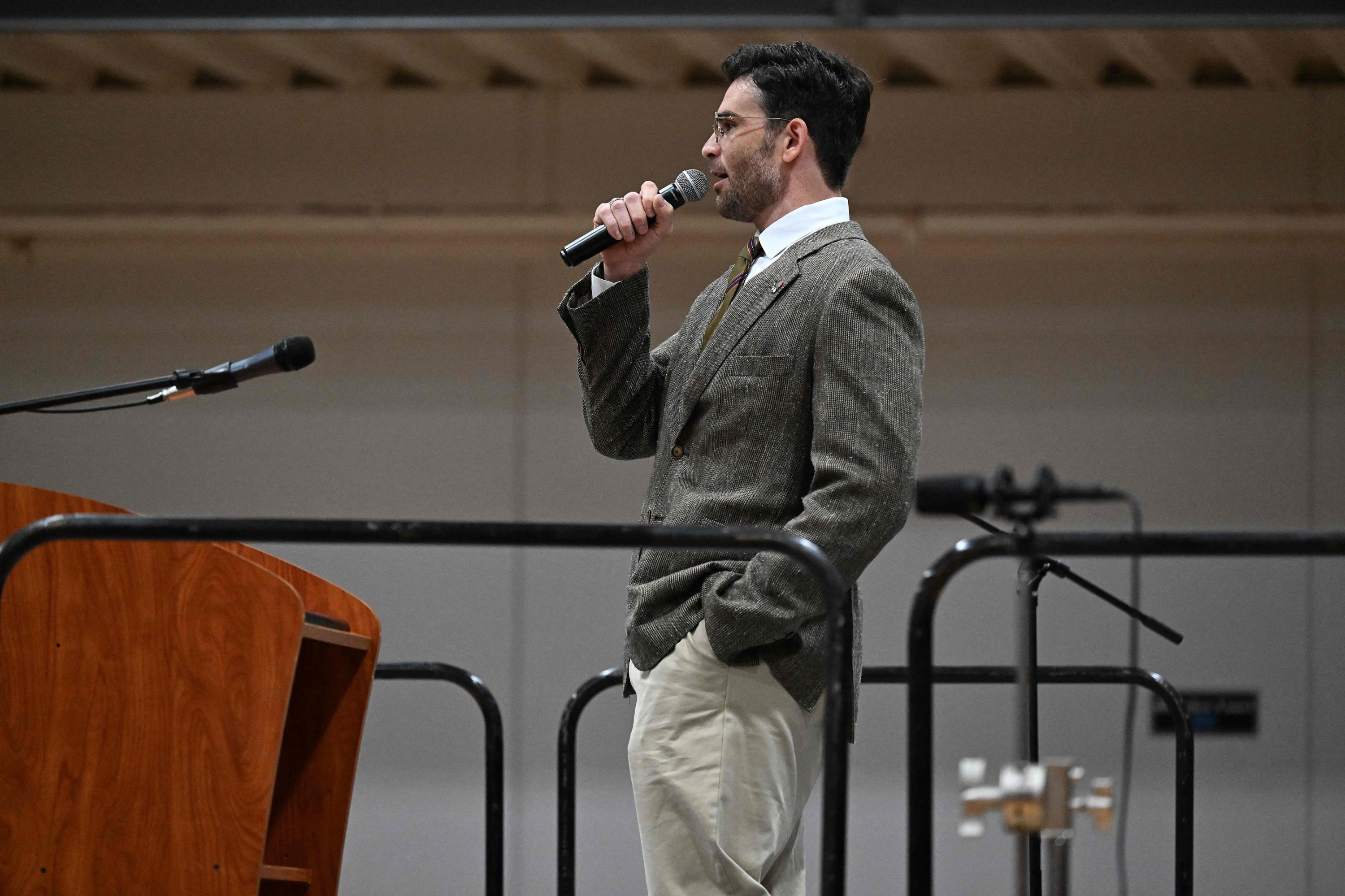
As the U.S. midterm elections approach, the political rivalry between Democrats and Republicans is not limited to the corridors of Congress but is also transforming into a war of words waged in the digital media ecosystem. In this new media landscape, Hasan Piker, who has surpassed traditional commentators and reached millions of voters, has recently become central to the debates.
Who is Piker? Piker, born in 1991 in New Jersey to a Turkish family, studied political science and communication at Rutgers University, then worked as a producer and presenter for The Young Turks, a progressive online news program founded by his uncle Cenk Uygur. Piker began streaming on Twitch in 2018 and left The Young Turks in 2020 to become an independent content creator. Today, he has 3.1 million followers on Twitch, and 14 million watch his live streams monthly.
Piker is a self-described socialist and long-time associate of the Democratic Socialists of America. However, what distinguishes him from the classical left is his proposal of a "post-liberal" vision. In an interview with The New York Times, he said: "Liberal capitalist democracies offered a great evolution for a long time, but the bloodshed created by this system continues. Liberalism is failing, and we see the illiberals benefiting from this. I define myself not as an illiberal, but as a post-liberal."
Piker sees capitalism as an evolution from feudalism, but argues that now is the time for a new evolution. He focuses on class inequality, free health care, workers’ rights, and a critical reassessment of U.S. foreign policy. He offers sharp commentary in the face of atrocities that have shocked the world's conscience. He is known for his support of the Palestinian struggle and his harsh criticism of Israel regarding the Gaza genocide – a stance that has earned him both a large following and made him a target for Zionists.
What sets Piker apart from traditional commentators is his direct political mobilization. From 2025 onwards, he became more politically vocal and accelerated these efforts in 2026 by taking to the field in Zohran Mamdani's New York City mayoral campaign. Mamdani won the election, becoming the first democratic socialist mayor in New York City history.
Piker also played a key role in the Michigan Senate primary of Abdul El-Sayed, another rising figure in U.S. politics. El-Sayed narrowly defeated the party's institutional nominee, Haley Stevens. Piker's campaign blitz and rallies are considered key factors in this victory.
Piker's influence isn't limited to elections. His 2024 election night broadcast garnered 7.5 million viewers, demonstrating his reach to an audience that is inaccessible to traditional media.
The similarities between Piker and right-wing commentators who contributed to U.S. President Donald Trump's victory are striking: First, both groups use the same strategy in the "attention economy." According to Fox News, Piker learned the "attention economy" from his uncle Cenk Uygur, then transformed it into the "anger economy" and the "personality disorder attention economy." Right-wing figures like Joe Rogan, Ben Shapiro, Jordan Peterson, Adin Ross, Sneako and late Charlie Kirk also operate the same mechanism and have serious political impact in America. This fits the "Horseshoe Theory," which suggests that the extremes are actually similar.
Second, they appeal to the same audience: young men who are dissatisfied with the system and see no future for themselves. In the 2024 election, men under 45 strongly supported Trump. Piker is clear on this: "The right is meeting these men where they are. The left is forcing them to come to where we are, and it's not working."
Thirdly, both are harbingers of a “post-liberal” era. Piker is described as left-postliberal, while right-wing figures like Curtis Yarvin are described as right-postliberal. Both wings assume the collapse of the current liberal order and want to build something beyond it. The Boston Globe describes Piker as “the Nick Fuentes of the left”: “The symmetry is almost perfect. Piker is understandable and witty; this is exactly the defense his fans use for Fuentes.”
The difference is this: Right-wing commentators directly contributed to Trump’s victory; Piker rose as a reaction to this. Against the right-wing media ecosystem that turned the 2024 election into a “podcast election,” Piker emerged as the strongest voice of the left.
Piker's influence can be read on three levels: First, the transformation of the American political infrastructure. Piker is becoming a campaign infrastructure for progressive candidates. As Vox notes, "progressive broadcasters are becoming part of the political infrastructure shaping young American voters."
Piker's influence can also be read in terms of the division within the Democratic Party. He is a symbol of a deep division among Democrats. While progressives see him as key to reaching young male voters, centrists worry that his rhetoric will harm the party.
People like Piker are also significant in balancing the new media ecosystem in America. Piker is the biggest alternative to the left in this right-dominated social media environment. His rise is a reflection of the left's efforts to regroup in the digital space after the "podcast election" shock of 2024. This undercurrent is spreading more from mobile phone screens than from rally squares.
Essentially, Piker is just a new representative of the undercurrent of U.S. politics. American politics and society are undergoing a radical transformation. One of the most visible faces of this transformation is Bad Bunny: He redefined who "America" is by singing in Spanish at the 2026 Super Bowl performance, drawing the ire of the MAGA right. Another face is Zohran Mamdani: As New York's first democratic socialist mayor, he dismantled institutional politics. Another is Abdul El-Sayed: He defeated the party's institutional candidate in the Michigan Senate race.
All these names, coming from outside traditional politics, represent a vision of "another America" with their identities, discourses and alliances. Bad Bunny's Super Bowl stage, Mamdani's city hall, El-Sayed's Senate campaign and Piker's Twitch studio are all different shores of the same wave. The movement, including Piker, is increasingly moving towards mainstreaming, particularly among young people, something Bernie Sanders failed to achieve.
Consulting the political science literature, Antonio Gramsci's concept of the "organic intellectual" is one of the most suitable tools for understanding Piker and this undercurrent. An academic study named "The Role of Online Influencers in Countering Digital Extreme-Right Messaging" examines Piker precisely within this framework: "Hasan Piker, theorized through Gramsci's notion of the organic intellectual ... is considered in conjunction with his role in combating far-right discourses and his interacting audience."
On the other hand, Neil Postman's "politics of attention" thesis is being updated today with digital platforms. Zeynep Tüfekçi's analysis of how digital tools are transforming politics offers a comprehensive framework for understanding the rise of figures like Piker: the ground of political competition is no longer institutional parties, but the economy of attention.
Finally, the "post-liberalism" debates conceptualize the crisis of the current liberal democratic order. The parallel between Piker's assertion that "liberalism is failing" and the post-liberal discourses of the right is a concrete manifestation of the "legitimacy crisis of liberalism," which political science has long debated.
In short, American politics is changing. This new current, extending from Bad Bunny to Hasan Piker, from Zohran Mamdani to Abdul El-Sayed, is perhaps the first page of the most important chapter that political science will write in the next decade. 2026 election might be the "influencer election" as it leads the ongoing transformation of political campaigning from rallies to streams.