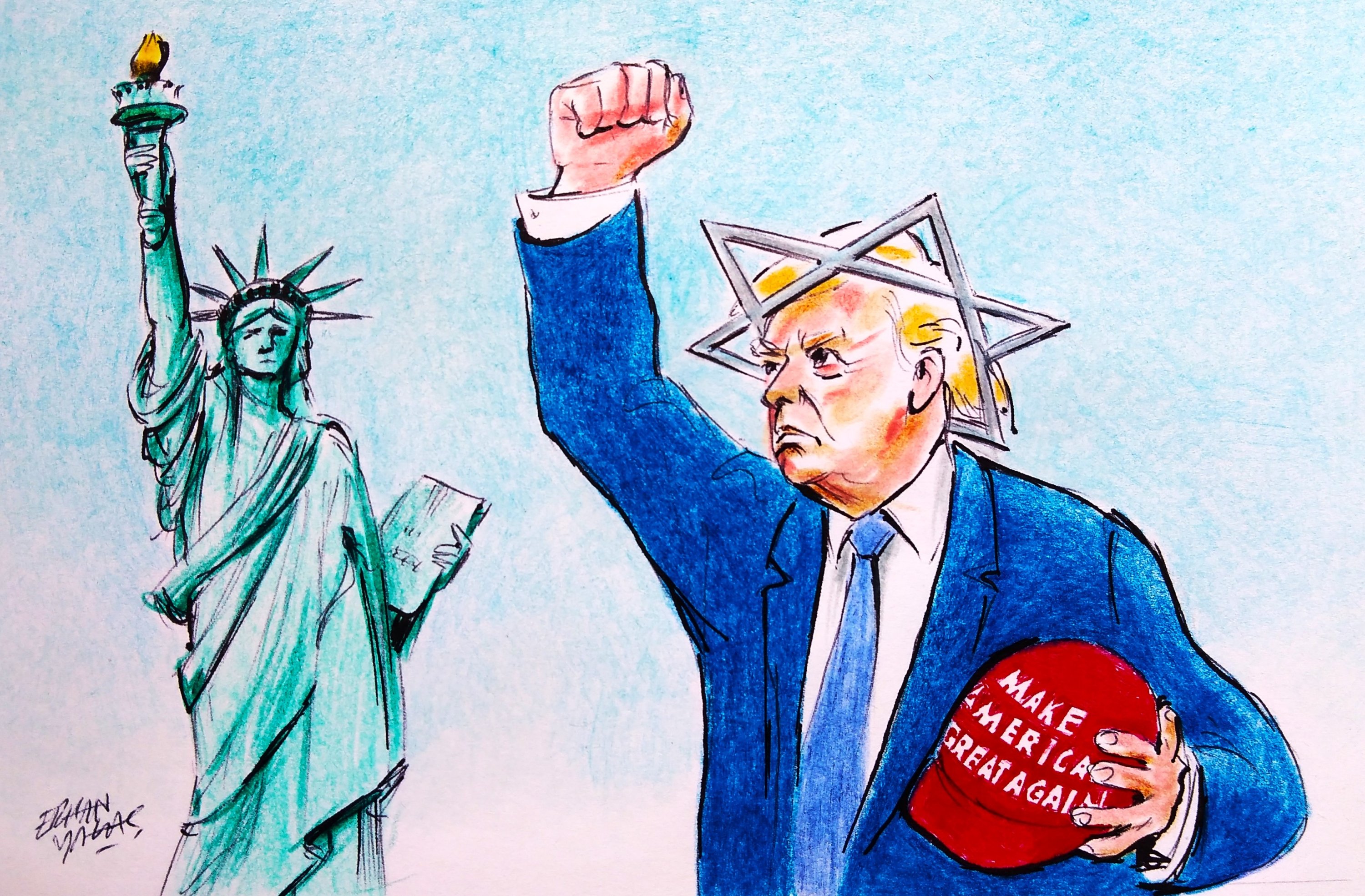
American exceptionalism is a deeply rooted conception of superiority and a shared sense of destiny grounded in the belief that the United States is divinely chosen, inherently virtuous and endowed with a unique mission in the world. This concept is predicated on the notion that the country places individual liberty above all political processes and assumes for itself a privileged, rule-making and at times rule-exempt leadership role within the international system.
At this juncture, however, this approach has evolved into an aggressive doctrine that exploits allies and adversaries alike, thereby systematically eroding international institutions and the rules-based multilateral order. By circumventing legal norms through unilateral military interventions and economic blackmail, this mode of conduct drives the global system toward a "law of the jungle" in which power prevails over principle, thereby exacerbating strategic uncertainty and instability.
On Feb. 28, 2026, Operation Epic Fury, launched by the U.S. and Israel against Iran, shook not only the geopolitical landscape of the Middle East but also the very foundations of the alliance systems established in the aftermath of World War II. This war of choice, initiated by U.S. President Donald Trump without congressional authorization and without consultation with America’s allies, has generated a profound crisis of confidence across allied capitals. The unlawful actions and aggressive posture of the U.S. under the Trump administration are transforming the international system from one of “benevolent leadership” into a model of “predatory hegemony” that exploits allies and adversaries alike.
The U.S. no longer seeks to cloak its interventions in normative claims such as democracy or human rights. Rather, it openly asserts that power and coercion constitute the iron law of world politics. The abduction of Venezuelan President Nicolas Maduro and the extrajudicial execution carried out in international waters reflect a “predatory” mode of conduct that disregards international law and sets dangerous precedents for other major powers.
It is abundantly clear that this foreign policy approach, which became particularly pronounced during Trump’s second term, has transformed alliance relations from partnerships based on mutual interests into zero-sum transactions in which the U.S. extracts concessions by exploiting its privileged position. Operation Epic Fury represents the most extreme manifestation of this approach. Instead of consulting its NATO allies beforehand, the U.S. waited until the costs and risks of the war had become evident, and only then compelled its allies to undertake dangerous tasks such as securing the reopening of the Strait of Hormuz.
At this juncture, the most concerning development is that, as a result of the U.S.'s attitudes and actions, the credibility of NATO’s security guarantees under Article 5 is once again being called into question. The prevailing opinion among the allies is that Washington has adopted a punitive, transactional approach in which its military protection guarantee is contingent on economic tribute and displays of political submission. Even more strikingly, the Greenland crisis has revealed that the U.S. may no longer fully rule out the use of military force even against its own allies.
U.S.-Iran war has pushed the disagreements between Europe and the U.S. to a threshold that may prove exceedingly difficult to reverse. Trump argues that the U.S. spends hundreds of billions defending Europe, yet allies fail to support Washington in conflicts like Iran. He warns that if they do not participate in U.S. operations, the U.S. may not uphold its Article 5 commitments.
At the heart of the crisis are deep disagreements over NATO’s mission, burden-sharing and strategic priorities. While countries such as the United Kingdom, France and Germany view NATO as a defensive alliance based on collective defense, they do not see the Iran War as a NATO responsibility. Trump, however, calls allies’ reluctance a “betrayal,” labels NATO a “paper tiger,” and signals he may withdraw the U.S.
His pressure is likely to accelerate Europe’s efforts to strengthen its defense capacity and reduce dependence on the U.S. Yet, divisions remain: while NATO Secretary General Mark Rutte insists Europe cannot defend itself without U.S. support, countries like France and Spain advocate greater strategic autonomy, including the idea of a “European army.”
Moreover, France has moved to intensify cooperation with other allies on nuclear matters to reduce dependence on the U.S. arsenal. In this context, at the initiative of French President Macron, a new military partnership entitled forward deterrence was established with seven European countries, Belgium, Denmark, Germany, Greece, the Netherlands, Poland and Sweden, to decrease reliance on the American nuclear umbrella. Across European capitals, there is now a growing conviction that the U.S. nuclear guarantees have become a negotiable commodity and that Washington increasingly regards Europe as a “burden.”
The consequences of the attack on Iran have not been confined to Europe; they have also profoundly unsettled alliance networks in Asia. The redeployment of U.S. military resources toward the war in the Middle East has generated a palpable “fear of abandonment” among allies such as Japan and South Korea. Indeed, South Korean President Lee Jae Myung expressed his frustration over the sudden withdrawal of American weapons from the country, a development that has accelerated the search among U.S. allies for alternative defence scenarios and a strategic “Plan B.”
The Trump administration’s demand for military and financial support from countries such as Japan and South Korea to secure control over the Strait of Hormuz has provoked serious public reactions in both countries. In Japan, anti-war sentiments have gained further momentum, while in South Korea, protests have increasingly centered on the perception that Trump is shifting the costs of a self-induced crisis onto America’s allies. Taken together, these developments demonstrate a marked erosion of Washington’s soft power in the region. This situation, in turn, is encouraging Asian states to seek deeper cooperation with alternative actors such as China, particularly in the context of energy security.
The Doctrine of Peace through Strength positions military and economic power as the most effective instruments for deterring adversaries and preserving peace, and it constitutes a cornerstone of the U.S. national security and defence strategies of 2025 and 2026. Yet, when this power-centric approach is fused with the Trump administration’s strategy of predatory hegemony, which seeks to exploit allies and adversaries alike, it generates a deeply destabilizing form of strategic uncertainty within the international system.
By reducing traditional alliance relationships from steadfast commitments to negotiable commodities contingent upon economic concessions, and by circumventing the rules-based order, this posture is driving global politics toward a nineteenth-century-style ‘law of the jungle’ environment in which the strong are free to do as they please, while the weak are left with no choice but to endure the consequences. Unfortunately, these developments threaten even the most fundamental norms of the international order, including the tradition of nuclear non-use and the prohibition on territorial annexation.
In sum, the global energy shock triggered by the Iran War, the surge in Brent crude prices to roughly $115-120 per barrel, together with the heightened strategic uncertainty, have made allies’ efforts to reduce their dependence on the U.S. a lasting feature of international politics. Trump’s aggressive practices under the doctrine of “America First” have set in motion a process of diplomatic self-destruction that may cause the U.S. to lose its global influence “first gradually, then suddenly.” The alliance system has thus ceased to function as a community of shared values and has instead been transformed into a fragile structure sustained by coercion and economic blackmail.