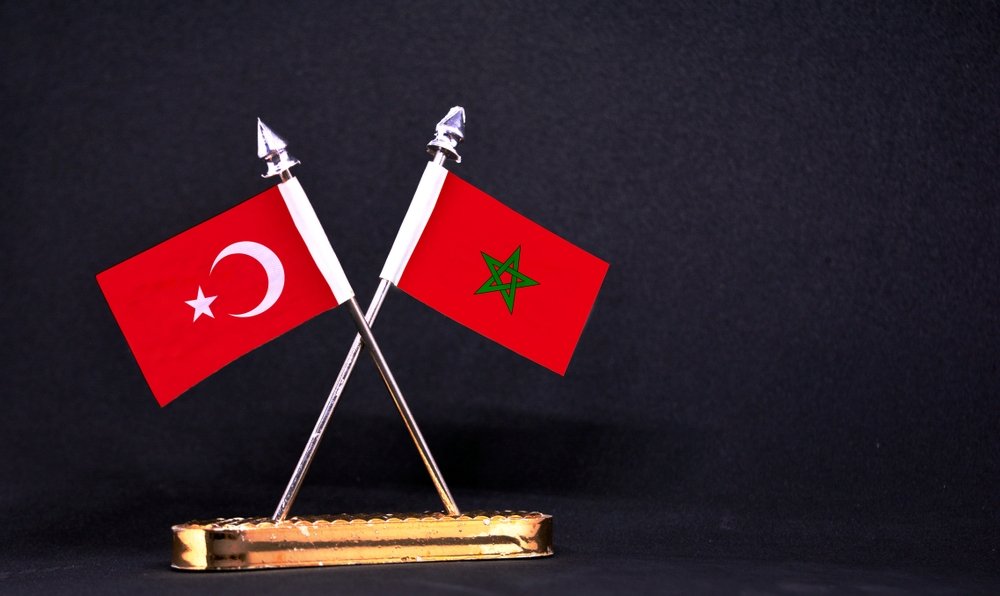
Have you ever noticed how the loudest crises get all the attention, while the most durable solutions often emerge in silence? Look at the map of the Mediterranean today. The eyes of the world are fixated on the chaos in Libya, the fragile cease-fires in the East, or the burning security vacuum in the Sahel. Yet, if you shift your gaze to the western rim of the sea, you will find something remarkably different. A quiet, sturdy axis of stability is solidifying.
It is not being built by the grand declarations of global superpowers. It is being forged by two historic, mid-sized powers that have decided to stop waiting for rescue: Türkiye and Morocco.
To dismiss the relationship between Ankara and Rabat as merely a transaction of textile quotas or summer tourism is a lazy analysis. It misses the tectonic shift happening beneath the surface. These two nations, one a NATO heavyweight guarding the Black Sea, the other the gateway to the Atlantic and a pillar of the African Union, are constructing a geopolitical counterweight to the region’s chronic instability. Throughout 2025, through a series of deliberate moves in trade and high-tech defense, this partnership has graduated from cordial friendship to strategic necessity.
What we are witnessing is not just diplomacy, but the birth of a new reference point for stability in North Africa.
Let us be honest about the elephant in the room. For years, the story of Turkish-Moroccan economic relations was dominated by a single, often grumpy complaint: the trade deficit. Moroccan manufacturers felt squeezed, and Ankara listened. But look at where we are now. 2025 was not only a turning point, but it was also the moment the relationship stopped keeping score of old grievances and started drafting a new blueprint together.
The free trade agreement, implemented initially in 2006, has been the engine of this growth, but it required an adjustment. And it got one. Following the 6th Joint Monitoring Committee meeting in Ankara in June and subsequent summits in Rabat, the numbers tell a new story. By 2025, the trade volume surpassed the $5 billion (TL 218.79 billion) mark. Yes, Türkiye still exports more – about $3.9 billion – but the dynamic has changed.
How? Because the logic has changed from “selling to” to “producing with.”
Turkish investors are not merely shipping boxes across the Mediterranean. They are exporting industrial capacity. Walking through the industrial zones of Casablanca or Tangier today, you will find nearly 250 Turkish companies deeply embedded in the local economy. We are talking about over $1 billion in direct investments and 20,000 Moroccan jobs. From massive infrastructure projects where Turkish contractors have exceeded $4 billion in volume, to textile factories weaving fabrics for European fashion houses, the integration is real.
Policymakers in both capitals have realized a simple truth: In a world of broken supply chains, Morocco provides Türkiye with an Atlantic platform, while Türkiye provides Morocco with the industrial know-how essential for its own export-led growth. The “trade imbalance” narrative is dead; long live the balanced partnership.
If economics is the muscle of this relationship, defense cooperation is its steel spine. But ask yourself: Is this just a shopping spree? Is Rabat simply buying hardware?
The answer lies in the timing and the technology. The trajectory of military ties has accelerated at a pace that has surprised many Western observers. It started with the Bayraktar TB2s in 2021, changing the balance of power on the ground. But the delivery of the cutting-edge Bayraktar Akıncı systems in February 2025 signaled a deepened trust that few non-NATO partners enjoy.
For Morocco, this is existential. Look at its neighborhood. Facing a volatile security environment, characterized by the spillover of Sahelian terrorism, the persistent frozen conflict in Western Sahara and sharp regional rivalries, Rabat cannot afford to wait for sluggish Western procurement cycles. It needs agile, combat-proven solutions. The Akıncı platform offers precisely this: a leap in long-range surveillance and precision strike capabilities without the heavy political strings often attached to Washington or Paris.
But let us look closer at the fine print of 2025. Rabat is not just signing checks for hardware. It is negotiating for capability. The whispers in defense circles are no longer just about procurement but about production. We are seeing the outlines of a localized drone ecosystem, maintenance hubs, repair bays and potentially assembly lines right on Moroccan soil.
For Türkiye, this is the masterstroke. It proves Ankara is not merely a crisis manager for shattered states like Libya or Somalia, but a trusted architect for stable, status-quo powers. It transforms a buyer-seller relationship into a “shared shield” guarding the Western Mediterranean.
Why this sudden velocity? Geography does ot lie.
Both capitals have realized that their locations are pieces of the same puzzle. For Turkish conglomerates, Morocco is not just a market. It is the Atlantic launchpad. Through its ports and trade deals with the U.S., Morocco offers Turkish business a shortcut to West Africa and the Americas that no other partner can match.
Flip the coin, and the logic holds. For Rabat, Ankara is the key to the East. As Morocco looks beyond its traditional partners, Türkiye unlocks the doors to the Balkans, Central Asia and the Black Sea. This is not abstract theory. It was the tangible energy in the Investment Forums held this year. When you combine Turkish Airlines’ reach with Royal Air Maroc’s network, you do not just get a flight path, you get a logistical super-connector that spans three continents.
Furthermore, consider the upcoming massive opportunity: Morocco’s co-hosting of the 2030 World Cup. Who is best positioned to build the stadiums, the roads, and the hotels rapidly and at high quality? Turkish construction firms are already rolling up their sleeves.
The political lexicon used by both sides, emphasizing “win-win” scenarios and complementarity, is not empty diplomatic rhetoric. It reflects the realization of two self-confident middle powers that they can achieve strategic autonomy by investing in each other rather than waiting for validation from Brussels or Washington.
Ultimately, what does the Ankara-Rabat axis mean for the world?
It represents a model for Global South connectivity. In a global order increasingly fragmented by great power competition, Türkiye and Morocco have refused to be passive bystanders. They are not choosing sides between East and West; they are choosing themselves.
Whether addressing the security vacuum in the Sahel or advocating for food security in Africa, these two capitals possess the diplomatic weight to shape outcomes. They demonstrate that nations with deep historical roots can modernize their economies and defense doctrines while retaining their sovereign decision-making mechanisms.
By fortifying the Western Mediterranean against the waves of instability crashing against the region, Türkiye and Morocco are doing more than protecting their national interests. They are holding the line. And sometimes, the most powerful geopolitical statements are made not with a shout, but with the quiet, steady hum of cooperation.