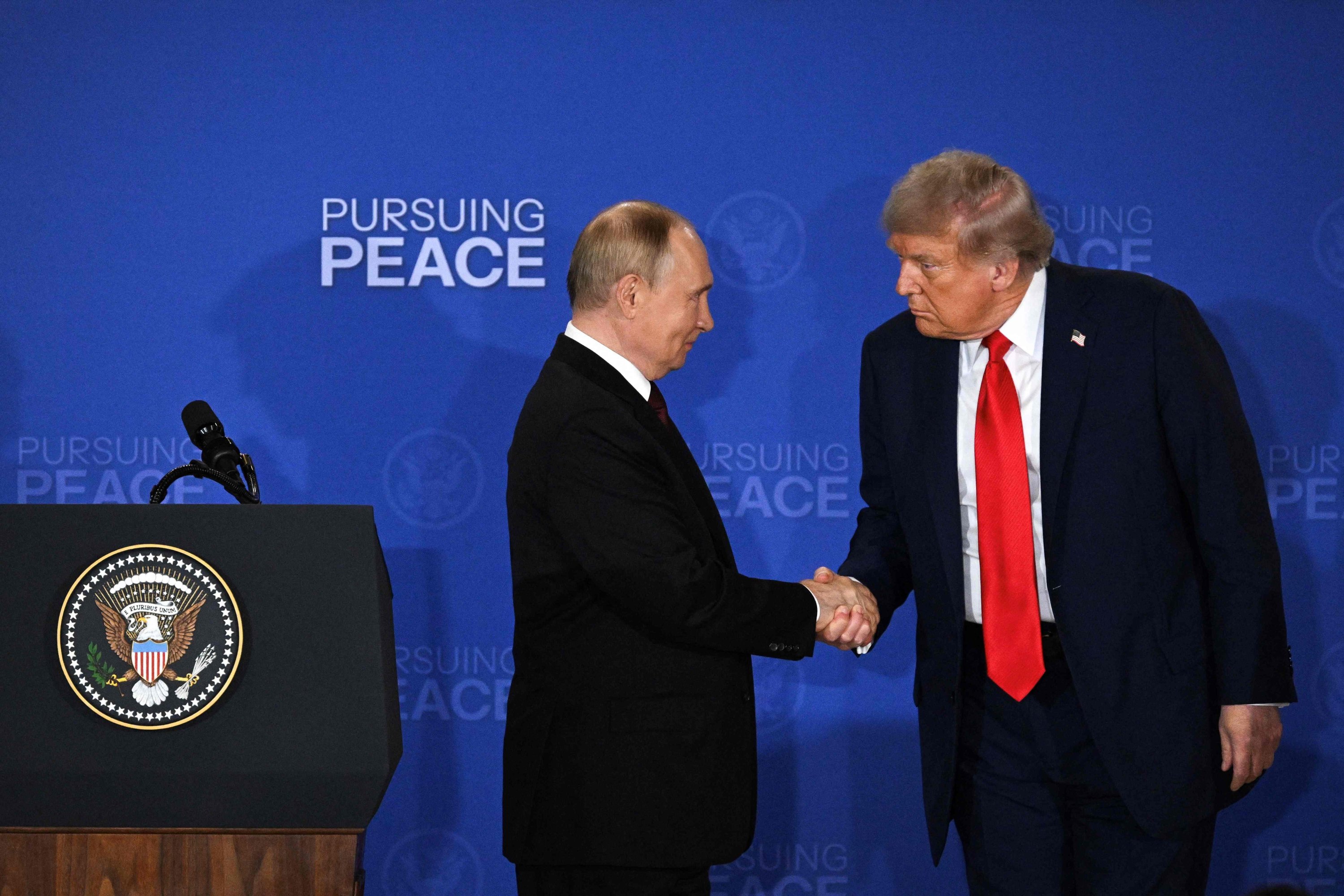
The Alaska summit, which took place on Aug. 15, was not merely a diplomatic meeting; it was a turning point that triggered deep fault lines in the international system. The symbolic significance of the summit stems from the fact that two nuclear powers, the U.S. and the Russian Federation, came face to face at one of the most critical junctures in history. While this meeting may evoke memories of the summits between the USSR and the U.S. during the Cold War, when they were the two poles of the system, there is a significant difference.
This time, Russia and the U.S. sat down at the table to take steps toward normalization and break the global isolation imposed on Russia. The most significant outcome of the summit was that it discussed not only the future of the Russia-Ukraine war but also the direction and course of trans-Atlantic relations. In this context, the Alaska talks revealed the fragile structure of the current international order and pointed to the emergence of a new world order. Both leaders left the meeting with a “win-win” mentality: Trump reinforced his image as a leader who had established peace in the global system and succeeded in bringing Putin to the table, while Russia achieved a greater strategic gain by breaking the political isolation that the West had been trying to impose. Of course, it should not be overlooked that in a summit where one of the warring parties, Ukraine, was absent, discussions still centred on Ukrainian territories.
The most significant outcome of the Alaska summit was undoubtedly the following meeting that took place in the Oval Office and was concretized by the visits of Ukrainian President Volodymyr Zelenskyy and the European leaders who act as his "protectors." This situation has brought the question of whether there is a balance of power or an imbalance of power in the global system back to the forefront.
The concepts of statehood and sovereignty within the realm of international relations were articulated based on the principle of equality as established by the Peace of Westphalia in 1648. This agreement served as a foundational element of the modern international system. However, throughout history, many attempts have been made to preserve and ensure the continuity of this principle. The establishment of the League of Nations and the subsequent entry into force of the United Nations Charter in 1946 were the most critical steps in this process. Article 2 of the U.N. Charter explicitly emphasises the sovereign equality of states and prohibits the use of force. However, the extent to which this provision is valid has been a subject of debate in every period. This issue is because, within the anarchic structure of the international system, the influence of each state is proportional to its power capacity. This reality has once again become concrete with Trump's reelection as U.S. President. Therefore, the developments following the Alaska summit confirm the existence of an order in which the great powers are decisive, despite the principle of sovereign equality providing a normative framework.
The summit’s exclusive focus on the U.S. and Russia revealed that a rupture had occurred within the international system. By sidelining Europe and Ukraine, Trump reinforced his hierarchical approach to power, effectively relegating them to the periphery. Nevertheless, this development should also be interpreted within the framework of MAGA’s power. The U.S., as the central actor of the global order, demonstrated that it still retains the capacity to define and enforce the rules of the system. At the same time, European leaders acted merely as “secondary actors” within this order. The visits of European leaders to Washington following the Alaska summit reflected these dynamics. Russia, on the other hand, assumed the role of a challenger to this hegemonic framework, acting as a “disruptive balancer.”
In this sense, the Alaska summit once again highlighted the vulnerability of small and medium-sized states in a hierarchical and hegemonic system established by the great powers, despite the theoretical emphasis on sovereign equality that has been a cornerstone of international relations since the Westphalia era. It even materialized these realities within the context of the 21st century. From this perspective, the Alaska summit can be seen not as a new Yalta, but rather as resembling the Munich Agreement or the so-called "percentages agreement," in which two major actors delineated their spheres of influence and decided upon the fate of other countries' territories.
This reality reflects the emergence of a different kind of realpolitik in the 21st century. Geopolitical power struggles have given rise to new forms of cooperation and unexpected alignments. At least in the short term, Trump's meeting with Putin revealed clear manifestations of this dynamic. The absence of Zelenskyy and European leaders from the Oval Office discussions has been perceived as an indication that matters concerning "percentages" or "partitioning" are once again being considered. Rather than the birth of an entirely new system, this process demonstrates an attempt to construct a reconfigured power hierarchy, one shaped according to Trump's vision and adapted to the international order through the prism of Ukraine.
The current picture suggests a Russia-centered peace, one that Trump appears eager to implement quickly in pursuit of a Nobel Peace Prize. At the Alaska summit, where the very term “cease-fire” was treated with allergic sensitivity, the peace framework that emerged was built on territorial exchange: Russia consolidating control over the areas it has already seized in exchange for halting further advances. This model is less about long-term visions and more about a pragmatic, immediate arrangement focused squarely on the present. Just as the mistake of giving away the Sudeten region in the Munich Agreement or the inclusion of spheres of influence on a napkin in the Percentages Agreement, the issue of exchange that has come to the fore today over Ukrainian territory reveals a thought-provoking geopolitical reality and perception of power. In other words, as the ice between the U.S. and Russia melts in Alaska, it has also brought new areas of conflict. Not only that, but it has also revealed the reality that a significant power hierarchy is hidden beneath the surface of the iceberg.
During the Aug. 18 Zelenskyy-Trump meeting, Europe made significant efforts to preserve its security perceptions and continuity within a fractured international system, while also seeking to sustain its strength against Russia through U.S. support. The discourse surrounding the interactions between Trump and European leaders was characterized by an abundance of accolades and a meticulously crafted framework. However, Russia’s presence was evident in Europe’s perception of threats, and yet another dimension emerged: to what extent Europe truly intends to prolong this war.
The most crucial yet often overlooked question is whether Europe possesses the determination or the capacity to continue without the U.S., much like Ukraine. In this sense, Alaska served as a litmus test, revealing the underlying dynamics. During the Crimean War, which paved the way for the sale of Alaska, Europe collectively declared Russia the “other” and acted in concert with the Ottoman Empire. Russia, meanwhile, was portrayed as the enemy in Western reality during this process. The process built on this hostility led to the reemergence of security dilemmas in the post-Cold War period. The current situation reflects the echoes of a century-old policy through the diplomacy displayed in Alaska. Of course, the sustainability of this situation or the acceptability of the peace efforts undertaken can be questioned. However, as the ice between the U.S. and Russia melts in Alaska, the global system once again demonstrates that when power hierarchies align with interests, peace and balances are shaped accordingly.