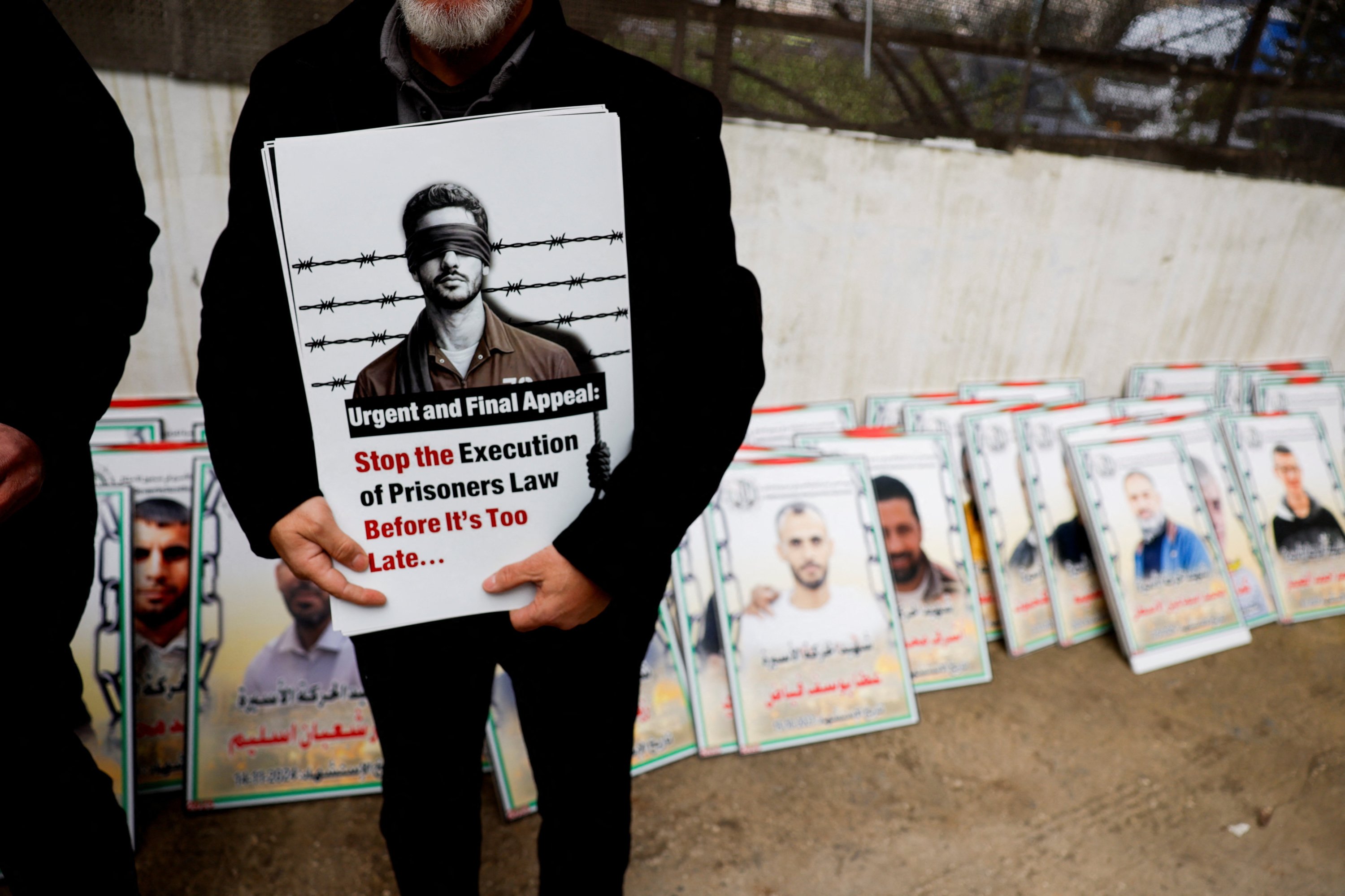
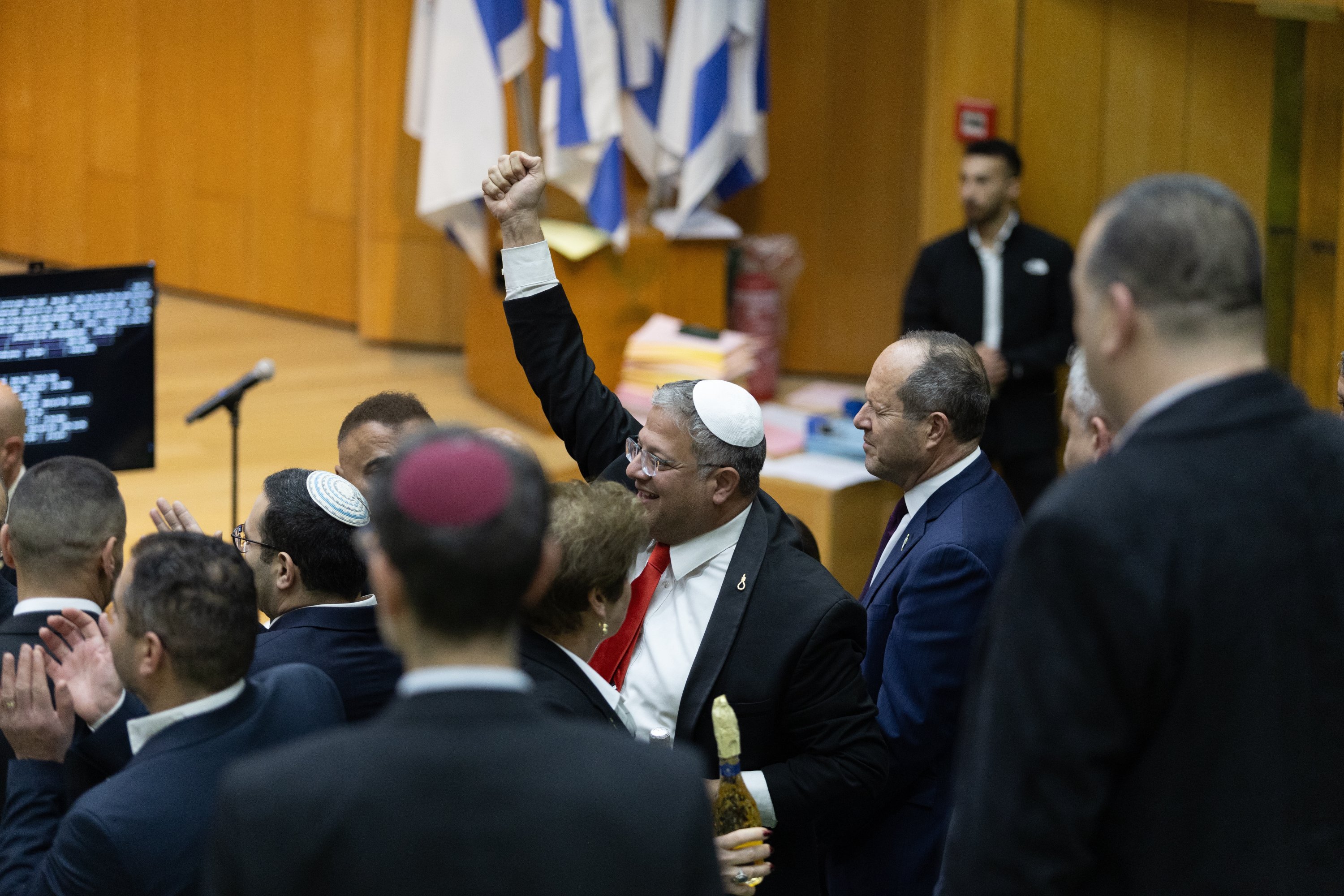
On March 30, 2026, the Israeli Knesset passed the Penal Law (Amendment No. 159), with cheers and applause from the chamber. Proponents, led by National Security Minister Itamar Ben-Gvir and the Otzma Yehudit party, wore golden noose pins during the vote: This was a death penalty statute targeting Palestinians exclusively. In the military courts, which govern Palestinians in the occupied territories, a death sentence became mandatory for any conviction of “intentional killing” categorized as terrorism. The bill cleared its final readings 62-48, and Ben-Gvir brandished a bottle of champagne and toasted with his fellows afterward.
The enactment of the Penal Law marks something more than a policy change; it is a new, cold-blooded strategic tool. It institutionalizes a racially split judicial regime built to target Palestinians under the logic of settler-colonial elimination. In the face of this mandatory penalty, judges lose all discretion; hanging within 90 days is mandatory, and family visitations are prohibited for those on death row.
The Penal Law does not introduce killing into Israeli governance of Palestinian life as a novelty. It is already the essence of the state, visible in tens of thousands dead in Gaza, hundreds killed each year in the West Bank, and dozens who have died under torture. The question is, if killing is already pervasive and accountability functionally nonexistent, what does juridical formalization add? The answer lies in the distinction between factual power and juridical authority, between the capacity to kill and the legally sanctioned right to execute. It converts the extrajudicial into the judicial, the exceptional into the normative, the contingent into the permanent. The Israeli state can now kill Palestinians not only through the "hot" violence of an airstrike but through the "cold" violence of a bureaucratic process.
The 2026 death penalty law provides a new tool to the Israeli state’s settler-colonialist project: the claimed "right to punish" through judicial killing. Here, the state validates death not as a casualty of war but as a moral outcome of law. The law converts extrajudicial killing, which operates in the register of emergency, military necessity and deniability, into judicial execution, which operates in the register of sovereignty, law and legitimate punishment. The distinction matters. Military killing is an act of external geopolitics; judicial execution is an act of internal carceral governance. One belongs to the battlefield, the other to the prison.
Law in colonial contexts does not restrain violence but organizes it. In British Africa, capital punishment served as an "integral aspect of colonial networks of power," a disciplinary tool targeting colonial subjects. But there is a crucial difference between classic colonialism and its settler variant. Classic colonialism seeks to exploit indigenous labor; settler-colonialism seeks to remove indigenous people altogether, to secure permanent control over their land. Amendment No. 159 sits squarely within this second logic, what historian Patrick Wolfe called the "logic of elimination," as an instrument of the ongoing Zionist settler-colonial project.
It demonstrates that the state’s authority over the Palestinian is not just that of an occupying army, but that of a permanent sovereign whose laws have the power to define the very boundary between life and death. Palestinians are pulled into the state’s juridical order only so far as they can be punished by it and excluded from everything else: the rights, the protections, the very category of "human" subject.
As Israeli restrictions in the occupied Palestinian territory already constitute racial segregation and apartheid, the 2026 law deepens this system by constructing a racialized hierarchy of death. Palestinians living in the West Bank are subject to wider criminal liability, military law and military courts, while Israeli settlers living in the same territory are tried under civil law with full due process. This dual-track system means that while the law is nominally applicable to "terrorists," its mandatory reach falls exclusively on Palestinians. The parallel to Apartheid South Africa is hard to miss: different laws, different courts, different punishments sorted by race.
What this new law fills is not a gap in capacity but a gap in legitimation. Extrajudicial killing needs no legal infrastructure and can always be denied. Judicial execution declares that the state holds not merely the factual power to kill but the juridical right to condemn and execute. The structural logic of elimination, previously operating through administrative detention, military orders, siege warfare and extrajudicial killing, has now achieved full juridical expression.
This is the point at which a colonial landscape of death is whitewashed through the law of the land. The legislation doubles as an exercise in geopolitical restructuring: by brazenly violating international law, the Israeli state once again asserts its status as an "exceptional" sovereign that considers itself unbound by any concern. The slaughter of the colonized is not a homicide but is instead framed as a necessary measure for the "order of things." Amendment No. 159 stands ready to prove this with nooses, legalizing killing in cold blood and celebrating the verdict with champagne.