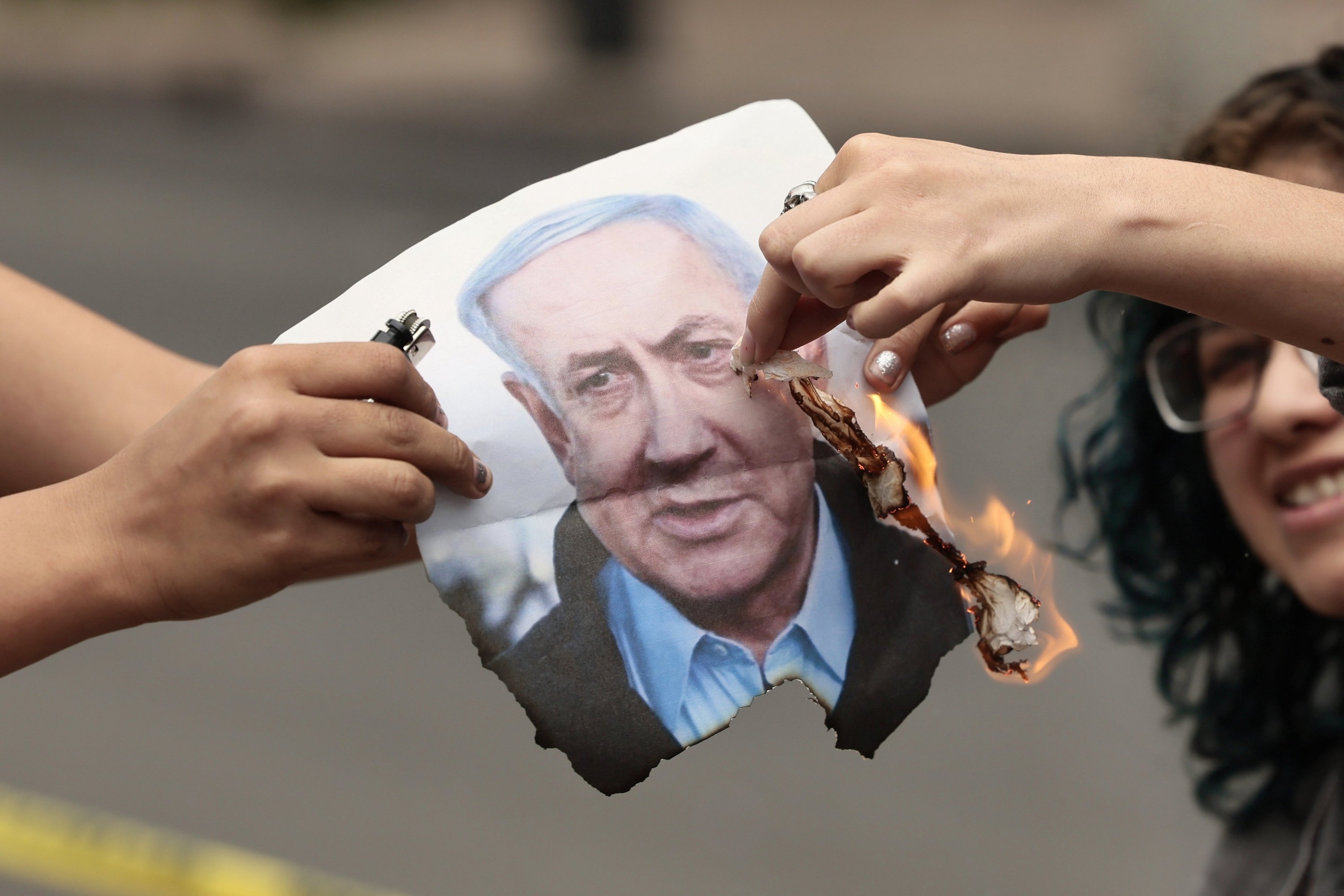
Few politicians have dominated their country’s political landscape as thoroughly as Israeli Prime Minister Benjamin Netanyahu. Over the past three years, he has not only shaped Israel’s policies but also, critics argue, recast its global image in a markedly negative way. Observers see something troubling in him: a leader who fused national survival with personal political survival, and, in doing so, strained Israel’s institutions, international standing and the broader Jewish diaspora.
Netanyahu’s decisions regarding the mass killings in Gaza and military attacks on Iran and Syria may prove historically significant in damaging not only the reputation of Zionism but also the global perception of Jews more broadly. His actions have also undermined Israel’s overall credibility and reputation internationally.
The genocide in Gaza has been consequential. Beyond the immense human toll, the conflict has inflicted economic strain. Israel’s economy remains closely dependent on the United States through trade, investment and military assistance. While that relationship has supported Israel, critics argue that years of political turbulence and prolonged war have complicated Israel’s ability to project economic resilience and long-term independence.
Israel’s attacks on Iran, in particular, exposed potential vulnerabilities in Israeli military technology and power while risking a wider regional conflict. For Israel’s opponents, the episode weakened the long-standing perception of Israeli technological and military invincibility that has underpinned its power doctrine.
On the other hand, the immense destruction of Israel’s cities has caused a huge amount of economic damage. Millions of Israelis either spent weeks living in underground bunkers or fled Israel en masse. The sharp decline in Israel’s stock market index in March also raised concerns about the country’s economic reputation and stability.
Netanyahu has long portrayed himself as Israel’s indispensable protector by nurturing instability in the region. Yet in recent years, his narrative of permanent, existential peril has mostly functioned as a political instrument. By casting multiple regional actors as immediate threats, he reinforced the sense that only he possessed the experience and international stature to safeguard the country.
A central pillar of Netanyahu’s strategy, which is shared by several like-minded Israeli politicians, has been portraying Israel as surrounded by persistent, existential threats. Within that framework, fostering regional fragmentation and instability is sometimes described as serving strategic objectives. This logic has also involved attempts to build leverage with minority or ideological groups in neighboring states as potential bargaining tools within a changing regional order. The outreach to Druze actors in Syria or rhetorical positioning around terrorist organizations such as the PKK in Türkiye can be given as examples.
Since the 1980s, Netanyahu, as a prominent Zionist political figure with deep connections in the U.S., has advocated strongly for a tougher U.S. and Western posture toward governments in the region. Within this interpretation, Israel directly confronted some adversaries itself, such as in conflicts with Lebanon, while larger confrontations were encouraged through U.S. policy.
Critics often cite the case of Iraq in the lead-up to the Iraq War, when claims that Iraq possessed weapons of mass destruction became central to the argument for military intervention. Those claims were repeatedly presented by the administration of former U.S. President George W. Bush, including in forums such as the United Nations. After the invasion, when such weapons were not found, the justification for the war became the subject of significant international criticism and debate.
In recent years, Netanyahu has consistently portrayed Tehran as a looming nuclear danger, not only to Israel but to global security. The argument echoes his earlier warnings about Iraq’s alleged weapons of mass destruction in the early 2000s, a position he strongly advanced at the time. Parallels are striking: in both cases, an urgent security narrative was elevated to the forefront of international diplomacy, only to become deeply contested in retrospect.
He sought to frame the confrontation with Iran in terms that could draw the U.S. into a broader regional conflict. There were moments when escalation appeared plausible, yet Washington initially avoided direct military entanglement. The episode underscored both the volatility of the region and the limits of Israel’s ability to shape U.S. strategic decisions.
Then, U.S. President Donald Trump was somehow “convinced” to attack Iran. That move was against all his earlier portrayals of himself as the president of peace. The U.S. started a war by attacking a country, killing 170 students and staff when it bombed a school. This last one absolutely will sink in history as a massacre of civilians by the U.S. bombers at the level of the U.S. killing hundreds of thousands of Japanese civilians in Nagasaki and Hiroshima.
Netanyahu sought to frame the confrontation with Iran in terms that could draw the U.S. into a broader regional conflict. There were moments when escalation appeared plausible, yet Washington initially avoided direct military entanglement. However, the events that took place during the last month underscored both the volatility of the region and the limits of Israel’s ability to shape U.S. strategic decisions.
Where military confrontation or territorial fragmentation has proven unrealistic, Netanyahu adopted another approach to support or encourage political change from within: seeking to align with popular protest movements in rival states in hopes that new leadership might prove less hostile to Israel. In Iran’s case, however, such expectations have not translated into decisive political transformation, at least not thus far.
Netanyahu’s irresponsible strategies reflect pragmatic deterrence, overreach or a combination of both, which remains a matter of intense debate. What is clear is that efforts to reshape the regional environment, through pressure, persuasion or alliance-building, carry unpredictable consequences in a Middle East already marked by deep volatility.
His close alignment with Trump amplified his leverage in Washington and bolstered his image at home. But personalization of foreign policy carries risks. When relationships hinge heavily on individual leaders rather than enduring institutions, they become vulnerable to electoral change. As U.S. politics grew more polarized, so too did debates over Israel.
That shift is visible in intellectual and policy circles. Prestigious journals such as Foreign Affairs have published critiques of what some describe as an “Israeli exception” in American foreign policy. On university campuses across the U.S., large demonstrations over the Gaza war have become flashpoints, sometimes met with heavy-handed policing. The result has been a widening and increasingly emotional public debate about Israel, Zionism and U.S. support that spills far beyond academia.
In Europe, similar dynamics are unfolding. Mass demonstrations from Berlin to Madrid have protested Israeli military actions in Gaza. Spain’s government has been particularly outspoken. Meanwhile, South Africa’s case against Israel at the International Court of Justice has carried symbolic weight regardless of its ultimate legal outcome. Such developments have reinforced a narrative in parts of the Global South that frames Israel less as a besieged democracy and more as a dominant regional power acting with limited restraint.
Domestic politics have compounded the international debate. Netanyahu remains embroiled in corruption trials, which is an unprecedented situation for a sitting Israeli prime minister. He denies wrongdoing and characterizes the charges as politically motivated. Still, the spectacle of a leader navigating legal battles while prosecuting a major war has fueled concern about democratic norms and institutional independence.
Scrutiny has also extended to his family. Media coverage of his wife, Sara Netanyahu, and criticism of his son’s time abroad during wartime have fed perceptions of a political elite insulated from the burdens borne by ordinary Israelis. In a society built on shared sacrifice, optics matter.
The cumulative effect is complex. Israel’s economy is weak. Its technology is now demonstrated, but it is far from the alleged levels. Its international standing is more contested than at any time in recent decades. For many Jews in the diaspora, particularly in North America and Europe, the reputational fallout has felt personal. As criticism of Israeli government policy intensifies, Jewish communities often find themselves navigating the fraught boundary between legitimate political critique and rhetoric that veers into antisemitism. Disturbingly, attacks against Jewish targets in various countries underscore how geopolitical conflict can reverberate far beyond the battlefield.
After everything he has done, it is obvious that Netanyahu will go down in history as a deeply controversial and embattled political figure, one widely accused of committing grave crimes against humanity and acts that led to the deaths of tens of thousands of people. His legacy will be debated for generations, and history will render its judgment in time.