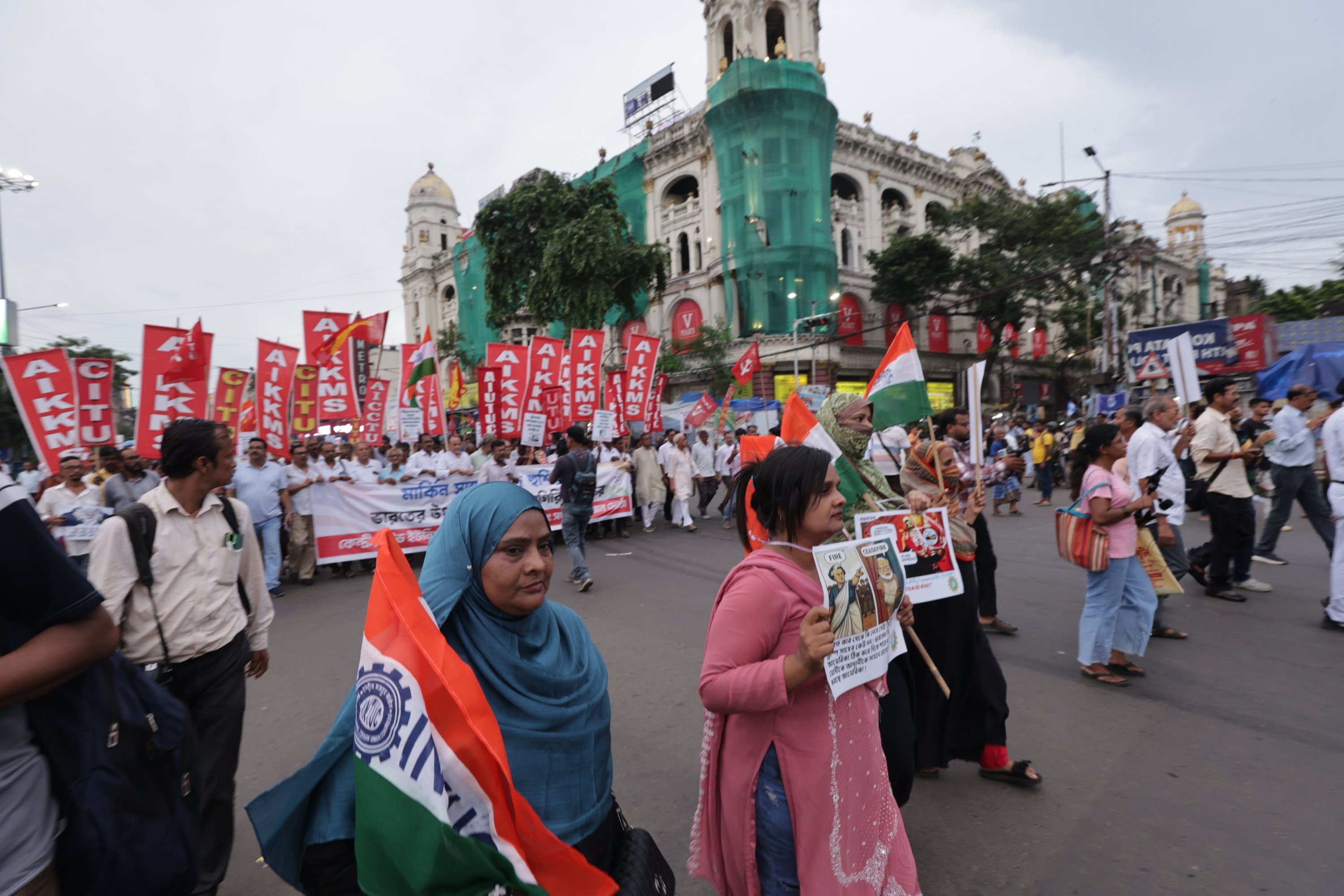
In July 2025, U.S. President Donald Trump announced a 25% tariff on Indian exports, citing India’s continued purchase of Russian oil and arms, high tariffs on U.S. goods and non-tariff trade barriers. Weeks later, New Delhi faced an unexpected development: an additional 25% tariff on Indian imports, making a hefty 50% penalty if India continues its trade with Russia.
The Indian credit rating agency, Care Ratings, anticipated that the direct export loss from these higher tariffs could be around 0.3%-0.4% of India’s gross domestic product (GDP) in the fiscal year 2026, considering India’s domestic-driven economy should provide some cushion. Additionally, the rating agency noted, India’s services exports remain outside the scope of these tariffs and should continue to support the external sector. Hence, reciprocating the acrimony, Indian Prime Minister Narendra Modi reiterated his commitment to India's "Make in India" initiative, aiming to boost local consumption and reduce dependency on imports. Yet the depth of the standoff was evident when U.S.-India trade talks, scheduled for August, were abruptly called off, underscoring how political frictions have derailed the dialogue.
Imagine how a 50% tariff will impact India’s approximately $80 billion in annual exports to the U.S., which account for over 17% of its total export market. Sectors such as pharmaceuticals, textiles and IT services will face sharp cost spikes and a loss of competitiveness against export competitors like Vietnam and China. This move puts real pressure on New Delhi’s trade strategy as financial giants, including Goldman Sachs and Nomura, warn that such tariffs could further slow India’s already weakened GDP growth, potentially cutting 0.3 to 0.6 percentage points off the forecast. While India's growth outlook for 2025 remains unchanged for now, the next few weeks of negotiations with the U.S. remain crucial.
It’s not just the economic realm; for India, the geopolitical context of these trade tensions is equally critical. The U.S. remained notably distant in its response to the heightened military escalation between India and Pakistan in May 2025, following a deadly terrorist attack in Kashmir. Its reluctance to intervene or even express support for India's blaming Pakistan for the terrorist attack created a sense of abandonment in New Delhi, sparking concerns about the U.S.’ reliability as a strategic partner. India’s perceived sense of growing U.S. rapprochement with Pakistan, which includes renewed trade talks and President Trump’s vocal interest in mediating the Kashmir issue, further raised questions about Washington’s South Asia policy.
As India's economic and security interests increasingly intertwine, the country now faces mounting pressure to recalibrate its U.S. vs. China strategy, with Russia acting as a moderating variable in this new equation, influencing the strength or direction of India’s relationship with the other two countries. Reports suggest Modi is expected to attend the Shanghai Cooperation Organisation (SCO) summit in China, signaling India’s policy of diplomatic diversification. Some fear that strengthened economic ties between India, China and Russia, which bypass dollar trade, could become a catalyst for weakening U.S. currency influence.
Although the India-U.S. relationship has strengthened significantly over the past three decades, with growing cooperation in strategically important areas, an inherent tension remains: India’s commitment to nonalignment clashes with the U.S.’ preference for a more aligned strategic partnership. As analysts point out, India does not understand alliances, and the U.S. does not understand nonalignment. This disconnect limits the extent to which the two nations can align on specific issues. However, with intensifying geopolitical polarization, India will inevitably be forced to take sides, which may aggravate the dilemma for New Delhi, given its economic dependence on China and military reliance on Russia.
Based on the above argument, there’s a chance that Trump’s blend of charm and coercion may prove ineffective against India, a nation deeply invested in so-called “strategic autonomy.” Some argue that punitive tariffs risk economic cooperation and could drive India towards greater alignment with Russia and China. India's National Security Advisor, Ajit Doval’s, Moscow visit, which focuses on strengthening India's defense and energy ties, signals this shift. Meanwhile, Beijing has expressed support for India against U.S. “bully” tariffs, as both sides reopened long-stalled border trade routes, such as Lipulekh Pass, Shipki La Pass and Nathu La Pass, signaling a cautious thaw in ties.
What emerges is a picture of India caught in the crosswinds of great power rivalry, trying to shield its economy while preserving its freedom of maneuver. For the U.S., the risk lies in pushing India too far and inadvertently driving it closer to Moscow and Beijing, an outcome that would weaken Washington’s Indo-Pacific strategy. For India, the danger lies in mismanaging this balancing act and overplaying its leverage, which could lead to isolation or economic pain.
Once close to Washington, Modi is now diversifying India's export markets, targeting the EU, the U.K., the UAE and Australia, thereby decreasing its dependence on the U.S. market. India may also choose to retaliate with reciprocal tariffs or even reinstate a digital tax on U.S. tech firms; however, either option could further escalate the situation. Nevertheless, India’s position in global supply chains, particularly in critical sectors such as pharmaceuticals and semiconductors, affords it significant leverage in these negotiations.
A more optimistic approach proposes that, despite tensions, the relationship between the U.S. and India is anchored in shared interests. They argue that while New Delhi cannot afford to give in to Trump’s outlandish demands, it must recognize the value of the India-U.S. relationship. A significant amount has been invested in it, and its potential remains high. From space cooperation to Quad, this partnership has weathered many challenges. Public sentiment in both countries remains relatively positive, suggesting that, despite trade disruptions, the larger strategic and technological collaboration may be enough to prevent a complete breakdown. Hence, a BRICS tilt would be foolhardy.
Nevertheless, the road ahead is likely to be one of uneasy compromises. India’s need for U.S. markets will drive negotiations, but its commitment to self-autonomy will prompt it to put more focus on domestic manufacturing and diversifying trade partnerships. However, the current tariff standoff reflects a unique shift in the dynamics of global diplomacy, where hard power collides with strategic interests. The resolution of this trade dispute will depend on the ability of both nations to balance their economic needs with their geopolitical priorities. The U.S. and India may find common ground, but it is not coming easily, especially with so many actors involved.