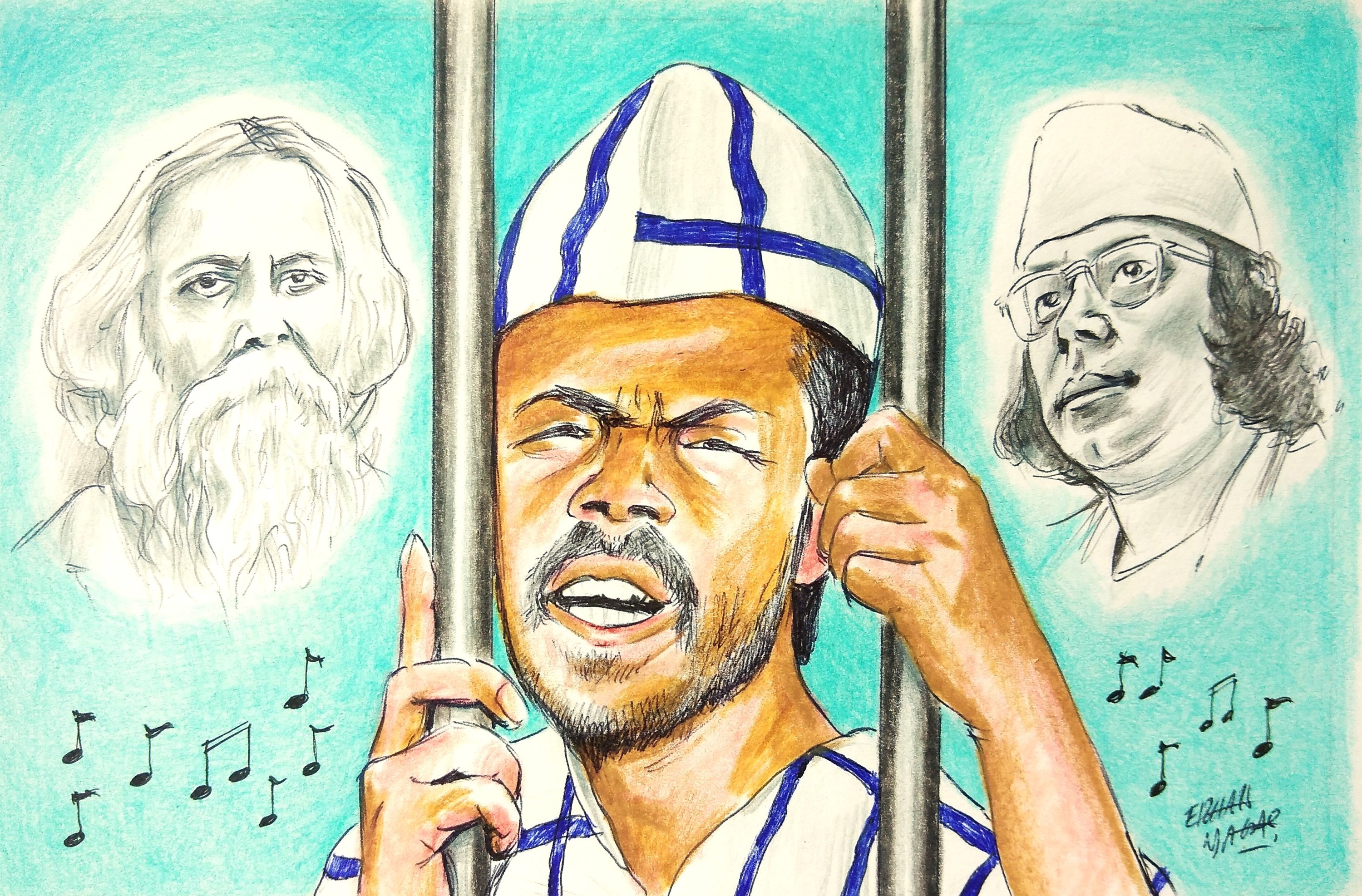
In 2022, Bangladeshi police summoned internet performer Hero Alom after outrage over his renditions of songs by poets Rabindranath Tagore and Kazi Nazrul Islam. Accused of “distorting” cultural heritage, he was reportedly pressured to stop singing them. An amateur online performance soon became a national controversy involving media debate, ridicule and police interrogation.
To an outsider, the episode appeared strangely disproportionate. Why would a singer face state attention merely for singing badly? The answer lies far beyond music.
Born Ashraful Alom, Hero Alom emerged from rural and economically marginal Bangladesh, far from the country’s traditional cultural elite. He became famous through low-budget videos, improvised performances and a public image many urban middle-class audiences considered aesthetically crude. He was mocked for his appearance, accent and mannerisms. Yet his popularity grew because he represented a figure outside elite cultural control.
Rabindranath Tagore, in contrast, occupies the highest place in Bengali cultural life. Born in colonial Bengal, in what is now Kolkata, India, he wrote in Bengali, shaped modern Bengali literature and composed “Amar Sonar Bangla,” which later became Bangladesh’s national anthem. His authority in Bangladesh cannot be explained through present-day national borders alone. For many cultural elites, Tagore is not simply a poet. He is a symbol of refinement, moral imagination and civilizational inheritance. Through him, one learns who counts as properly Bengali.
This is why the Alom controversy became sociologically significant.
When Alom sang Tagore, the reaction changed in tone. He was no longer treated merely as a comic internet figure. The response carried moral anger. Cultural voices described his performances as insults to Bengali heritage. Many justified punitive action in the name of protecting culture itself.
But Alom’s problem was never merely vocal imperfection. Countless poor performances circulate online every day without producing national outrage. His transgression was symbolic. He entered a protected cultural space without possessing the aesthetic legitimacy historically associated with Rabindra Sangeet. He did not embody the refined “bhadralok” (gentleman in English) image tied to elite Bengali culture. His body, speech, class background and performative style appeared culturally unauthorized. So, the anxiety was not simply that Tagore had been sung badly. It was that Tagore had been sung by the wrong body.
This distinction matters because Bengali secular culture often presents itself as liberal, inclusive and opposed to religious orthodoxy. Yet over time, it has developed its own forms of sanctity, emotional policing and symbolic protection around particular cultural figures and practices. Tagore occupies such a position. To say this is not to deny his literary genius or historical importance. The issue is sociological rather than literary. Modern secular societies often relocate sacredness rather than abolish it. What religion once organized through scripture, ritual and symbolic authority, nationalism and culture increasingly reproduces through literature, heritage and collective memory.
In Bengal, Tagore has gradually become part of this secular sacrality. His songs today function as more than music. They accompany mourning ceremonies, national commemorations and Bengali New Year celebrations.
Tagore himself was not an atheist figure detached from religion. He came from the Brahmo spiritual tradition. Yet many secular Bengali cultural elites present his songs as neutral culture. The issue is not that they sing devotional Tagore songs, but that they deny the sacred atmosphere their own performances create, while defending the Tagorian canon with an intensity usually associated with religious texts.
Secularism here does not eliminate the sacred. It redistributes it.
This helps explain why perceived distortions of Tagore provoke reactions far stronger than ordinary artistic disagreement. In practice, Tagore appears less as an artist open to reinterpretation and more as a protected cultural authority whose representation must remain within regulated boundaries. What is publicly defended is not only artistic quality but a symbolic order tied to Bengali secular identity.
Yet the selective nature of this outrage is equally significant. Bengali popular media has often commercialized, repurposed or casually recontextualized Tagore songs without provoking comparable moral panic. In a recently circulated scene from the film Bonolota Express, “O Amar Desher Mati,” a Rabindra Sangeet associated with reverence and patriotism, is inserted into a comic bodily context for entertainment. It has not generated outrage comparable to the reaction against Hero Alom. His case became exceptional not because reinterpretation itself was unprecedented, but because it came from a socially unauthorized figure outside elite respectability.
This is why the distinction between “Bengali” and “Bangladeshi” matters. Bengali refers to a wider linguistic and cultural identity spread across Bangladesh and India’s West Bengal, while Bangladeshi refers to the civic and territorial identity of citizens of Bangladesh. Yet many secular-cultural elites in Bangladesh remain more comfortable with a Tagorian and Kolkata-centered idea of Bengali culture than with a more plural Bangladeshi identity shaped by Muslim-majority everyday life, regional dialects and non-Bengali ethnic communities.
The irony becomes difficult to ignore. Bengali secular discourse often defines itself against religious conservatism and theological absolutism. Yet around Tagore, it has produced its own emotional orthodoxies and protected symbolic boundaries. This does not mean Tagore is literally worshipped as a deity. Rather, he occupies a quasi-sacred position within the emotional architecture of Bengali cultural nationalism.
This same cultural order also explains why certain forms of Islam are accepted only when aestheticized as folklore, while mosque-centered, madrassa-linked or visibly orthodox Islam remains culturally uncomfortable.
This distinction is not accidental. Much of modern Bengali cultural nationalism historically emerged through upper-caste Hindu literary and aesthetic frameworks during colonial modernity. Over time, these particular traditions became universalized as neutral Bengali culture itself. Once detached from explicit religious labeling and absorbed into secular heritage, their dominance became naturalized and less visible.
Alom disrupted this order because he democratized access to a cultural sphere historically guarded by elite custodians. He represented the unsettling possibility that Tagore might no longer remain the exclusive property of cultural priests.
The controversy was never simply about music. It was about ownership of culture, authority over national identity and the invisible boundaries regulating who belongs within respectable Bengali civilization. Beneath the language of artistic refinement lay a deeper fear: that a sacred cultural order had become accessible to unauthorized voices.
Modern secular societies often imagine themselves free from orthodoxy. Yet they too produce sacred symbols, ritual performances and protected authorities that cannot easily be violated. Bengal is no exception. Its secular-cultural sphere has gradually developed its own canon, emotional theology and forms of symbolic policing.
Hero Alom merely exposed this reality by singing a song he was never socially expected to sing.