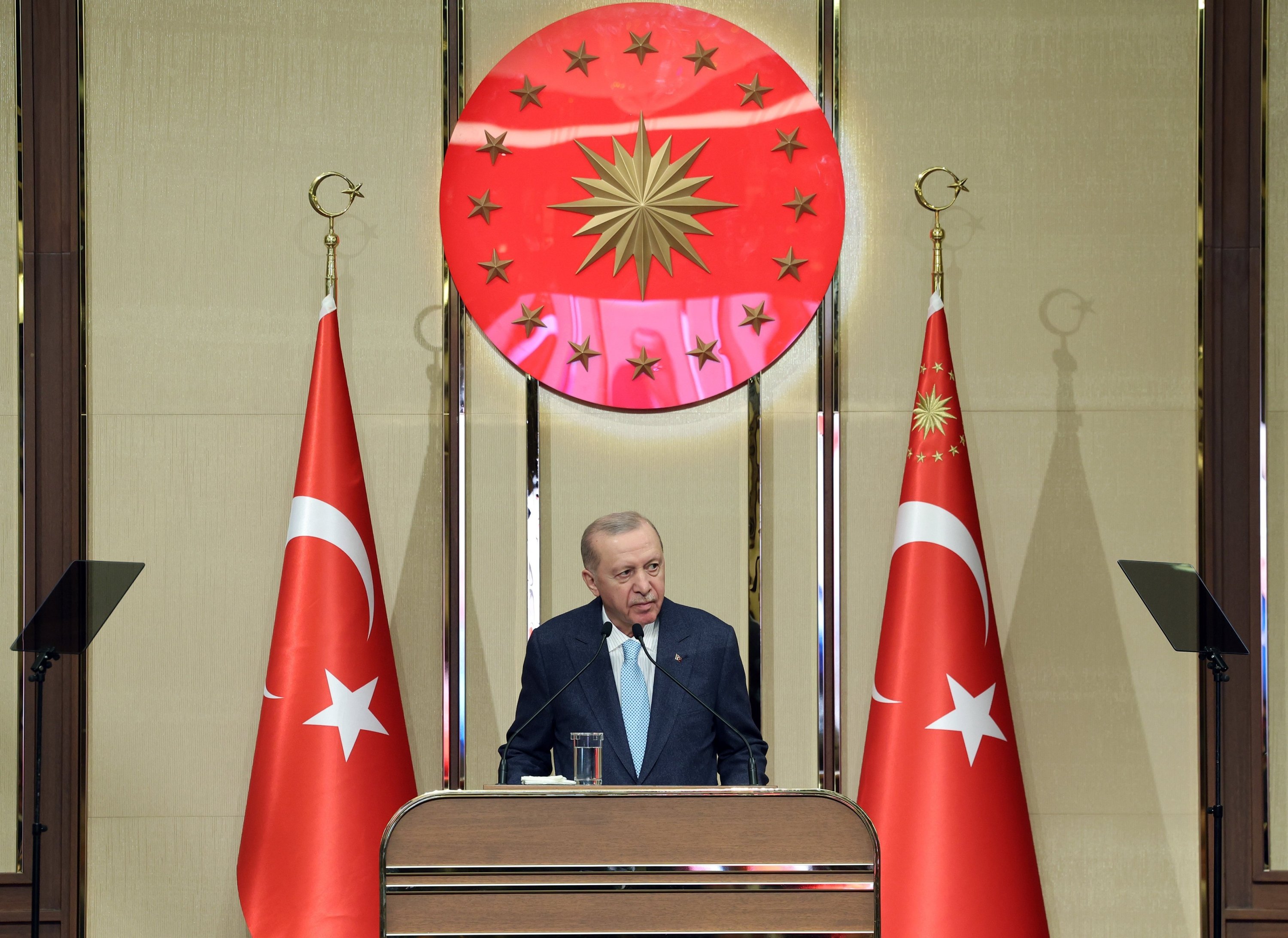
Recent statements by President Recep Tayyip Erdoğan and the diplomatic efforts of Foreign Minister Hakan Fidan collectively reveal a unified Turkish response to the quickly worsening regional situation. Erdoğan clearly presented his vision with a very strong message: “We will keep our country out of the fire pit." Fidan elaborated on the regional risk: “Unfortunately, this war, which the United States and Israel have launched unlawfully and in violation of international law, is increasingly facing the risk of spreading throughout the region.”
Essentially, Türkiye’s concerns are manyfold, and Ankara is pursuing a coordinated strategy built on three interconnected pillars: maintaining domestic stability, avoiding direct military involvement in the growing regional conflict, and using diplomacy to protect both geopolitical flexibility and economic resilience.
At the domestic level, Erdoğan’s messaging strongly emphasizes the continuity of the “Terror-Free Türkiye” process and the government's determination to respond firmly to provocations, avoiding the use of either Iran or the U.S. and Israel as instruments. This framing goes beyond law-and-order rhetoric, situating internal security within a broader narrative of national unity and resilience amid regional instability. The government signals that domestic fragmentation, social unrest or renewed violence would pose not only security threats but also strategic vulnerabilities, especially as Türkiye’s nearby region becomes more unstable and militarized. Therefore, internal stabilization is seen as a necessary foundation for effective foreign policy.
Regarding Türkiye's strategy, both Erdoğan’s statements and Fidan’s diplomatic efforts show a deliberate policy of maintaining a cautious distance from direct conflict. Erdoğan’s resolve to keep Türkiye “outside the ring of fire” is complemented by Fidan’s active outreach to regional, European and trans-Atlantic players. Ankara is not adopting passivity or neutrality in a narrow sense; instead, it seeks to be actively non-belligerent. In other words, Türkiye intends to remain politically influential and diplomatically central without becoming directly involved in the conflict. This clearly demonstrates Turkish strategic autonomy, but under more perilous and compressed regional conditions than in previous crises.
In this sense, Turkish diplomacy appears to focus on managing crises, reducing tensions and maintaining communication channels among increasingly divided actors. Contacts with Gulf partners, European nations and broader trans-Atlantic organizations show that Ankara is trying to be involved in every relevant diplomatic effort simultaneously, and the Islamabad meeting was within that frame.
This multi-faceted approach reflects a middle-power strategy. Türkiye aims to maximize its influence by helping multiple sides at once. This usefulness is not only due to its geographic location or military strength but also to its ability to keep dialogue open with parties who do not trust each other.
A key aspect of the overall picture is the merging of foreign policy and economic security. Ankara views the regional war not only as a military and diplomatic challenge but also as a direct economic threat, primarily through oil price fluctuations, inflationary pressures and uncertainties in energy supply. Erdoğan’s mention of potential fiscal tools, such as fuel price adjustment mechanisms, indicates that the government is preparing to shield the domestic economy from geopolitical spillovers, as other developing countries are. Meanwhile, the diplomatic agenda reportedly includes energy resilience and broader economic coordination, showing that Türkiye is working to manage external shocks before they fully affect the internal economy. This highlights a growing understanding that, in today’s environment, diplomacy can no longer be separated from inflation control, supply security or social stability.
The broader systemic perspective is equally significant. Erdoğan’s references to multipolarity, technological competition, supply chains, energy corridors and geopolitical influence place the current crisis within a larger transformation of the international order. His diplomatic actions seem to mirror this worldview in practice. Ankara views the present moment not as an isolated regional flare-up but as part of a long-term restructuring of global power dynamics. In this restructuring, Türkiye aims to position itself as a resilient, self-sufficient and vital regional player. The focus on defense-industrial autonomy, energy security and adaptable diplomacy all support this broader strategic narrative.
At the same time, this strategy faces clear limitations. The policy of balancing among adversarial groups becomes more difficult as wars escalate and parties demand clearer alignment. Türkiye’s mediation ability depends on whether relevant parties still see Ankara as credible, helpful and sufficiently neutral. Likewise, attempts to stay out of the conflict may be challenged by indirect spillovers, such as refugee movements, proxy escalation, market disruptions and domestic political polarization. Israel’s malign attempts to disrupt the Türkiye-centric initiative should also be emphasized. As the regional conflict deepens, the space for calibrated ambiguity may become even more limited.
Türkiye is entering a period of increased strategic hedging. It is boosting internal stability, investing in political and economic resilience, and expanding diplomatic ties across competing blocs. Therefore, Ankara expects the regional crisis to be long-term rather than short-term, developing into a prolonged state of geopolitical volatility.
The success of this strategy will depend on three factors: first, whether domestic stability can be maintained without creating new internal tensions; second, whether Türkiye can continue to act as a credible interlocutor among rival groups; and third, whether economic tools are enough to cushion the domestic impacts of prolonged energy and market instability. If these three aspects stay manageable, Türkiye could strengthen its position as a key middle power. If not, the same approach might face significant challenges.