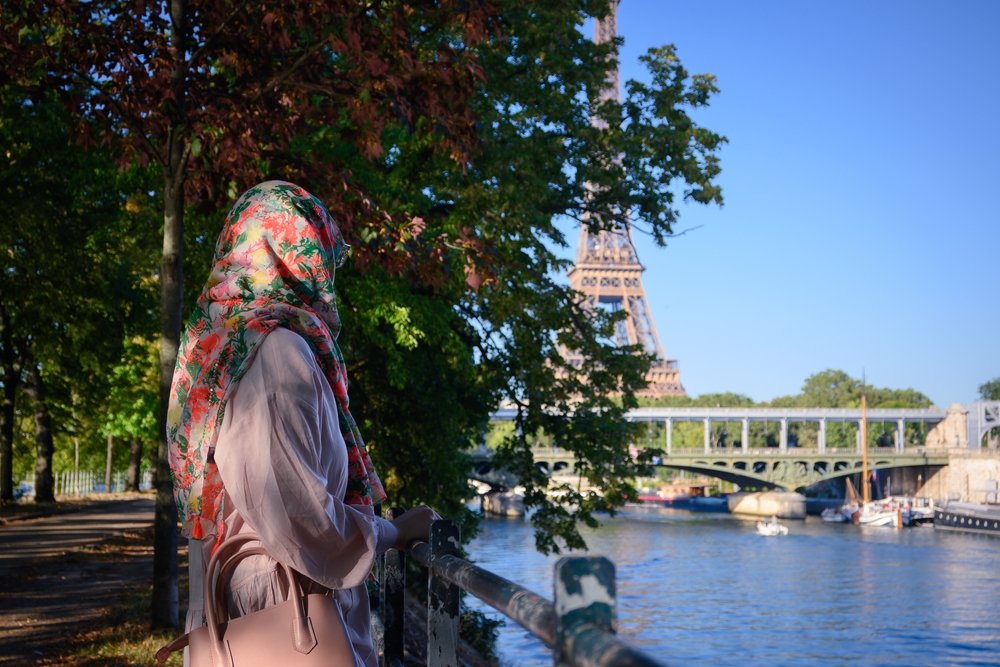
France likes to present itself as the guardian of universal values. "Liberté, Égalité, Fraternité" is not simply a national slogan but the foundation of the French republican imagination. Yet, the country's debate over the Islamic headscarf raises an uncomfortable question: How universal are these values when the citizen exercising them happens to be a Muslim woman?
The question has returned with force as France approaches the 2027 presidential election. Marine Le Pen's far-right Rassemblement National (RN) has revived its longstanding proposal to prohibit the hijab in public spaces. The party has discussed financial penalties for women wearing the headscarf, while Le Pen has proposed putting the broader policy to a referendum. The proposal has even exposed tensions within the RN, with party head Jordan Bardella expressing reservations about the feasibility and scope of a general ban.
This is not merely another French culture-war controversy. It goes to the heart of what France means by liberty.
There is, of course, nothing inherently illegitimate about France defending secularism. The separation of religion and the state is a central principle of the French Republic. French secularism has deep historical roots, and the state has every right to remain neutral toward religious belief. But neutrality of the state is not the same thing as neutrality of the citizen. That distinction is increasingly blurred in France.
A secular state should not favour Islam over Christianity, Judaism or any other religion. Nor should it prevent citizens from practising their faith, provided that their conduct does not violate public order or the rights of others. The problem begins when secularism becomes a demand that citizens themselves suppress visible expressions of religious identity. A public institution is not the same thing as a public space. A civil servant acting on behalf of the state is not the same thing as an ordinary citizen walking down a street. Yet, the French debate increasingly treats these categories as interchangeable.
The RN's latest proposal illustrates the problem particularly clearly. The party claims that the headscarf is not simply a religious symbol but a manifestation of "Islamist ideology." Some RN figures have explicitly argued that the hijab represents a rupture with the republican state. Others have suggested that it should be treated differently from the Jewish kippah.
This creates an obvious question: Who gets to decide whether a woman's headscarf is an act of religious devotion, cultural identity, personal preference or political ideology? And why should the state make that determination?
Perhaps the greatest contradiction in the French debate concerns women's freedom.
Supporters of a hijab ban frequently present the measure as a defense of women. The argument is that the veil represents patriarchal oppression and that restricting it will liberate Muslim women. But there is a fundamental problem with this reasoning. If a woman is forced to wear the hijab, her freedom has been violated. But if the state forces her to remove it, her freedom has also been restricted. In both cases, somebody else is deciding what a woman should do with her own body.
A genuinely liberal position should therefore focus on coercion, not clothing. If a woman is forced to wear the hijab, punish the coercion. If she freely chooses to wear it, why should the state punish the choice? This is particularly important because the French Republic claims to treat citizens as individuals rather than members of religious communities. Yet by defining the hijab as inherently "extreme," the state risks doing precisely the opposite: reducing an individual woman to a political symbol. The result is a remarkable paradox. France claims to liberate women by telling some women what they cannot wear.
The intensity of France's hijab debate is also striking when compared with many of its European neighbours. France has already legislated extensively on religious clothing, including the 2004 prohibition of conspicuous religious symbols in public schools and the 2010 prohibition of face-covering garments in public spaces. The latest proposal would go much further by targeting the ordinary hijab itself across public spaces.
That expansion should concern anyone who takes liberalism seriously.
There is a difference between preventing the concealment of one's identity in specific circumstances and prohibiting a visible religious identity altogether. The controversy surrounding the Council of Europe's 2021 campaign promoting women's freedom to wear the hijab was revealing in this respect. The campaign provoked an intense backlash in France and was eventually withdrawn. The episode demonstrated just how politically charged the idea of a Muslim woman's voluntary choice to wear the hijab has become. France appears increasingly comfortable with the proposition that a woman must be liberated from a religious symbol even when she insists that wearing it is her own choice.
There is also little doubt that the current debate is electoral. The RN has made immigration, Islam and national identity central components of its political strategy. The hijab is an extraordinarily effective political symbol because it allows several anxieties to be compressed into a single piece of clothing.
The numbers explain why the party keeps returning to it. According to a January 2026 Verian poll cited by Le Monde, 66% of respondents supported banning the headscarf in public spaces, while support rose to 94% among RN sympathizers. But popularity does not automatically make a policy liberal, constitutional or wise.
Indeed, the fact that the RN is considering a referendum illustrates the legal difficulties surrounding the proposal. French constitutional and European human-rights principles place limits on the ability of governments to restrict religious freedom.
France does not need to abandon secularism. It does not need to tolerate coercion, extremism or discrimination. It has every right to confront religious violence and organizations that threaten the Republic. But it should not confuse terrorism with Islam, or religious expression with political extremism. Most importantly, it should not turn Muslim women's bodies into a permanent battlefield for France's unresolved anxieties about Islam and national identity.
The true test of a liberal republic is not whether it protects people who conform to the majority's expectations. It is whether it protects the freedom of those whose lawful choices make the majority uncomfortable.
That is what liberté means. That is what égalité requires. And that is what fraternité should look like.
Otherwise, France may continue to display its famous republican motto everywhere, while quietly adding an invisible qualification: Liberty, equality and fraternity, but not if you are wearing a hijab.