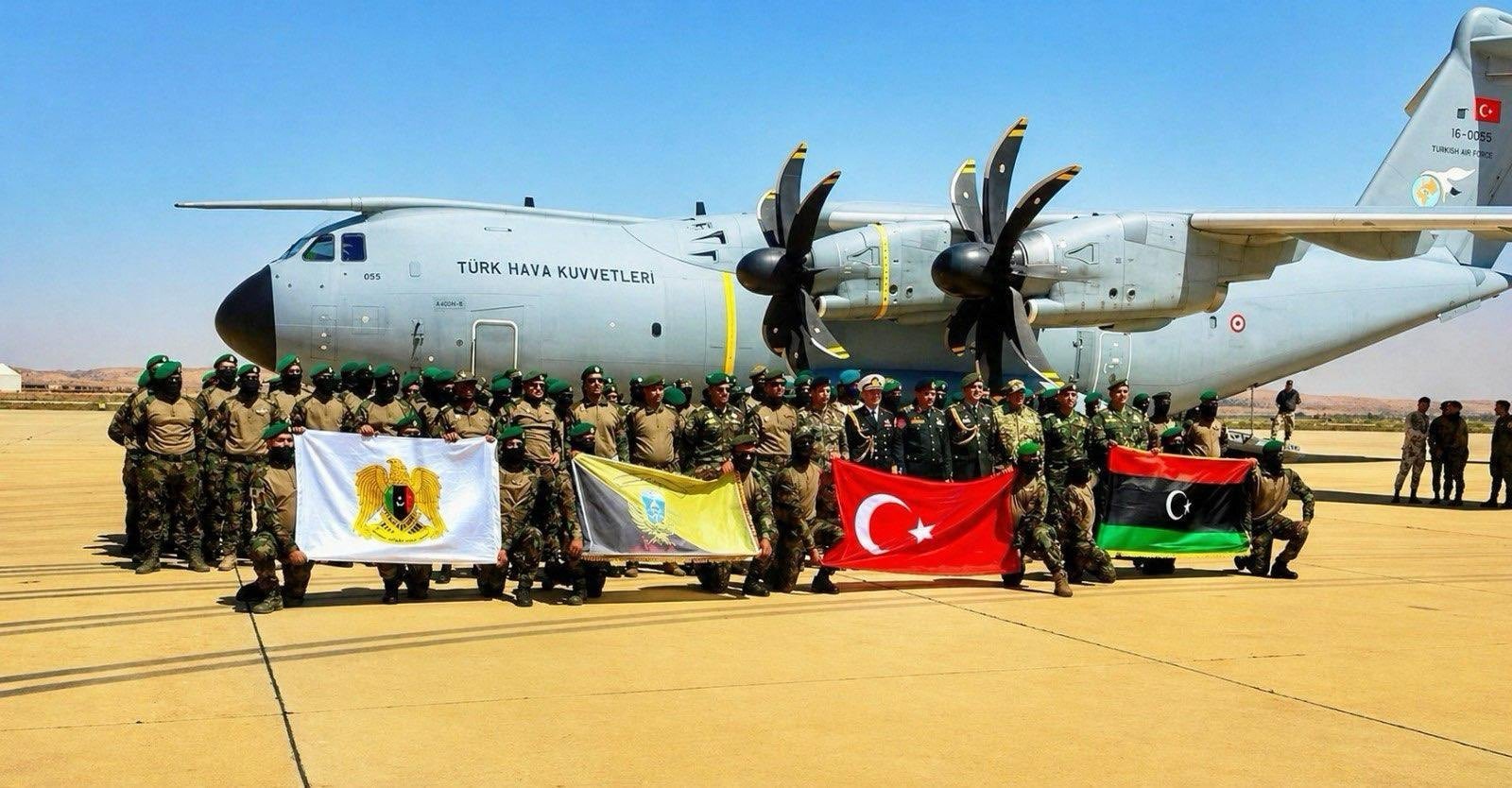
On May 6, Istanbul hosted Libya’s Deputy Defense Minister Abdulsalam Al-Zoubi as part of SAHA Expo 2026, one of the region’s largest defense exhibitions. His presence in Istanbul was not a courtesy visit. It came just days after eastern and western Libyan military personnel completed a joint phase of EFES-2026 on Turkish soil, the second time rival Libyan factions had trained together under Ankara’s coordination in a short span of time. Taken together, these are not isolated moments.
What makes the timing critical is the backdrop. Only days before al-Zoubi’s appearance in Istanbul, Greek Foreign Minister George Gerapetritis was in Tripoli, meeting Government of National Unity (GNU) officials and pushing for the activation of a joint technical committee on maritime delimitation. Athens called it a step toward “new agreements.” The core of the message, though, was less about new beginnings and more about undoing something old, specifically, the 2019 Türkiye-Libya maritime memorandum that Greece has spent years calling legally invalid.
The two capitals have indeed two very different approaches. This competition is no longer mainly about weapons, oil contracts or military bases. It is about legal architecture, diplomatic presence and who gets to influence the terms of Libya’s slow and uncertain reintegration into the regional order.
Athens has been methodical, as Gerapetritis’ visit to Tripoli consisted of several steps. The visit came with a package of joint technical committee for maritime delimitation, coast guard training and a broader signal that Athens wants to rebuild institutional ties with the GNU.
The proposal promises training for coast guard and military officers focused on migration control and search-and-rescue operations, support for the repair of ships and patrol vessels and closer cooperation with European institutions on border management. The offer tells you a great deal about who it is really designed to serve.
In other words, Athens is saying that if Libyan actors align more closely with Greece on maritime issues, they will also be better positioned within the networks that shape the EU’s migration policy and funding. Yet these offers are tightly framed by what Europe wants Libya to stop, not by what Libya itself is trying to build.
Athens did not stop there. Shortly before, Greece sent an official letter to the United Nations reiterating its position that the 2019 agreement is geographically inconsistent due to the location of Greek islands between the two countries and that this situation makes a common maritime border legally impossible.
Still, a legal record is one thing. Field presence is another. While Greece was proposing its commission in Tripoli, Libyan military personnel from both Benghazi and Tripoli were already in Izmir and Istanbul, transported on Turkish Air Force aircraft, for a joint exercise that, by its very nature, required both sides to accept Ankara as a trusted coordinator. This relationship is not the result of a newly established technical committee. It is the result of years of accumulated experience that has been tested under pressure.
The limitations of a strategy based on paperwork are, of course, not merely hypothetical. Internal divisions in Libya have not yet healed, and any external actor that relies primarily on legal arguments and official proposals will find that these tools quickly lose their effectiveness when the political landscape shifts. Even if Greece puts forward a legally sophisticated argument, this approach on paper rarely translates into leverage on the ground.
For years, Türkiye’s Libya policy was practically synonymous with Tripoli. The relationship with the GNU was deep, institutionalized and politically loaded, built during a civil conflict in which Ankara made consequential choices. That depth was real, but a relationship anchored entirely to one side of a divided country has obvious ceilings.
What has changed recently is the widening of Ankara’s contacts. Turkish naval vessels docked in Benghazi. Defense Minister Güler held direct talks with Haftar‘s deputy commander, Saddam Haftar, in Ankara. And now EFES-2026 has brought soldiers from both sides of Libya’s fault line to the same drill for the second time.
In this year’s exercise, 331 personnel from eastern Libya and 177 from the west participated in the joint exercise EFES-2026, which included assets of the Libyan Navy, such as the fast attack craft Şafak.
The logic is to put soldiers from opposing camps through the same drills, let them share a mess hall and a planning room and they go home with something no commission proposal can manufacture.
Coordinating rival military factions under a joint exercise requires trust from both parties, logistical investment and a willingness to absorb the political risk if it goes wrong. Managing to do it twice, in a short period, says something about where Ankara actually stands in Libya’s security landscape. It is not simply the preferred partner of one camp. It is trying and apparently succeeding at being relevant to the whole country.
That is what real leverage looks like, and it is a position Greece has no credible path to replicating soon. For Libyan commanders trying to stitch together a broken security sector, this is less a theory and more a lived experience with units traveling, training and eating together under a partner that speaks to both camps.
The asymmetry between the two approaches should be highlighted. Greece’s Libya strategy is essentially defensive in origin. It was built to challenge the 2019 memorandum, limit Türkiye’s maritime footprint in the central Mediterranean and manage migration flows across the central route. The strategy is largely about what Greece does not want to happen, rather than what it wants to build.
Türkiye’s interest in Libya runs in a different direction. Remaining embedded in Libya’s security sector, maintaining operational access to the central Mediterranean and supporting a political process that does not exclude Ankara, which requires a long-term presence, not a one-time diplomatic push. Equipment supply, field training, joint exercises, high-level military dialogue and now engagement with both political blocs is a model that compounds over time.
On the civilian side, Ankara is pairing security cooperation with bricks, roads and hospitals. Turkish contractors have already signed development deals in four eastern cities, Benghazi, Al-Bayda, al-Shahid and Tobruk, covering roads, utilities and public hospitals. With a cumulative project portfolio in Libya exceeding $30 billion, the focus is now shifting toward airports, energy facilities and modular infrastructure. Training programs, meanwhile, are structured to keep command and doctrine in Libyan hands while Turkish teams focus on qualification, joint planning and maintenance support. This is a model that a Libyan official described as one in which Ankara seeks to be inside their security architecture, but not above it.
Competition over Libya has intensified in recent weeks. Athens has been more active than at any point since the 2019 memorandum was signed. The U.N. letter, the Tripoli visit, and the commission proposal reflect Greece’s efforts.
Yet the memorandum remains in effect. Tripoli has shown no genuine interest in distancing itself from it, despite consistent Greek pressure. Libya’s GNU has its own reasons for keeping that relationship stable and a newly formed technical committee does not outweigh them. For a country trying to become whole again, the partner who trains, rebuilds and stays will almost always speak louder than the one who only files objections.