When the wave of Arab uprisings that swept through Tunisia, Egypt and Syria finally reached Libya, Muammar Gaddafi's four-decade rule ended. The 2011 NATO-backed intervention delivered on that promise, toppling the regime, but it left nothing resembling a functioning state in its place. What followed was a vacuum that has defined Libya ever since. For 15 years, the country has been split between the U.N.-recognised Government of National Unity (GNU) in Tripoli, led by Abdul Hamid Dbeibah, and the Haftar family's Libyan National Army (LNA) in the east.
When Türkiye became militarily involved in the Libya crisis, Khalifa Haftar's assault on Tripoli halted, and the involvement has underpinned a fragile military equilibrium ever since. This year, however, the picture changed notably. In April, the conflicting parties jointly signed Libya's first unified budget in 13 years. Then, on June 18, a trilateral power-sharing agreement emerged, brokered not through the U.N. process but directly by Washington. Those developments raise three interlocking questions: what is driving the transformation in U.S. policy toward Libya, how much of it owes to the fallout from the war with Iran, and where does Türkiye actually stand in this evolving picture?
Oil sits at the center of the U.S.'s Libya policy, though it does not fully explain it. The plan pursued under Massad Boulos, senior adviser on Arab and Middle Eastern Affairs and concurrently as senior adviser for Africa, aims to bring the country's rival factions under a single governing umbrella, for a straightforward reason: the internationally recognized government sits in Tripoli, while the oil fields and export terminals that matter most remain under Haftar's control. Without an agreement between the two sides, neither large-scale investment nor durable stability is realistically achievable.
What is being constructed, then, is less a democratization project in the tradition Washington usually invokes, and more a power-sharing formula between the Dbeibah and Haftar households. Publicly, the initiative is framed as inclusive; in practice, the priority has been persuading the two families to formally share executive authority. That helps explain why, even as an election timetable is floated for February 2027, the substance of the deal rests on something narrower: a new Presidential Council under Saddam Haftar paired with a Dbeibah-led government, with military command divided along family and geographic lines rather than folded into unified institutions.
Washington has pursued this objective along three tracks simultaneously. Diplomatically, a process that began with a secret meeting in Rome last September has culminated in the June agreement. Economically, American and European energy majors have signed multibillion-dollar exploration and development deals, most notably the $20 billion, 25-year Waha agreement with TotalEnergies and ConocoPhillips. Militarily, the Flintlock 2026 exercises in Sirte brought eastern and western forces under joint command for the first time, largely as a symbolic gesture.
Yet political momentum alone has not made Libya investable. The National Oil Corporation has gone without an approved budget, the dinar has been repeatedly devalued, fuel smuggling has siphoned off billions of dollars in a single year, and infrastructure continues to decay. Washington's intent is unambiguous, but the ground it is building on remains unstable, which is precisely why the deal risks freezing at the level of an elite bargain rather than maturing into genuine institutional reform. Libyan critics have been blunt about this: the initiative, they argue, has been built around personalities rather than institutions, and neither women's groups nor civil society were represented at the table in Rome.
The timing of Washington's renewed interest in Libya cannot be separated from the war with Iran. The conflict between the U.S., Israel and Iran triggered a serious crisis around the Strait of Hormuz, a chokepoint through which a fifth of the world's oil supply passes. Prices climbed above $115 a barrel, and Washington was compelled to release roughly 172 million barrels from the Strategic Petroleum Reserve as part of a coordinated drawdown with International Energy Agency members, pushing reserves to their lowest level since the early 1980s.
Against that backdrop, Libya has become attractive precisely because it offers an alternative that does not depend on Hormuz: proximity to Europe, and a light, sweet crude that suits European refineries particularly well. The country's constraint, as analysts have repeatedly noted, is governance rather than geology. With political stability, production could rise well above 2 million barrels per day, offering a buffer against further disruption in the Gulf. The Iran war, in this sense, functions as an accelerant and a public justification for an interest that predates the conflict, though its limits should not be overstated. Libyan output cannot decisively reshape global supply on its own; its real effect operates through market expectations and confidence rather than raw volume.
Türkiye's stake in Libya rests on a fundamentally different logic than Washington's. For Ankara, the priority has never been oil, but rather Libya's stability, the preservation of its territorial integrity, and the fulfillment of popular demands, chief among them free elections and legitimate representation. That distinction becomes clearer when set against the last decade's trajectory on the Libya file.
In 2019, as Haftar besieged Tripoli and threatened to overrun the internationally recognized government, Türkiye signed a military cooperation agreement and a maritime boundary memorandum with the GNU (Government of National Unity), then got involved to halt his advance in 2020. That involvement did more than save Tripoli; it also unsettled the geopolitical order that Greece, France and others had been assembling in the Eastern Mediterranean, since the Turkish-Libyan maritime agreement effectively nullified its legal and practical basis.
Around the same period, Türkiye backed the Syrian people's revolutionary demands and, through cross-border operations, dismantled the PKK's attempt to entrench a proto-state structure in northern Syria, which culminated in the fall of the Assad regime. Ankara also impacted the regional balance in the Caucasus through its support for Azerbaijan, and played an active role in breaking the blockade imposed on Qatar.
Taken together, these moves transformed the Libya file from a theater where Türkiye was operating against unfavorable odds into one where it became the decisive actor on the ground.
The implication for Washington is straightforward: no durable settlement in Libya is achievable without accounting for the military and political balance Türkiye has actually built. That recognition appears to underpin the shift crystallizing in the Boulos process, which is not an attempt to sideline Ankara, but an effort to work alongside it.
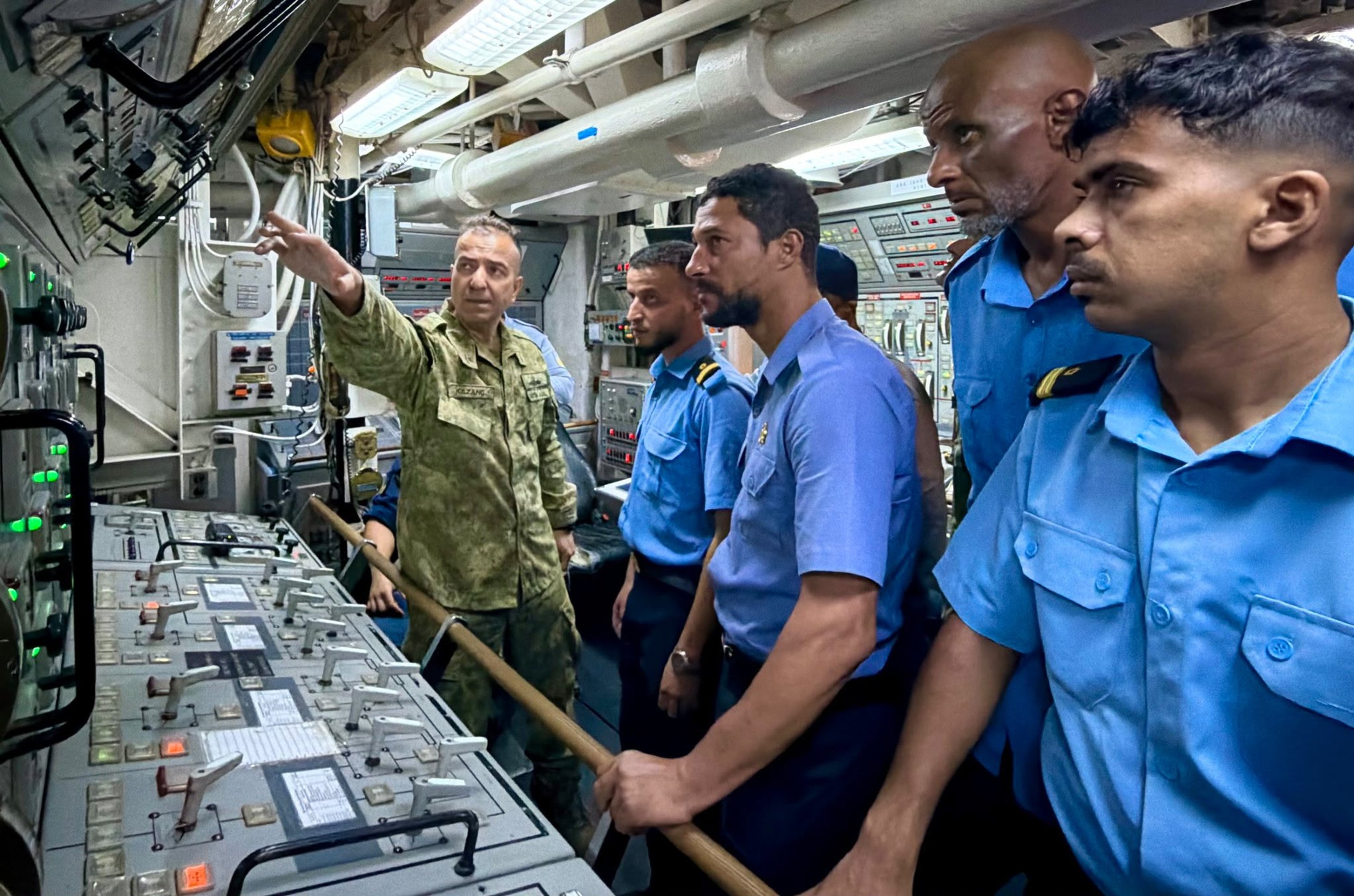
The recent meeting between Turkish intelligence chief Ibrahim Kalin and Lt. Gen. Saddam Haftar in Benghazi, Foreign Minister Hakan Fidan's participation in a Cairo meeting alongside Boulos, the Turkish navy's visit to Benghazi, and the first joint exercises bringing together forces from both halves of Libya, all point to the same conclusion: these are not signs of rivalry, but of two actors increasingly working from the same script.
What deserves particular emphasis is that Washington and Ankara are not running competing projects in Libya. Rather, the U.S. appears to have concluded, after more than a decade of policies aimed at containing Turkish influence in the region, that the strategy has not delivered the results it once promised, and that the Libya file simply cannot be managed without Ankara. That recognition suggests the rapprochement that began over Syria is finding a parallel expression in Libya.
Türkiye's priority remains stability and territorial integrity rather than hydrocarbons; Washington's remains energy security and investment conditions. But these no longer function as competing objectives; they have become complementary ones. A stable Libya serves both capitals, and Washington seems to have accepted that Türkiye is the actor best positioned on the ground to help deliver it.
The parallel with Syria is instructive. In both cases, Washington finds itself adjusting to a Türkiye capable of shaping outcomes independently, one that has repeatedly outmaneuvered efforts to contain it. Whether this translates into a concrete partnership in Libya will depend on how the Haftar-Dbeibah negotiations unfold, and on whether Türkiye can play its role in that process without compromising the priorities that have defined its Libya policy from the outset: stability, unity, and the fulfillment of legitimate popular demands. For now, what is visible is a shift away from confrontation and toward a working understanding between two actors pursuing different priorities but converging, for the moment, on the same objective: a stable Libya. It remains the clearest test case for what this emerging model of cooperation can actually deliver.