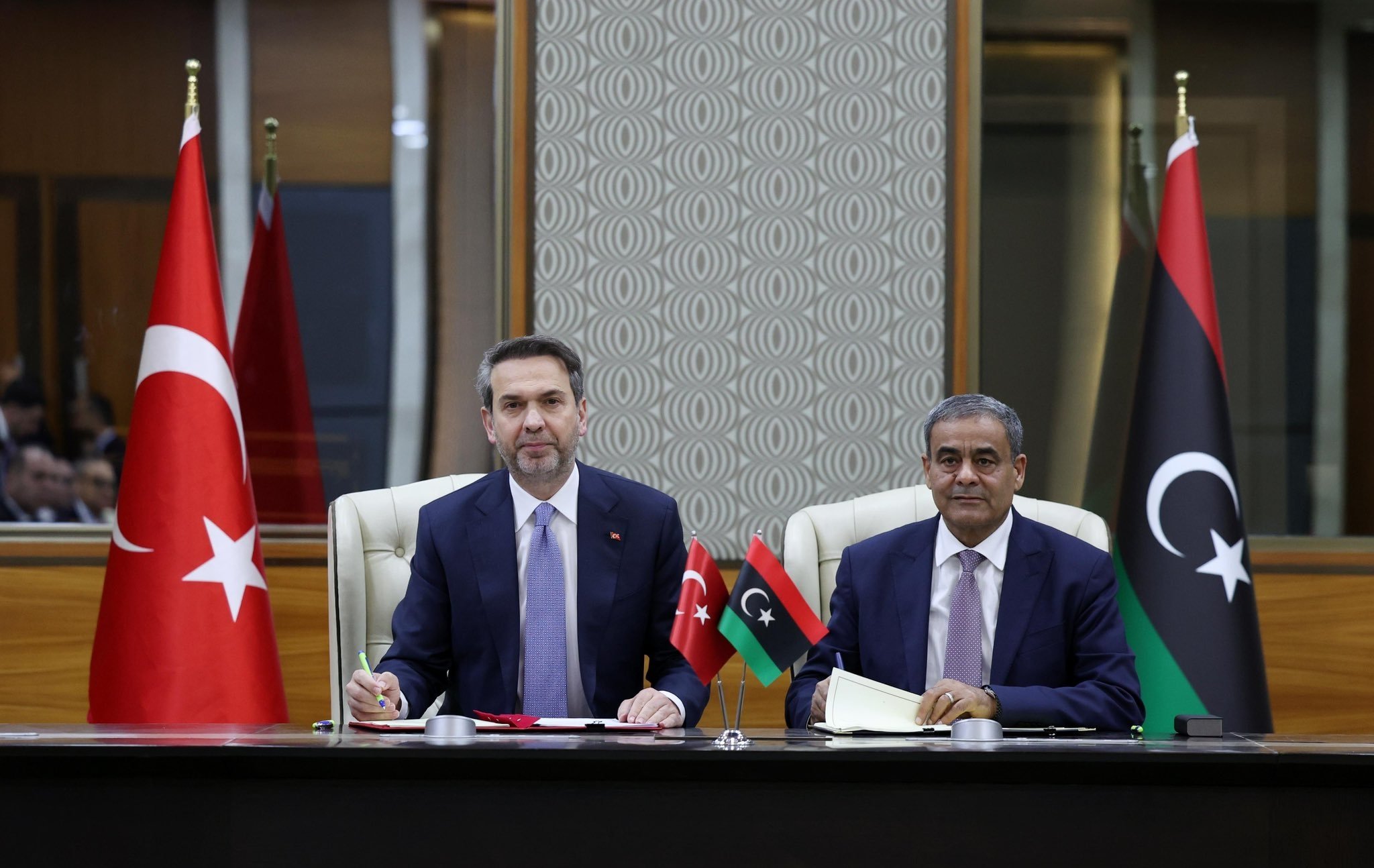
Despite holding one of Africa’s largest oil reserves, Libya stands out as a country unable to transform this advantage into a stable energy strategy. Before 2011, the energy sector operated under state control and reflected a structure based on a high reserve-low diversification equation. Oil revenues constituted the main source of financing for the central state. This model created a rent-based economic order rather than strengthening institutional capacity.
In the post 2011 period, Libya’s energy sector became a direct reflection of political fragmentation. Oil fields, ports and pipelines began to be used not only as economic assets but also as instruments of military and political bargaining. During this process, the National Oil Corporation continued to exist technically as the country’s sole legitimate energy institution, yet in practice, it turned into a structure attempting to balance between different power centers. Frequent production disruptions between 2014 and 2020, forcibly closed terminals and pressure from militias pushed Libya into the category of an unreliable supply source in global energy markets. This situation caused not only revenue losses but also accelerated the withdrawal of international energy companies from the country.
At the current stage, a clear paradigm shift has been observed in Libya’s energy strategy. The Government of National Unity (GNU) seeks to position oil not merely as a short-term revenue tool but as a long-term lever for rebuilding state capacity. Long-term upstream agreements, production increase targets and the recall of international companies form the main pillars of this strategy.
In this context, the Libya Energy and Economy Summit should be read as both a symbolic and practical showcase of the country’s desire to move into a new phase of energy policy. The summit conveys a clear message to the international community. Libya is back at the table for energy investments. The most critical aspect of this summit lies in the use of long-term agreements with international energy companies not only as economic instruments but also as tools for generating political legitimacy. Through this platform, the GNU government aimed to position itself as the primary actor planning Libya’s energy future. Within this framework, the summit created a space where energy diplomacy was intertwined with domestic politics. The series of large-scale energy agreements signed recently in Libya, together with the renewed interest of U.S.- and France-based energy companies, has introduced the question of whether Libya's potential is being rediscovered.
The return of global actors such as TotalEnergies, ConocoPhillips and Chevron to Libya may appear sudden and surprising at first glance, but the process is rooted in accumulated structural dynamics. Following the Russia-Ukraine war, perceptions of energy security in Europe and the U.S. changed fundamentally. The exclusion of Russian oil and gas from the system, rising security risks in the Middle East and Organization of Petroleum-Exporting Countries (OPEC) production constraints pushed Western countries toward low-cost, quickly deployable and geographically proximate production areas. Libya stands out within this equation. Alongside holding one of Africa’s largest oil reserves, the country produces low-sulfur crude that is advantageous for refining. Relatively low production costs make Libya profitable even in an environment where high oil prices are not permanent. For this reason, Libya is no longer viewed by Western companies as a fragile high-risk country but as an early positioning area with high return potential.
This development is the result of changing priorities in global energy geopolitics rather than domestic stability in Libya. The renewed acceleration of investments in Libya’s energy sector reveals not only a technical recovery in production capacity but also a new arena of competition shaped among national and international energy actors. At the center of this competition stand the Turkish Petroleum Corporation (TPAO), representing Türkiye, TotalEnergies, representing France, and Chevron, representing the U.S. Although these three actors appear to be targeting the same fields, their presence in Libya reflects different strategic priorities and different geopolitical readings.
The return of TotalEnergies and Chevron to Libya represents a natural extension of Western energy security pursuits on a global scale. Both companies view Libya as a low-cost and rapidly activatable area for diversifying European and trans-Atlantic energy supply in the post-Russian period. Long-term production projects, reserve optimization and rehabilitation of existing fields constitute their core priorities. This approach positions Libya within the global portfolio as an unstable yet indispensable production point. For TotalEnergies and Chevron, Libya represents an investment area where high risk is balanced by advanced technology and long-term capital.
The TPAO’s presence in Libya clearly diverges from this classical multinational corporate logic. The TPAO’s participation in exploration tenders reflects not only a commercial investment decision but also Türkiye’s desire to establish a lasting geopolitical position in Libya through energy. From Türkiye’s perspective, Libya goes beyond being an upstream portfolio expansion area and represents a strategic extension with legal, political and economic dimensions in Eastern Mediterranean and North African energy geopolitics. For this reason, the TPAO’s competition in Libya is linked as much to the continuity of energy diplomacy as to direct profit maximization.
The most significant difference shaping competition among these three actors emerges in their perception of risk. TotalEnergies and Chevron are companies capable of distributing Libyan risk across their global portfolios and maintaining flexibility for rapid exit when necessary. For TPAO, Libya signifies a longer-term political and economic engagement. From Libya’s perspective, this distinction offers an opportunity to create a multilayered cooperation structure rather than a single type of partnership within the energy sector.
The Eastern Mediterranean dimension constitutes an implicit yet decisive element of this competition. While TotalEnergies and Chevron view their activities in Libya as part of broader offshore strategies in the Mediterranean, Libya represents for the TPAO the potential to generate an economic and practical counterpart to the Türkiye-Libya maritime jurisdiction agreement. This situation transforms TPAO’s exploration activities in Libya into not only energy production efforts but also a legal and diplomatic confirmation mechanism.
For Western companies, Libya represents an important yet replaceable link in global energy supply security. For TPAO, Libya represents a long-term and multidimensional strategic partnership area where Türkiye’s energy diplomacy materializes on the ground. This difference carries the potential to create a complex yet balanced coexistence order rather than an increasingly hardened competition in Libya’s energy field.