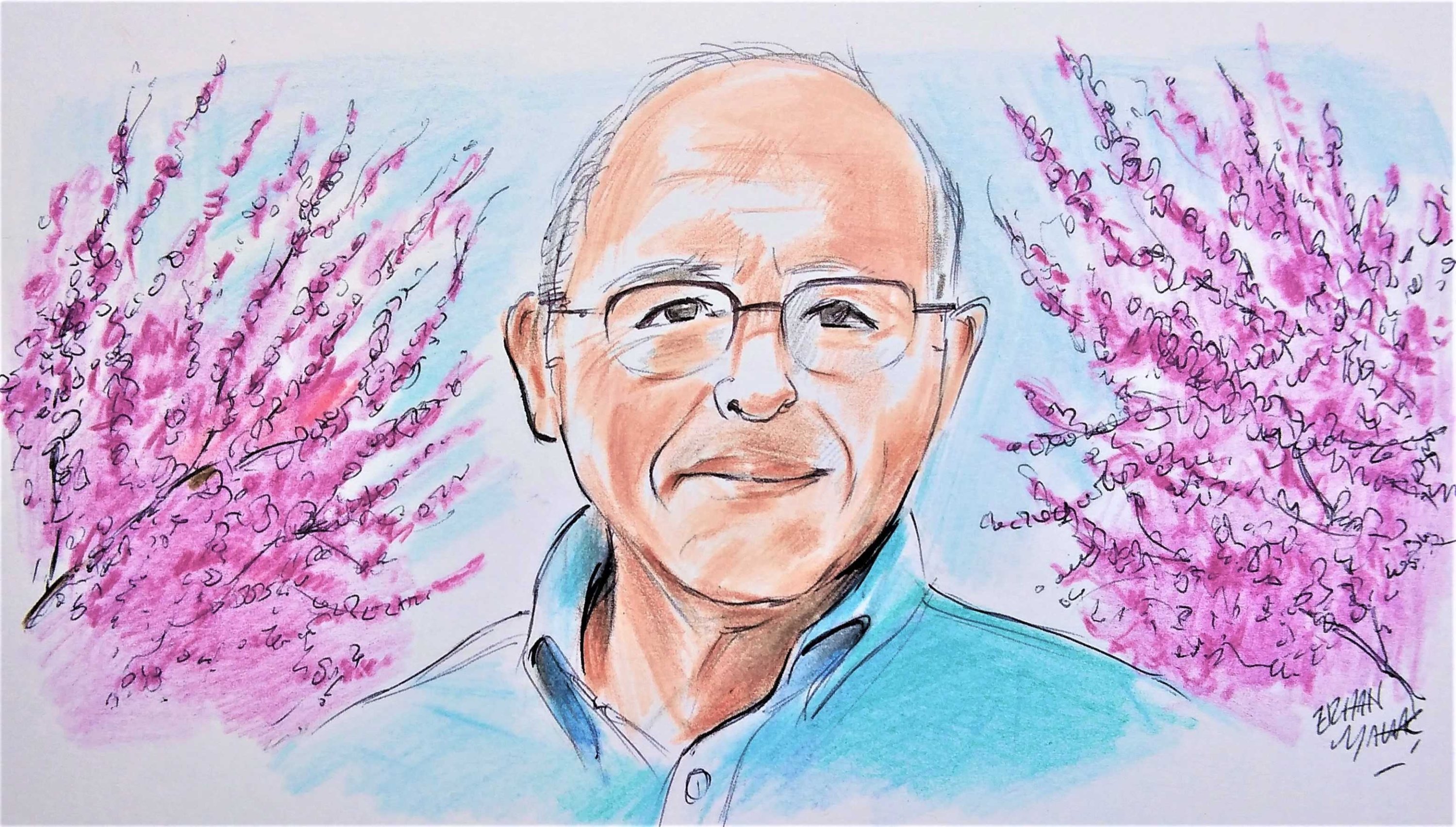
On Aug. 19, 2019, Deputy Minister of Culture and Tourism Ahmet Haluk Dursun died in a traffic accident in the Erciş district of southeastern Van while in his official vehicle, which I was also in. Even today, Dursun’s name is one of the first things that comes to mind when we remember the Judas tree, or Cercis siliquastrum (erguvan in Turkish), a type of redbud tree. Dursun was neither an ordinary academic nor an ordinary bureaucrat. In the midst of daily discussions or bureaucratic turmoil, he always found time for culture, from history to flowers.
Dursun was an important academic who understood and researched Istanbul, introducing it to us since his years at the Galatasaray High School on the Bosporus. He describes his love for the city and Bosporus in his book "Forty Years in the Bosporus" from when he first arrived at the boarding house during his high school years. Its place is indisputable in terms of the contributions it has made to the cultural life of Istanbul.
In his article "Istanbulites who are not familiar with fishing," Dursun expresses with regret that the people of the city have an extraordinary fishing culture, but that it has regressed over time and even disappeared from place to place. His writings on the bluefish are very interesting in terms of fish culture. In his book “Fig Kernel,” he describes the olive groves, vineyards and Judas trees in the Hereke district of Sakarya, where he spent his childhood. In his book titled “The Art of Living in Istanbul,” he is like a compass for those who live in Istanbul but cannot be from Istanbul and for those who want to experience the city. According to Dursun, “Istanbulites need to know Istanbul, its importance in the past and its historical beauties in order to love it.” The historical buildings, squares, trees, flowers and symbols of the city were distilled and flowed from Dursun's pen and engraved in the minds of the youth, including myself. According to him, everyone must know “which fish is eaten in which month and which flower blooms in which month.” Even today, when we see Judas trees on the Sarıyer ridges in Istanbul, where they are mostly found, Dursun comes to mind.
The Judas tree, which turns the edges of the Bosporus a hue of magenta in May, has become popular with its color and scent in many cultures, from the Byzantines to the Ottoman Empire, Ancient Greece to Egypt. It has even been the subject of legends.
So what did this tree represent from Dursun’s perspective? In an article titled "The Erguvan Feast in the Bosporus," Dursun explains what the color purple symbolizes in Istanbul, Christianity and especially in terms of culture:
“When one thinks of erguvan, Istanbul and especially the Bosporus come to mind first. When this imperial city of ours was founded by Constantine in 330 A.D., in other words, when the walls were finished and the city was inaugurated, the season was the erguvan season. Historians consider this day to be May 11. In other words, it’s the season when erguvans bloom in Istanbul and adorn the city as a natural decoration. Known as 'judas tresst' in the Byzantine Christian world, erguvans have continued to receive the attention and love it deserves in the Turkish-Islamic periods as well. So much so that from time to time, the Ottoman sultans did not find the number of erguvan trees in the capital sufficient and gave orders to bring erguvans from the provinces to Dersaadet (an old name for Istanbul, meaning 'door of love').”
One of the beauties of the Bosporus is its Judas trees that blossom in spring, turning a unique purple color and releasing a magnificent scent. Judas trees, which have another white variety, have always been loved by the emperors, kings and sultans of Istanbul with their color, scent and heart-shaped petals. Festivals have been held in its name for centuries. Not only in Istanbul, but also in all Mediterranean countries, the Balkans and even other continents, these trees were accepted as the heralds of spring.
Its Latin name is "cercis siliquastrum." Cercis means "tree" in ancient Greek, and the Latin word “siliquastrum” means "encapsulated fruit" or "pod-shaped fruit." It is also called "love tree" in English and Spanish ("love tree" and "arbol del amor," respectively). In Persian, the word "argavan," which means reddish purple color, is used for this tree. In Arabic, it is called "arcuvan" or "arguvan.” It is known that erguvan is a Persian word and it comes from the Aramaic and Syriac word "argwana." This word is derived from the Akkadian word "argamannu," meaning "purple and red purple color.”
In the Christian world, the tree symbolizes a very different world of meaning. According to the Christian belief, it is said that Judas Iscariot, one Jesus' apostles who betrayed Jesus by reporting his location and identity to the Roman soldiers, hung himself on this tree out of regret. It is said that this is why the tree, which was actually white, turned a purple color.
The Turkish cultural world lost Dursun in the 2019 summer. He is one of those people who will be nearly impossible to replace in terms of his capacity as an intellectual and a gentleman. Let me conclude the article with one of his quotes, a call to look at not what we have lost but at what we have. “We must love what have, even if it’s not what we had loved.”