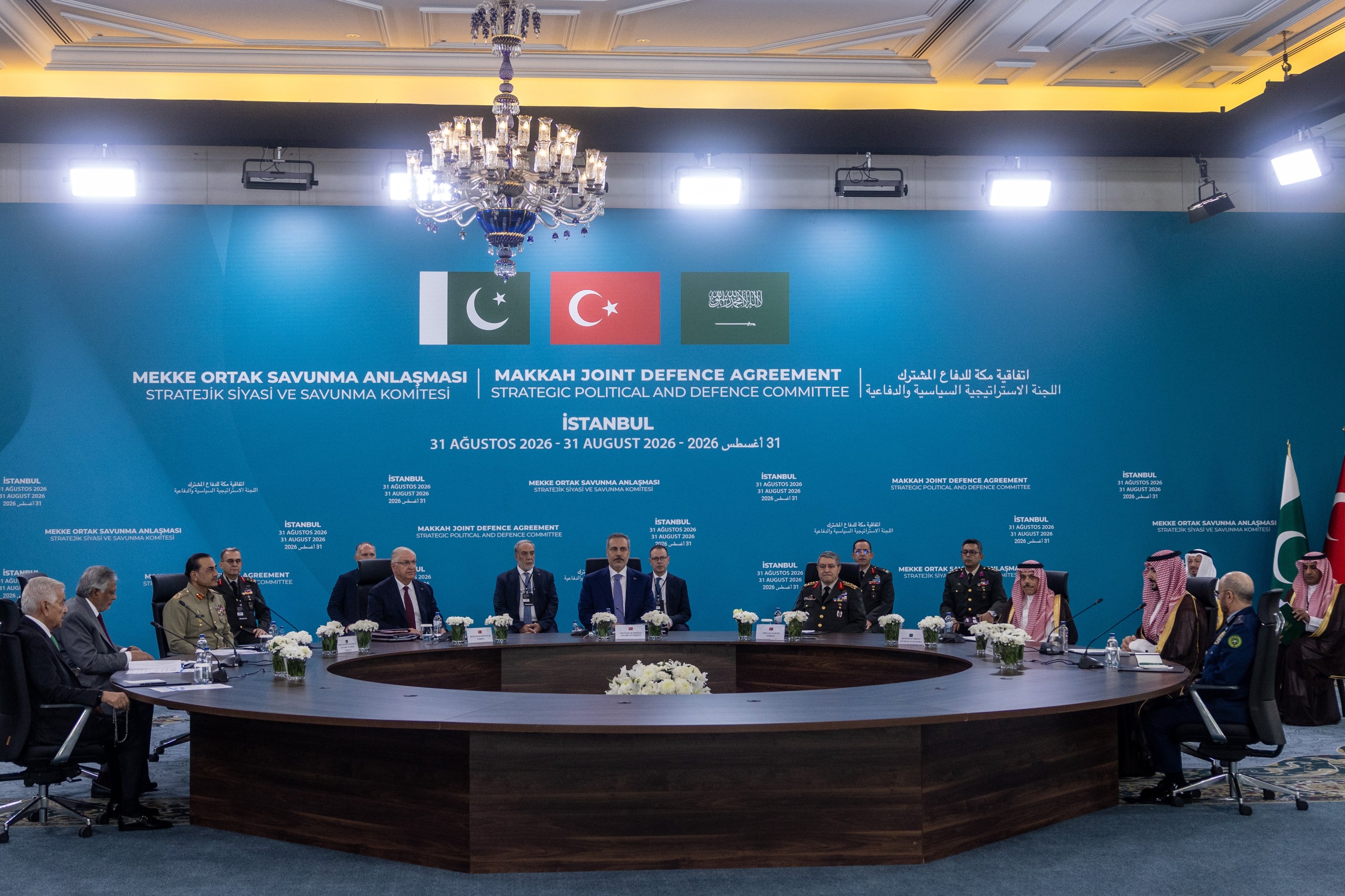
One of the longstanding challenges facing the Middle East's security architecture has been the difficulty regional states have had in translating their military, economic, and geopolitical capabilities into a common, sustainable security framework. Against this background, the Mecca Joint Defense Agreement, signed in August 2026 by Türkiye, Saudi Arabia and Pakistan, should not be viewed merely as another arrangement for military cooperation among three states. Its broader significance lies in the attempt to institutionalize a willingness among regional actors to assume greater responsibility for security across a wide Afro-Eurasian space extending from the Indian Ocean and the Gulf to the Red Sea, the Eastern Mediterranean, and the Black Sea. One of the most significant elements of the Mecca Agreement is the principle of collective defense, under which an armed attack against one party is regarded as an attack against the others. In this respect, the existing bilateral military relations among Türkiye, Saudi Arabia and Pakistan have, for the first time, been brought together within a common deterrence framework. Nevertheless, it would be misleading to interpret the Mecca framework as either a regional version of NATO or an alternative to NATO. Türkiye has also made clear that the alliance is not intended to replace its existing international commitments, including those arising from NATO membership, but rather to complement them.
The first meeting of the Strategic Political and Defense Committee, held in Istanbul on Aug. 31, 2026, demonstrated that the agreement had begun to move from political declaration toward institutionalization. The foreign and defense ministers and chiefs of general staff of Türkiye, Saudi Arabia and Pakistan participated in the meeting, during which the parties agreed to establish a permanent secretariat in Saudi Arabia, deepen defense-industrial cooperation, enhance joint technological development and production capabilities, and strengthen interoperability among their armed forces. The next phase of the alliance will likely focus on enlargement.
Evaluating the possible membership of Egypt and Syria using the same logic would be analytically misleading. The capabilities that each state could bring to the alliance, as well as the security benefits each could seek from it, are fundamentally different. Egypt is not simply an external third country standing outside the broader framework from which the Mecca alliance has emerged. Cairo already maintains regular political and strategic coordination with Türkiye, Saudi Arabia and Pakistan through the Regional Four (R4) mechanism. Egypt’s possible accession to the alliance should therefore be understood not as an entirely new alliance preference, but as a potential extension of an existing political and strategic coordination mechanism into collective defense. This distinction matters for understanding the alliance's future evolution. The transformation that could result from the participation of both countries would therefore be geopolitical rather than merely numerical:
Such a configuration could connect previously distinct security spaces within a single regional defense framework. Egypt and Syria's strategic significance begins precisely at this point. Egypt is, first, one of the most important Arab states in demographic and military terms. Its participation would considerably strengthen the regional representativeness of a broader security architecture. Second, Egypt occupies one of the most important geographical spaces currently missing from the alliance. Incorporating Cairo into the developing security relationship between Türkiye and Saudi Arabia would bring the Eastern Mediterranean-Red Sea-Suez axis within the same strategic framework. Third, Egyptian membership could help transform the Mecca alliance from a specific security arrangement centered on Türkiye, Pakistan, and Saudi Arabia into a broader Arab and regional security platform. It could also extend the alliance's geographical scope further across the Afro-Eurasian space. The Suez Canal and the Red Sea are particularly important in this context. Recent security crises in the Red Sea have demonstrated that Egypt’s economic security and maritime security can no longer be treated as separate issues. Any prolonged security disruption around Bab el-Mandeb can divert commercial shipping away from Suez towards the Cape of Good Hope, with direct consequences for Egyptian canal revenues. For Cairo, therefore, Red Sea security has become not merely a military issue but also a question of economic security.
The Syrian case is more complex because it raises a broader question: within which security architecture will a post-war Syria position itself as it continues its reconstruction? Damascus faces a fundamental security challenge. The new administration needs to consolidate state authority across the country, complete the integration of armed formations into central institutions, secure national borders, protect Syrian airspace, and establish credible deterrence against external military intervention. For this reason, the Mecca alliance could mean something different for Syria than for Egypt. For Syria, the alliance could potentially serve as a security pillar of state-capacity reconstruction. From Ankara’s perspective, and within its broader approach centered on stability diplomacy, Syria's stability can no longer be viewed solely as a matter concerning a neighboring state. Restoring Syrian state capacity is directly connected to regional border security, counterterrorism, irregular migration, the return of refugees, the reopening of trade routes, and the restoration of land connectivity with the wider Middle East. Within such a framework, Türkiye could contribute military training, defense-industrial capabilities, and institutional expertise. Saudi Arabia could contribute through financing and reconstruction investment. Pakistan could share its experience in military training, personnel development, and defense cooperation. The model that could emerge would therefore involve not only collective defense but also the collective reconstruction of state capacity.
Ultimately, the significance of Egypt and Syria in the current context extends well beyond the possible addition of two new members to the Mecca alliance. Egypt’s potential participation could bring the political coordination already established through the R4 mechanism together with the Mecca alliance's collective defence framework, thereby contributing to institutional deepening. Syria’s participation, by contrast, could create a strategic link through the Levant between Türkiye and the Arabian Peninsula, strengthening geographical continuity among existing security spaces. In this respect, the strategic implications of the two potential memberships are distinct yet complementary: Egypt, via institutional deepening, and Syria, via geographical integration.
This emerging picture matters not only for regional defense but also for the changing meaning of security itself. Conflicts and crises extending from Ukraine and Gaza to the Red Sea and the Gulf show that state security can no longer be understood solely in terms of territorial defense and military capabilities. The security of energy networks, ports, maritime chokepoints, trade routes and overland connections has increasingly become an integral component of national and regional security. As existing routes become more vulnerable to war and geopolitical tensions, developing alternative corridors – and securing them – has become a strategic necessity.