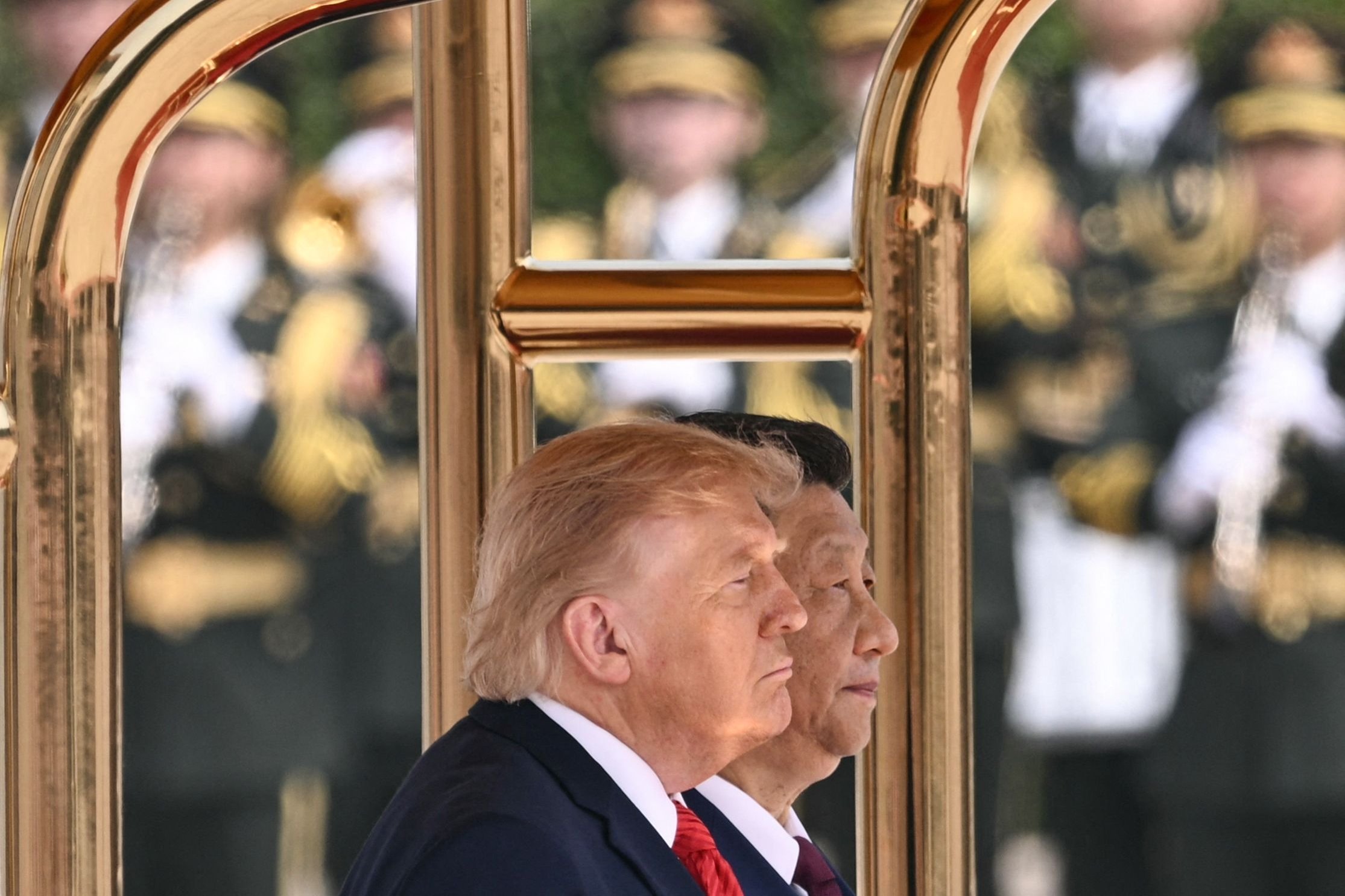
On May 14-15, the entire world focused on U.S. President Donald Trump’s visit to China. Trump had previously visited Beijing during his first presidential term. However, this visit, taking place after eight years, occurred in a far more critical and chaotic period. This time, the issue was not merely a “trade war.” Taiwan, technological competition, trade deals, the Iran-Hormuz line and the global power transition were all compressed onto the same diplomatic table.
One of the clearest indicators that Trump went to China with a strong bargaining agenda and an economic focus was the presence of Treasury Secretary Scott Bessent. During his first presidential visit to China in November 2017, Trump was accompanied by figures such as Secretary of State Rex Tillerson and Commerce Secretary Wilbur Ross, along with a large business delegation. That visit reflected the logic of classical trade diplomacy: reducing the trade deficit, expanding market access and producing major commercial announcements. The 2026 visit, however, was different. The fact that Bessent, rather than representatives from the State Department, was present showed that the meeting had shifted from ordinary diplomacy to economic-security bargaining.
Indeed, this showed that the meeting was designed not as a conventional diplomatic table, but rather as an “economic security table.” Yet, in terms of its outcomes, the visit created a new field whose effects continue to unfold. Washington no longer speaks to Beijing only as a rival to be contained but as a great power with which the rules of competition must be renegotiated.
For decades, U.S.-China relations moved between hostility, engagement and strategic competition. During the Cold War, Washington initially viewed communist China as a revolutionary threat. In 1972, U.S. President Richard Nixon's visit changed that equation. It was not a reconciliatory rapprochement but a planned strategic opening: the United States aimed to use China to balance the Soviet Union, while Beijing aimed to use Washington to escape isolation.
The normalization of diplomatic relations in 1979 institutionalized this new phase, and China’s entry into the World Trade Organization in 2001 deepened its integration into the U.S.-led global economy. In other words, China’s rise did not take place outside the American order; it emerged, at least partly, through the opportunities created by that order. This historical background is essential for understanding the present moment.
Today, Washington is no longer dealing with an isolated or dependent China. It is facing a power that has transformed globalization into an instrument of national capacity. China used trade, foreign investment, industrial policy and technological absorption to become the world's central manufacturing platform. The irony is that the very order that enabled China’s rise has now become the terrain of U.S.-China rivalry. The U.S. opened the system to China; now it is trying to limit the strategic consequences of China’s success within that system. Trump’s recent China visit must therefore be read through this historical transformation. The issue is no longer only trade rivalry.
The U.S. no longer sees China merely as a market, a manufacturing base or a useful counterweight against another great power. China has become a systemic competitor: a technological rival, a maritime actor, a manufacturing superpower, an energy consumer, a critical minerals player and, increasingly, a diplomatic center where other powers seek recognition, leverage and room for maneuver.
This is why Trump’s recent visit to Beijing should not be read as a simple diplomatic meeting. It was a scene from the emerging world order. The images, the dinners, the protocol and the carefully managed language revealed something deeper than bilateral dialogue. They showed that China has moved from being an object of American strategy to becoming one of the arenas in which the future of American strategy itself is negotiated.
There is another important point that should be underlined here. In almost all of Trump’s visits and in many of the receptions he has organized at the White House, he has rarely displayed this degree of statesmanlike restraint. He often prefers a language of pressure, humiliation or open bargaining, especially when dealing with traditional allies. Yet in Beijing, as in his Alaska summit with Russian President Vladimir Putin, Trump adopted a different tone. He appeared more careful, more measured and more aware of the symbolic weight of the moment.
This tells us something important about Trump’s worldview. For him, not all leaders occupy the same place in the hierarchy of power. Some are treated as "less-efficient actors to be oppressed," some as "allies to be disciplined," and some as "equals" with whom the rules of the game must be renegotiated. In that sense, the Trump meeting with the Chinese President Xi Jinping was not only a meeting between two superpowers. It was also a meeting between two hierarchies: the American hierarchy of transactional power and the Chinese hierarchy of civilizational statecraft.
Power is no longer built only through military capacity. It is increasingly shaped through energy routes, critical minerals, supply chains, sanctions, maritime chokepoints, technology platforms, payment systems and direct leader-to-leader bargaining. In normless realism, power is not only used but also displayed. A rival is not merely balanced, but forced into negotiation. An ally is not simply protected, but it is subjected to a cost-benefit calculation. A crisis is not only managed but also used to create leverage in other files. Trump’s relations with China and Russia are direct products of this logic.
Yet the real question is this: What did Trump actually bring back to the table? Trump did not go to China alone. He went with powerful representatives of American business, with the expectations of major corporations and with the claim that “America is once again making big deals.” However, the outcome did not produce a picture of victory in which Trump obtained everything he wanted. Chinese support on the Strait of Hormuz remained limited. In Taiwan, the perception that U.S. support had weakened became stronger. The trade agreements also fell short of expectations. Even the decline in Boeing shares showed that the markets did not read this visit as a major economic success.
Therefore, Trump was received in Beijing as a great leader, but he was also forced into great-power bargaining. The images were strong, the protocol was impressive, and the diplomatic language was measured. Yet the concrete gains remained limited. This visit revealed both the strength and the limits of Trump’s search for a new world system: the U.S. remains extremely powerful, but it is no longer the only actor writing the rules of the game. China is not yet the global hegemon, but it is no longer a passive listener at the table; it is now an actor shaping the very framework of negotiation.
Did Trump’s failure to fully obtain what he wanted at the Chinese table trigger the possibility of entering a third cycle of war against Iran in a more aggressive manner? This is where the real rupture, and the real question, emerges. If the war with Iran is to end at the negotiating table, then it can be argued that the China talks became an important bargaining space behind closed doors. The Iran file is no longer shaped only along the Washington-Tehran axis. It is now also being shaped through Washington-Beijing, Beijing-Moscow and global energy markets.
China’s limited influence over the Strait of Hormuz, energy flows and Iran was a critical balancing factor for Trump. Yet if Beijing did not provide the kind of open and strong support Washington expected, this may have fed a new need for a “show of force” in Washington. The issue here is not only Iran. The deeper issue is Trump’s attempt to demonstrate that U.S. hegemony can still produce results in his search for a new world system. When the gains from the China talks remained limited, Washington may seek to compensate for this gap through harder moves in another file. In this respect, Iran has become one of the most suitable pressure points.