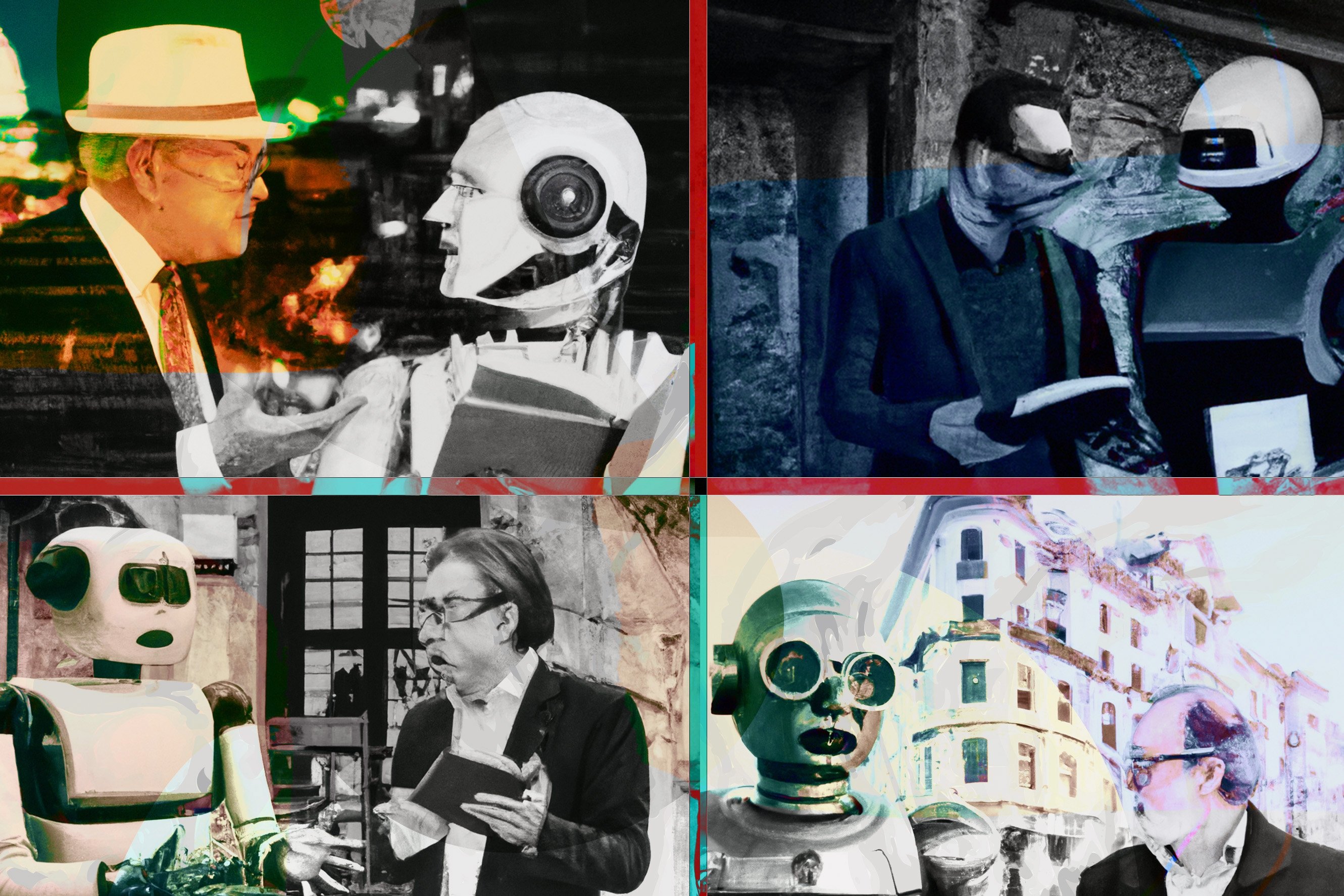
Hakkı Öcal. The legendary figure in Turkish journalism. A reader of the highest caliber. And apparently, a critic with a razor-sharp wit.
Yes, Hakkı Hoca (Master) took issue with a column I wrote earlier this year. More accurately, as a staunch Daily Sabah reader, he criticized the paper’s managing editor to the managing editor.
While it's not impossible for an individual or an institution to make a decision about their own righteousness or wrongdoing, it has always been difficult, and if nothing else, it's questionable in terms of procedure. As the famous principle in Turkish law says, "procedure is more important than substance," and I agree. Plus, it is unethical for a person to be the arbitrator in a matter related to themselves.
Yet, still, I will explain the issue, give Hakkı Hoca unlimited right to criticize and write my defense. It is up to our readers to judge.
Everything started on Thursday morning, March 2, when Hakkı Hoca sent me a WhatsApp message, saying he wrote an extra column that week and asked if we would be interested in it. Without hesitation, I said, "Yes!"
Hakkı Hoca is regularly published in Daily Sabah's Monday edition. We always receive Gmail notifications before the sun rises on Sunday with an attached piece that only requires minimum copy editing with a P.S. "Selam ve sevgiyle (With greetings and love)... ." This has never changed.
Hakkı Hoca reminds me of Immanuel Kant. It is said that Kant was a very regimented and disciplined person who followed a strict daily routine. He believed that living an orderly life was essential for achieving his intellectual goals and for leading a morally upright life. According to his biographers, Kant followed a daily routine that was almost mechanical in its regularity.
For example, it is said that he woke up every day at 5 a.m. and spent the first hour of his day meditating on philosophical problems. He then spent the rest of the morning teaching and writing. In the afternoons, he would take a walk at the same time and along the same route every day, and he would return to his home to read and write until 10 p.m., then he would go to bed.
We must ask Hakkı Hoca's friends and neighbors.
When I received the article, I didn't open it as it was only 9:21 a.m. How could I read a column so early in the morning? Upon arriving in the newsroom, our op-ed editor was smiling. "Hakkı Hoca targets you in the piece,” she said.
"Are you serious? Brilliant!"
On Jan. 29, I praised what Hakkı Hoca described as "the new universal truth of humanity," artificial intelligence (AI), or as he put it, "intelligent programmers and their intelligent algorithms."
The topic of discussion was ChatGPT, the trendy material of global media these days. I was expressing my astonishment at its capabilities when I must have gone too far, drawing the attention of Hakkı Hoca, who, as he said, “personally contributed thousands of lines of code to the World Wide Web Consortium (W3C) microblogging codebase, which later turned out to be the basis of what we call today 'social platforms,' such as Twitter, Instagram, Facebook, Pinterest and so on.”
Hakkı Hoca is a programmer himself. He is a tech addict and an all-time geek. I had to listen very carefully to what he was saying.
Simply put, Hakkı Hoca revealed the technique behind what I wrote, which "highlights the versatility and potential of language models in mimicking human-like writing."
He was referencing "lexical analysis (lexing or tokenization)" in computer science, which was unfamiliar to my vocabulary. I googled it and asked also ChatGPT, and I think it confirmed what Hakkı Hoca had said.
He was also saying, “If you are using ChatGPT, you may utilize Common Crawl with 410 billion tokens, WebText2 with 19 billion tokens, Books1 with 12 billion tokens, Books2's 55 billion tokens and Wikipedia with 3 billion tokens.”
It took me hours of Google searching to understand some of the paragraphs, but I was slowly getting used to the terminology. Although it was complex, it was also understandable.
Hakkı Hoca continued: “The ChatGPT is not 'writing' anything either! It is simply putting already written things together. At school, we have a utility website to check student homework if there is significant plagiarism in them. When I ran Mr. Takış’s ChatGPT article in one of them, it found no significant problem with it. But when you search each and every sentence it has, you see that all the text has been indexed previously by Google because ChatGPT used the same indices Google uses.”
He discovered the Google footprint in the piece that was co-authored by me and ChatGPT, and he was right. Following his informative paragraphs, he gave me credit for my warning. I had highlighted a looming danger for the publishing sector and predicted that the death of the human author was near.
“This brings us to the danger my dear managing editor warns about: the death of the human author,” he said.
“Yes, the author has been dead since 1967 when the French literary critic and theorist Roland Barthes declared in his famous essay “La mort de l'auteur.” But Barthes and Takış talk about different demises here. Barthes said unlike traditional literary criticism we cannot rely on the intentions of an author to definitively explain the "ultimate meaning" of a text; Takış fears that soon computers are going to write up the text, not hale and hearty individuals.”
There is no point in saying "I agree" or "I disagree" with what Hakkı Hoca revealed. Science is science, and a computer is a computer. But evolution is evolution. The publishing sector and media are evolving in front of our eyes toward an AI-dominated era. I believe that Hakkı Hoca is soon likely to create an AI shortcut on his computer and mobile phone for easy use in his academic and journalistic works.
The monthly American publication WIRED recently unveiled a comprehensive and illuminating guide on the judicious employment of cutting-edge AI technology within their esteemed platform. This insightful exposition expounds upon the areas in which the publication is willing to harness the boundless potential of AI, as well as those domains where it is deemed prudent to eschew the use of this technology.
In 2017, The Guardian developed an in-house AI tool called "ReporterMate" to assist journalists in their work by analyzing data, identifying trends and providing insights. Since then, it has been used by The Guardian's journalists to help them investigate complex issues and identify potential story leads.
The New York Times and The Washington Post have both embraced the use of AI tools in their journalism, utilizing them in various ways to enhance their reporting and streamline their workflow.
It is coming, what is yet to come...
I can only thank Hakkı Hoca for his criticism on my behalf. His words emphasize the importance of the position I hold. As a senior professional, Hakkı Hoca has shed light on the logic and science behind AI and its relation to content creation. This is important, and he should have no doubt that I will take note of his words.
Perhaps one day, he, I and AI will write a column together. Who would be there to be criticized then?