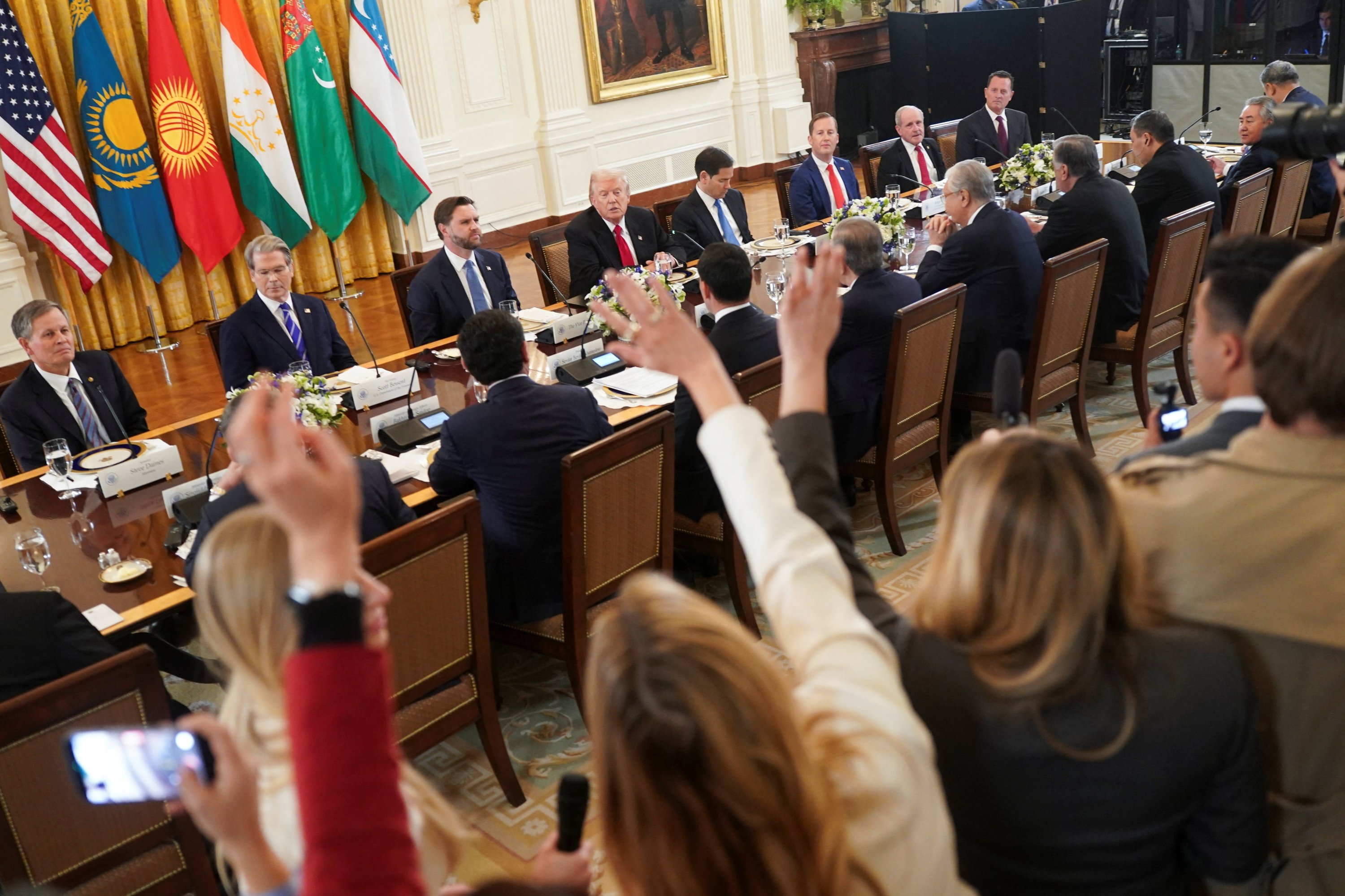
The C5+1 summit held at the White House on Nov. 6, 2025, signaled a new phase in the U.S. strategy toward Central Asia. The meeting, which brought together U.S. President Donald Trump and the leaders of Kazakhstan, Kyrgyzstan, Tajikistan, Turkmenistan and Uzbekistan, revealed Washington's quest to reshape its relations with the region through strategic minerals.
Rare earth elements, which have become a fundamental component of global industry, are now at the centre of the U.S.' geo-economic competition with China. This situation signals the beginning of a new era of resource diplomacy, transforming Central Asia into more than just an energy corridor. Washington aims to break China's dominance in the global supply chain while establishing a long-term sphere of influence through Central Asia's mineral wealth.
The C5+1 Summit organized by the Washington administration at the White House was not merely a diplomatic gesture, but a concrete manifestation of a new strategic orientation that could be described as “rare earth elements diplomacy.” The agreements signed at the summit clearly demonstrated that the American interest in Central Asia has now moved beyond energy pipelines to a deeper, strategic mineral-based level. A $1.1 billion tungsten mining partnership with Kazakhstan and a commitment to invest and purchase over $100 billion in Uzbekistan are at the heart of this geo-economic move.
Today, this move by the U.S. involves a strategic orientation that is too profound to be explained solely by economic gain or investment diplomacy. Washington is seeking to counterbalance China's dominance in the global supply chain for rare earth elements, where it accounts for 70% of production and 90% of processing.
The Trump administration's expansion of its list of “critical minerals” indicates that these resources are now being considered from a national security perspective. This forms the basis of the U.S. goal of energy transition, defense industry modernization and independence in green technologies.
Countries such as Kazakhstan, Uzbekistan and Turkmenistan have become natural links in this strategy due to their vast reserves of uranium, tungsten and rare elements. Through its agreements with these countries, the U.S. is not only curtailing China's economic sphere of influence but also building a “new resource-centered sphere of influence” in Eurasian geopolitics. In this context, rare earth elements are becoming a new “strategic power tool” that is replacing classic energy diplomacy.
Another noteworthy aspect of the U.S. approach is the “security of green supply chains.” Washington is seeking to strengthen its hand in future economic competition by securing strategic minerals that will be used in clean energy technologies during the global energy transition. In this sense, Central Asia is not only a mineral-rich region; it is also seen as a “geo-economic insurance zone” for the U.S. in its sustainable energy transition.
However, this strategy is not merely a matter of access to resources. Through its mining investments in Central Asia, the U.S. is also attempting to shape the political orientations, economic dependencies and diplomatic preferences of the countries in the region. Washington's “resource-centered influence policy” is an economic countermove to Beijing's long-standing Belt and Road Initiative (BRI).
The Trump administration is transforming energy diplomacy in the region into “mining diplomacy,” turning rare earth elements into a strategic tool that shapes the global balance of power beyond economic competition. This is transforming Central Asia's future into a global geo-economic battleground that transcends regional borders.
The U.S.'s growing interest in Central Asia may appear to be economic on the surface, but fundamentally it represents a profound geostrategic repositioning. The Washington administration is building its new engagement with the region on the concept of “strategic balancing,” beyond the classical understanding of hegemony.
China's BRI and the economic corridors it has established across Eurasia, along with Russia's attempts to rebuild its sphere of political influence through the Eurasian Economic Union, now pose a global challenge to the U.S. In this context, with every step it takes, the White House is positioning Central Asia as a strategic crossroads at the center of great power competition rather than a resource-rich hinterland.
The Trump administration's hosting of Central Asian leaders in Washington can also be interpreted as an attempt to make up for lost time in the region. Indeed, the U.S. is seeking to exert influence in the region through military bases as well as investment, technology, energy and diplomatic channels. This indicates that Washington's foreign policy is shifting toward building a “power architecture” rather than the use of force.
The C5+1 format has become the most visible diplomatic tool of this new strategy. The U.S. does not view this mechanism solely as an economic cooperation platform; it sees it as a testing ground for a regional integration model that excludes Russia and China.
Thus, a “third way” is being proposed to Central Asian countries: neither Moscow's security-centered model nor Beijing's debt diplomacy-based model. Washington is effectively utilizing “soft power” elements by supporting this approach with sustainable development, digital infrastructure, mining technologies and green energy collaborations.
The U.S. return to the region also means the redefinition of energy and logistics routes. Strengthening the transport corridors passing through the Caspian Sea frees Central Asia from Russia's monopoly on northern routes, while also limiting China's influence on the Middle Corridor.
At this point, Washington supports the Trans-Caspian route stretching across the South Caucasus and the Caspian Sea as a strategic “Western connection.” In this way, the U.S. is turning economic cooperation in the region into a tool for geopolitical steering.
However, this new U.S. engagement is perceived by Moscow and Beijing as a “containment strategy.” Russia views these moves as a threat to its historical sphere of influence, while China is concerned about increased competition in mining and infrastructure projects in Central Asia. The current situation is transforming Central Asia into an increasingly fragile but more central geopolitical stage.
Recent developments have not only intensified competition between major powers but also led to increased regional multilateralism. Central Asian countries are now expanding their diplomatic autonomy by maintaining parallel relations with actors such as the U.S., China, Russia and Türkiye, rather than remaining dependent on a single power. Consequently, while Washington's growing presence has the potential to destabilize the region, it also opens the door to a period of multipolar cooperation.
Ultimately, American moves in Central Asia should be interpreted as an attempt to establish a new power architecture in Eurasia. Whether this attempt succeeds will depend on Washington's capacity to translate its economic promises into sustainable investments on the ground and on the extent to which the countries in the region can act independently in this balancing act.