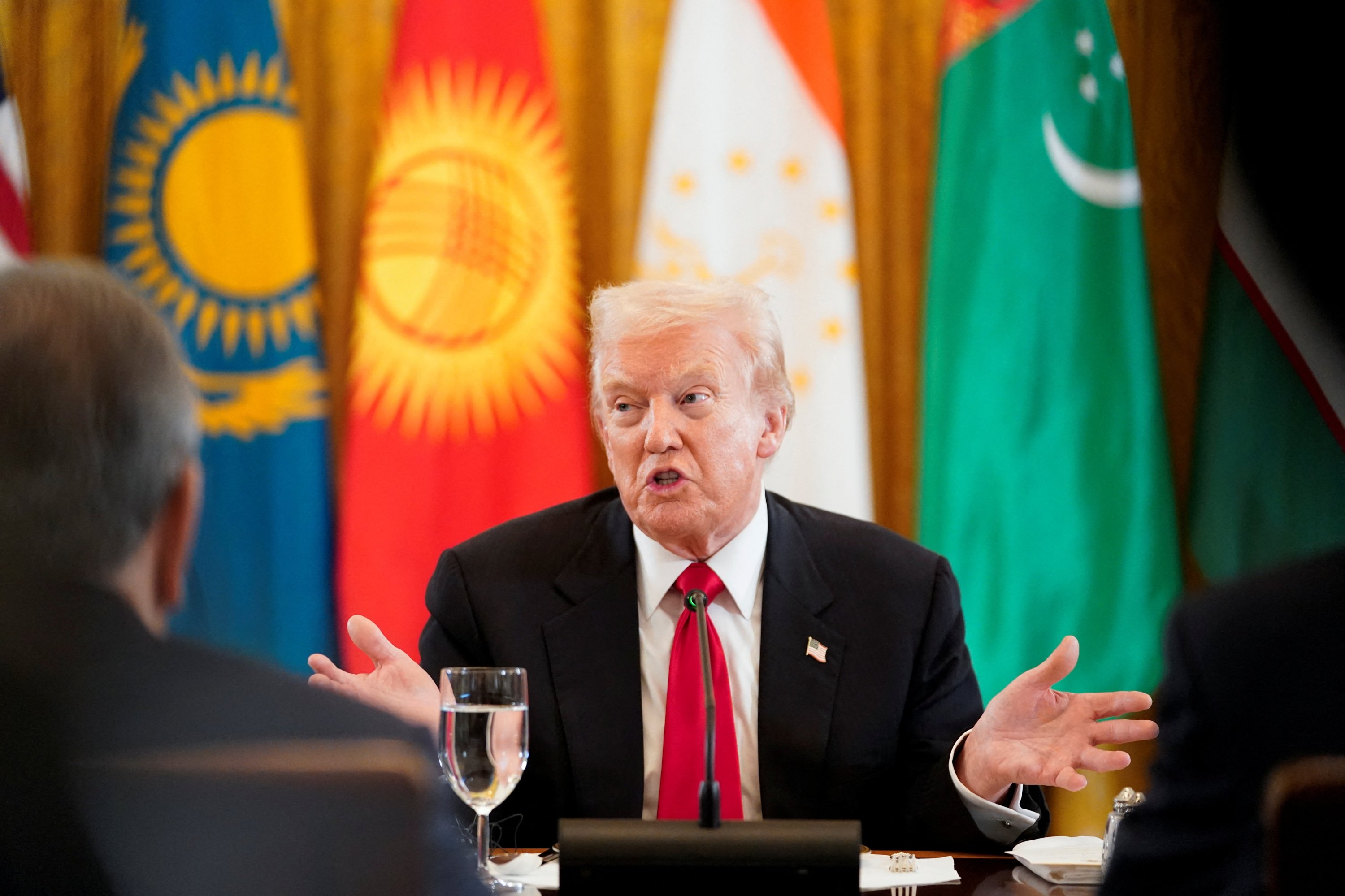
The C5+1 summit in Washington came right after U.S. President Donald Trump wrapped up a high-profile tour of Seoul, Tokyo and Manila focused on supply chains and industrial capacity. Central Asia was the next stop with almost the same agenda. Central Asia’s resources sit at the center of the global move toward electrification. The five overwhelmingly Muslim states are rich in minerals and energy, yet their economic and institutional ties to surrounding powers run deep.
China’s financial presence is already embedded: More than $120 billion in contracted projects across the region, with at least $75 billion already invested in energy grids, roads, logistics and manufacturing. In Kazakhstan alone, Chinese-supported industrial capacity is estimated at about $66 billion. These are investments with a 25- to 40-year lifespan in furnaces, transmission stations, mineral processing lines, the kind that define where value flows for decades.
Russia, despite pressure, remains the region’s operating environment. Millions of Central Asians work in Russia. Security academies are Russian. Border protocols, gas distribution and professional vocabularies are institutional habits and cannot be replaced quickly.
The U.S. is now entering this mix with interesting deals, such as aircraft and locomotive contracts in Uzbekistan and Kazakhstan. But deals are not yet structured. Central Asian governments have lived through cycles of U.S. attention that surged and faded: Afghanistan exit cycles, sanctions phases and democratization rhetoric that rises and falls with Congress. They know American time runs differently from Chinese capital or Russian embeddedness.
Meanwhile, China has been patient. It began building rare-earth infrastructure when the industry was unglamorous, when refining was polluting and low-margin. And even though Central Asia holds some of the core minerals required for the 21st-century industrial economy, China retains a monopoly in rare earth processing. At the October 2025 Xi-Trump interaction, Chinese President Xi Jinping signaled China would pause some of its outbound licensing restrictions for a year, only in categories where Beijing assessed minimal strategic risk. Processing bottlenecks remain under Chinese control.
This is why U.S. Secretary of State Marco Rubio’s language landed differently when he confirmed he will visit all five Central Asian states in early 2026 to pursue cooperation tied to resource development. When he said: “You are looking to take the resources ... that God has blessed your nations with, and turn them into responsible development that allows you to diversify your economies.”
Deputy Secretary Christopher Landau said the same thing more directly: “The opportunities are amazing – business opportunities. Many ways to partner there.”
There are early signals of what this could look like. U.S. commerce figures show ongoing discussions between an American minerals firm and Kazakhstan’s sovereign wealth fund on two major deposits. And Kazakhstan’s announcement this spring of a rare-earth deposit potentially exceeding 20 million tons, still being verified, could place it among the top three holders globally. If processing capacity is developed locally or jointly rather than offshore, the region’s position changes from supplier to participant.
And this is the real question: will the U.S. anchor full value-chain involvement like refining, processing, off-take guarantees, financing risk, rather than signing extraction deals?
Because those are exactly the layers China already offers, and why China’s influence in the region has staying power.
“The U.S. approach to Central Asia has historically focused on security, and it has long become apparent that security cooperation alone cannot ensure a lasting presence. In contrast, American business interests, especially in Kazakhstan’s oil and gas sector, have created more durable ties. Kazakhstan now accounts for about 97% of all U.S. exports from the region, anchoring the country more firmly to global and American markets,” said Oleg Abdurashitov, chief policy advisor at Outpost Eurasia, which works with U.S. tech and infrastructure investors.
And there were deals. At the summit, new contracts were announced: the U.S. administration publicized up to 37 Boeing jets to airlines in Kazakhstan, Tajikistan and Uzbekistan (15 for Kazakhstan’s Air Astana alone) as part of fleet-modernization efforts. Also, a U.S. company, in partnership with Kazakhstan’s state mining firm, will take a 70% stake in a major tungsten venture valued at $1.1 billion, backed by a letter of interest from the U.S. Export-Import Bank for $900 million.
The region is assigning different sectors to different partners, based on financing terms, technical competence and predictability over time. “As the U.S. foreign policy has grown more transactional and business-driven, particularly under Trump, it is American companies that Central Asian leaders have increasingly sought to engage, offering opportunities in critical minerals, transport, digital technologies and other sectors,” noted Abdurashitov.
Most of the outcomes of the summit will not be visible immediately. The relevant decisions will take place in working groups and project negotiations over the next year, especially on processing capacity and transport infrastructure. If the U.S. follows through at that level, its presence will develop naturally. If not, the region already has other options. Central Asia will proceed the way it usually does by choosing what is practical.