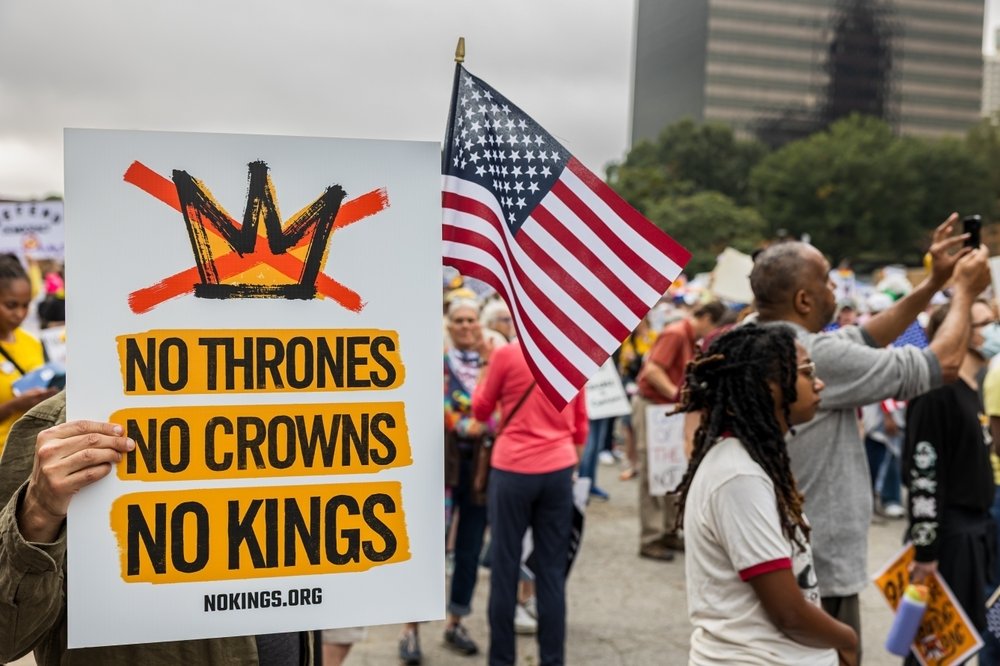
In recent weeks, a new wave of "No King" protests against President Donald Trump swept across America. Millions of people are reported to have joined demonstrations held at thousands of locations. The central theme of the protests was that Trump has been interpreting his powers broadly and repeatedly crossing constitutional lines. Similar protests against Trump took place last year as well, again drawing a notably high turnout.
Such protests reflect a growing reactionary sentiment forming in liberal circles in response to the Trump presidency. Mass deportation campaigns targeting undocumented immigrants, the birthright citizenship debate, the SAVE America Act, and the war with Iran stand out as the most heated topics of recent debate in America. On all these fronts, Trump is criticized for overstepping or broadly interpreting his authority through his policies.
Trump already signaled what kind of presidency his second term would be when he won both the popular vote and the Electoral College in the 2024 election. He publicly declared that he had received a mandate. In that sense, Trump raised expectations that he would usher in a new form of imperial presidency. And he did not prove that prediction wrong. Considering his presidential performance so far, both domestically and in foreign policy, he cuts quite a prodigal figure.
By just the second year of his new term, Trump, who came to power touting himself as a “peace president” and promising to end wars, has presided over a trade war, the ouster of Venezuela’s Nicolas Maduro, and two operations against Iran, one of which was a massive military campaign. On the domestic front, American society has been grappling with mass deportations carried out through Immigration and Customs Enforcement (ICE), and with immigrant-related protests in places like Los Angeles and Minnesota.
These recent policies are generating pushback on both the domestic and international fronts. In international politics, there is still no realistic prospect of a concrete balancing act against American power. No actor appears willing to bear the cost of standing up to the U.S. On the domestic front, the dynamics are somewhat different. Institutional and popular resistance to the Trump administration is starting to take shape.
It is worth remembering, particularly at this juncture, that 2026 is a midterm election year. Both the Senate and the House will be up for renewal. If Democrats manage to hold the majority in both chambers of Congress, American politics could head for a more turbulent stretch. The popular opposition building against Trump could, at that point, find its institutional counterpart as well. The Trump administration could find itself more constrained, both at home and abroad.
Should Democrats hold a majority in Congress, however, American domestic politics could also become the stage for another kind of tension. In such a scenario, Democrats could initiate an impeachment process centered on how the Trump administration has used its authority, particularly regarding the Venezuela and Iran operations.
Democrats are currently busy constructing a broad opposition. Protests such as “No King” should be understood in this context, even if they are not directly tied to the Democratic Party’s corporate identity. For now, these protests are taking shape more as grassroots organizing: slow, steady, and incremental. Such movements do not yield sharp results immediately. But for Democrats, it is an important indicator of political mobilization. The regular recurrence of these mobilizations matters as it keeps the base politically energized and sharp.
After all, political parties need to ensure high turnout for the 2026 midterms; they cannot afford for political energy to wane. In recent years in the U.S., winning elections has increasingly depended on mobilizing one’s own voters rather than swaying supporters from the opposing side. This strategy is particularly consequential in highly polarized societies, given the widely held view that social polarization in America has grown significantly in recent years. It is therefore reasonable to expect that, in the November midterms, the party that most effectively mobilizes its base will likely secure victory.
Given the deep internal divisions in the U.S., a strategy of framing the 2026 elections as a referendum on Trump could potentially succeed for the Democrats. Their attempt to do so in 2024 had backfired, but the political landscape has since shifted. With the current atmosphere, they may now be able to turn the tide in their favor.
The Trump administration is currently grappling with a range of internal challenges. In recent weeks, Secretary of Homeland Security Kristi Noem was removed from her post. She had been the central figure in the controversy surrounding ICE protests. Attorney General Pam Bondi was also dismissed. Both were known for their loyalty to Trump, yet both were removed. Meanwhile, National Counterterrorism Center Director Joe Kent resigned after publicly opposing the Iran war, marking the first Iran-related resignation within the administration. The recent removal of Army Chief of Staff Randy George further illustrates how dismissals, once limited to the civilian leadership, have now expanded into the military leadership. While each of these departures has its own immediate cause, Trump is once again, as he was in his first term, dealing with a string of resignations and removals from within.
That said, Trump still appears to hold the upper hand. Whereas departures in the first term tended to come more in the form of individually initiated resignations, the second term's exits are proceeding more as outright dismissals. In that sense, one could argue that Trump is running a kind of recalibration process aimed at consolidating stability and unity within his administration.
In sum, Trump, fully aware that he entered office with substantial political capital, is pursuing assertive policies both domestically and internationally. His strongest points of leverage have been the unwavering support of his base and Republican control of Congress. Yet, as the second year of his second term unfolds, Trump faces the potential erosion of both broader public support and loyalty within his own party.
On issues ranging from the Iran war to the Epstein files, he has faced criticism even from his closest supporters. Democrats, meanwhile, if able to sustain a vibrant social momentum through the 2026 midterms, could transform it into a political project capable of carrying forward to the 2028 presidential election. Taken together, these dynamics suggest that Trump, like a prodigal emperor, may find it increasingly difficult to operate with the same freedom he currently enjoys for the remainder of his presidency.