Daily Sabah logo

Politics
Diplomacy Legislation War On Terror EU Affairs Elections News Analysis
TÜRKİYE
Istanbul Education Investigations Minorities Expat Corner Diaspora
World
Mid-East Europe Americas Asia Pacific Africa Syrian Crisis Islamophobia
Business
Automotive Economy Energy Finance Tourism Tech Defense Transportation News Analysis
Lifestyle
Health Environment Travel Food Fashion Science Religion History Feature Expat Corner
Arts
Cinema Music Events Portrait Reviews Performing Arts
Sports
Football Basketball Motorsports Tennis
Opinion
Columns Op-Ed Reader's Corner Editorial
PHOTO GALLERY
JOBS ABOUT US RSS PRIVACY CONTACT US
© Turkuvaz Haberleşme ve Yayıncılık 2026

Daily Sabah - Latest & Breaking News from Turkey | Istanbul

  • Politics
    • Diplomacy
    • Legislation
    • War On Terror
    • EU Affairs
    • Elections
    • News Analysis
  • TÜRKİYE
    • Istanbul
    • Education
    • Investigations
    • Minorities
    • Expat Corner
    • Diaspora
  • World
    • Mid-East
    • Europe
    • Americas
    • Asia Pacific
    • Africa
    • Syrian Crisis
    • Islamophobia
  • Business
    • Automotive
    • Economy
    • Energy
    • Finance
    • Tourism
    • Tech
    • Defense
    • Transportation
    • News Analysis
  • Lifestyle
    • Health
    • Environment
    • Travel
    • Food
    • Fashion
    • Science
    • Religion
    • History
    • Feature
    • Expat Corner
  • Arts
    • Cinema
    • Music
    • Events
    • Portrait
    • Reviews
    • Performing Arts
  • Sports
    • Football
    • Basketball
    • Motorsports
    • Tennis
  • Gallery
  • Opinion
    • Columns
    • Op-Ed
    • Reader's Corner
    • Editorial
  • TV
  • Opinion
  • Columns
  • Op-Ed
  • Reader's Corner
  • Editorial

Retaliation or restraint: A scenario co-written by Israel and Iran

by Imran Khalid

Nov 04, 2024 - 12:05 am GMT+3
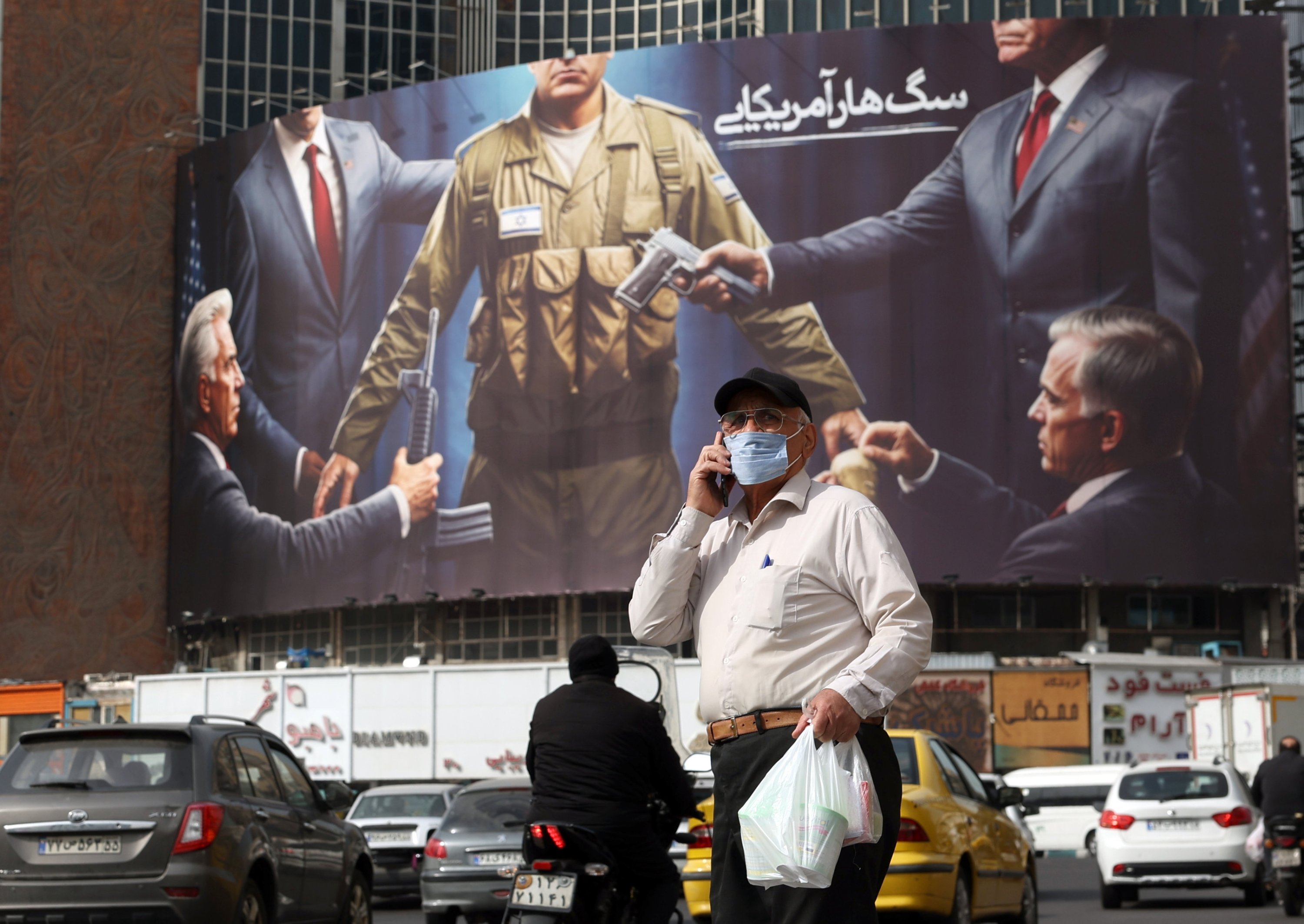
An elderly man walks past an anti-Israeli and U.S. billboard depicting an Israeli soldier receiving military supplies from the U.S. with the title "American rabid dog," at Tehran's Valiasr Square, Tehran, Iran, Oct. 28, 2024. (EPA Photo)
by Imran Khalid Nov 04, 2024 12:05 am

It appears that under the U.S.' guidance, Israel and Iran are both adhering to their scripted roles in the Middle East

It was expected to happen this way. Very few anticipated that Israel would launch a genuinely destructive attack to "retaliate" for Iran's Oct. 1 fireworks in Israel. Israel’s response to Iran’s recent provocations was inevitable, but it was not expected to be more than a "limited" surgical strike, aimed primarily at pacifying domestic audiences in Israel – and Iran.

Israeli Prime Minister Benjamin Netanyahu boasted about destroying missile manufacturing sites, while Tehran claimed the attack had been effectively dismissed. However, neither side has provided tangible evidence or video proof to support their claims. The optics of Iran’s missile strike on Oct. 1 and Israel’s so-called retaliation on Oct. 16 suggest that both actions were “carefully scripted” to avoid causing massive damage on either side – damage that could provoke public pressure for an all-out war between the two countries.

Washington and other Western capitals appear to have played a key role in these “controlled” retaliations between Israel and Iran, shaping an intricate balance in this volatile region. Netanyahu’s government, however, insists that reports suggesting Israel warned Tehran beforehand are inaccurate. A statement from Netanyahu’s office clarified that “Israel did not inform Iran before the attack – not about the time, not about the targets, not about the strength of the attack.” However, the ground realities tell a different story, hinting at a scripted episode.

The Israeli strikes appeared to be benign and symbolic in nature – Iran has not disclosed the extent of the damage. Israeli jets reportedly spent more than three hours in Iranian airspace, all returning safely without a scratch. As per media reports, Iran had already closed its airspace to commercial flights in anticipation of Israel’s aerial strikes and there are no reports that Iranian airforce confronted any intruding Israeli jets. International pressure, particularly from U.S. President Joe Biden, likely influenced Tel Aviv to limit the scope of its retaliation. Reports indicate that Biden repeatedly warned Netanyahu against targeting strategically sensitive sites in Iran, such as oil refineries or nuclear reactors, to prevent the conflict from escalating beyond Gaza’s borders ahead of the Nov. 5 elections.

In the last year, perhaps this is the only – if any – diplomatic success that Biden has so far achieved in the Middle East by convincing Netanyahu to show restraint in its airstrikes against Iran. Otherwise, Netanyahu has been blatantly ignoring all such calls from the White House regarding Gaza, the West Bank and Lebanon. U.S. Secretary of State Antony Blinken was also in the region to ensure that the Israel-Iran tussle does not turn into a full-fledged war before the presidential results are announced in Washington.

Yet, Israel’s military focus remains squarely on operations in Gaza and Lebanon, with the Israeli Defense Forces (IDF) highlighting that their “war objectives” remain concentrated within these regions. The IDF has laid the blame for any wider escalation on Iran, accusing Tehran of “pushing for a broader regional conflict” through its proxies in Southern Lebanon and Gaza.

In Washington, Biden is very confident that the Israeli strikes on Iran mark the end of a period of escalation in the Middle East. “It looks like they didn’t hit anything other than military targets. My hope is this is the end,” is how U.S. President Biden commented after the Israeli attack on the Iranian territory.

Not surprisingly, Iran’s response has been quite benign: labeling the strikes as a violation of international norms while simultaneously affirming its own “right to defend itself.” For obvious reasons, Iran's next move in response to Israel’s recent strikes will define the spectrum of regional stability.

The continuation of this “ostensible” cycle of retaliation and counter-retaliation between these two rivals has the potential to turn into a dangerous regional war. While both Iran and Israel have been making very calculated – and limited – military actions against each other, the chaos of conflict may defy such control, setting off unpredictable chains of escalation. In case of an accidental full-scale confrontation between the two countries, it would not be possible to contain it within Israel and Iran’s borders. All the neighboring states like Syria, Iraq and even Türkiye would eventually be dragged into this melee, and major powers such as the U.S. and Russia will inevitably be part of the spreading metastasis of this conflict

Such an expansion could lead to a regional conflagration that risks engulfing the Middle East, with ripple effects that would reach far beyond. In a region already fraught with tensions, even one misstep could spark a chain reaction with catastrophic global implications. Factually speaking, Biden is in no mood to let both Tehran and Tel Aviv have another round of direct airstrikes before the presidential elections.

Nevertheless, Tehran also acknowledged its “responsibilities toward regional peace and security,” a statement that hints at a balancing act between retaliatory pride and strategic caution. Images shared by Iranian state media present a facade of calm and normalcy, with busy streets, parkgoers exercising, and markets open for daily trade. Yes, the Iranian government’s actions hint at an effort to downplay the recent strikes. It appears that, instead of having a direct war, for the time being, Tel Aviv and Tehran both will prefer to revert to their indirect war in Lebanon and Gaza. But Netanyahu does not seem to be in the mood to slow down on Hezbollah and Hamas at this stage, so we must expect more intense war in Southern Lebanon and Gaza in the coming days – at least till mid-November.

About the author
Op-ed contributor based in Karachi, Pakistan
The views and opinions expressed in this article are solely those of the author. They do not necessarily reflect the editorial stance, values or position of Daily Sabah. The newspaper provides space for diverse perspectives as part of its commitment to open and informed public discussion.
  • shortlink copied
  • KEYWORDS
    iran-israel tensions middle east plan us-israel relations us elections 2024 iran
    The Daily Sabah Newsletter
    Keep up to date with what’s happening in Turkey, it’s region and the world.
    You can unsubscribe at any time. By signing up you are agreeing to our Terms of Use and Privacy Policy. This site is protected by reCAPTCHA and the Google Privacy Policy and Terms of Service apply.
    No Image
    Turkey's oil wrestling festival returns after yearlong hiatus
    PHOTOGALLERY
    • POLITICS
    • Diplomacy
    • Legislation
    • War On Terror
    • EU Affairs
    • News Analysis
    • TÜRKİYE
    • Istanbul
    • Education
    • Investigations
    • Minorities
    • Diaspora
    • World
    • Mid-East
    • Europe
    • Americas
    • Asia Pacific
    • Africa
    • Syrian Crisis
    • İslamophobia
    • Business
    • Automotive
    • Economy
    • Energy
    • Finance
    • Tourism
    • Tech
    • Defense
    • Transportation
    • News Analysis
    • Lifestyle
    • Health
    • Environment
    • Travel
    • Food
    • Fashion
    • Science
    • Religion
    • History
    • Feature
    • Expat Corner
    • Arts
    • Cinema
    • Music
    • Events
    • Portrait
    • Performing Arts
    • Reviews
    • Sports
    • Football
    • Basketball
    • Motorsports
    • Tennis
    • Opinion
    • Columns
    • Op-Ed
    • Reader's Corner
    • Editorial
    • Photo gallery
    • DS TV
    • Jobs
    • privacy
    • about us
    • contact us
    • RSS
    © Turkuvaz Haberleşme ve Yayıncılık 2021