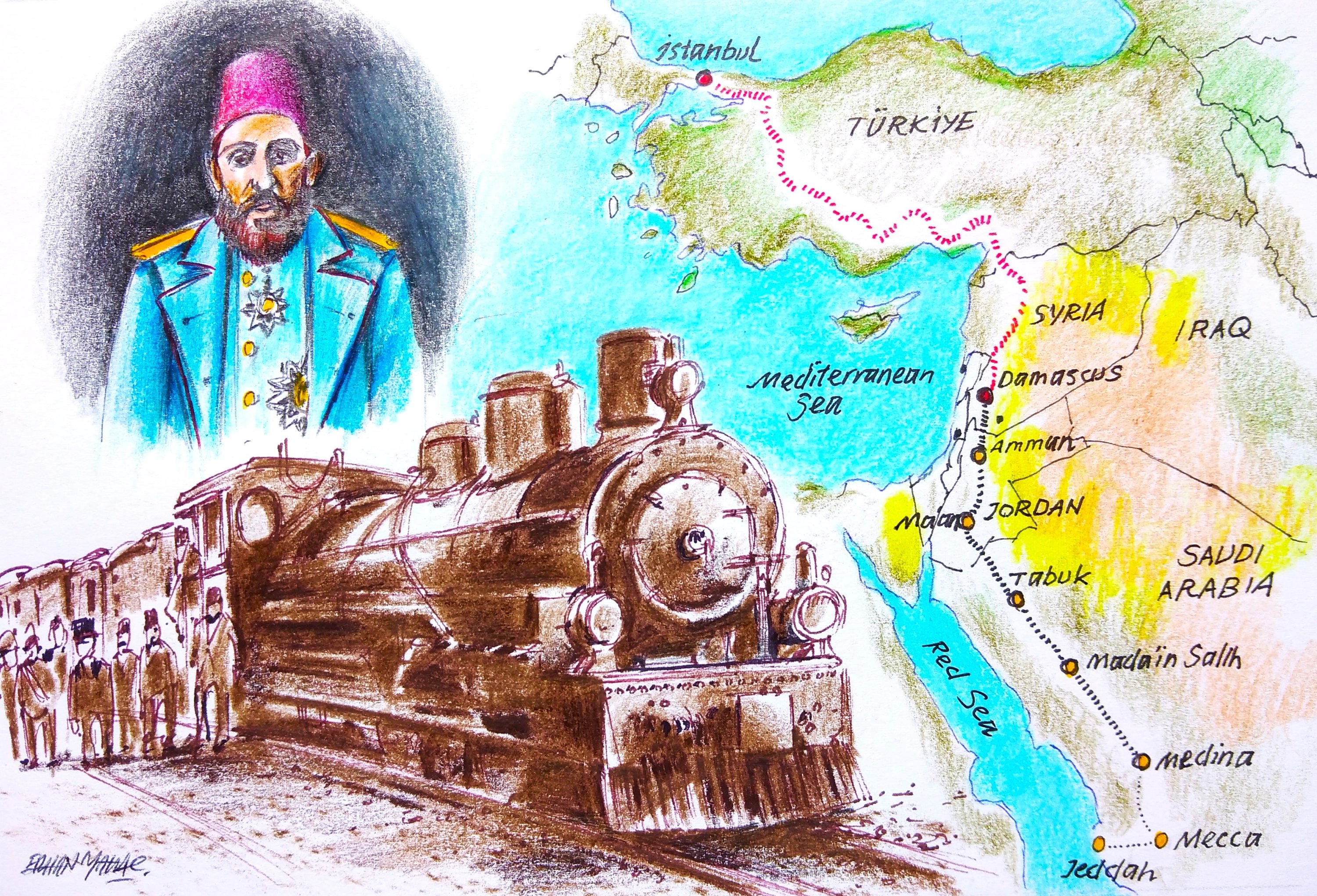
More than a century after its construction between 1900 and 1908 during the reign of Sultan Abdulhamid II, the 1,322-kilometer (822-mile) Hejaz Railway is now poised for revival as a manifestation of a profound historical legacy. Far from being merely symbolic, this initiative carries strategic weight within Türkiye’s broader vision of inclusive and integrative regional connectivity.
During his visit to Jordan last month, Minister of Transport and Infrastructure Abdulkadir Uraloğlu, following meetings with his Jordanian and Syrian counterparts, underscored the transformative potential of the project. Speaking at the restored Hejaz Railway Amman Station and museum, currently being restored by the Turkish Cooperation and Coordination Agency (TIKA), Uraloğlu emphasized that the railway would facilitate both human mobility across the region and more efficient commercial flows. With the completion of the Türkiye-Syria-Jordan corridor, and growing political will and optimism from partners such as Saudi Arabia and Oman, the project is set to emerge as both a historically significant and economically viable connectivity initiative across the Gulf.
Originally commissioned by Abdulhamid II, the Hejaz Railway stood as one of the Ottoman Empire’s flagship infrastructure projects of the early 20th century. At the time, it faced staunch discontent, particularly from the British Empire, as such a large-scale connectivity initiative in the Hejaz region ran counter to its imperial deeds. France similarly opposed the project for comparable reasons. British propaganda sought to undermine public perception of the railway in the region, spreading disinformation about the infeasibility of its financing and a smear campaign by alleging the misuse of collected funds.
Within the framework of the proposed revival, Türkiye has already prepared an action plan under a memorandum of understanding agreed in September last year. This roadmap envisages consultations and preparatory work among the technical teams of the participating countries. Syria, with Türkiye’s support, is expected to complete the remaining 30-kilometre segment of missing infrastructure, while Jordan will oversee the maintenance, repair and operational management of locomotives. Recent statements also indicate that, given their expressed interest, Saudi Arabia and Oman may be incorporated into the project’s further extension.
The modernization of the Hejaz Railway has the potential to become a cornerstone of Türkiye’s regional connectivity vision. When viewed in the broader context of Syria’s stabilization following the removal of the Assad regime in late 2024 and the mitigation of terrorist threats in the region, the project transcends mere railway integration. It represents a strategic corridor extending toward the Gulf and assisting Syria’s new regional and global integration agenda with the aid of logistics and facilitated trade flows.
This vision is further reinforced by the largely completed Türkiye-Iraq Development Road Project, which has already positioned Türkiye as a central actor in regional connectivity by linking the Persian Gulf through Iraq into its own territory via an integrated port, road and rail network. In this context, the Hejaz Railway serves as a complementary axis, reviving a historical link between Türkiye and Syria, extending into Jordan. Coupled with the recent expansion of Türkiye’s high-speed rail network, the project effectively outlines a complementary corridor connecting Türkiye directly to the Gulf.
Beyond infrastructure, this renewed connectivity vision underscores Türkiye’s proactive approach to generating alternative regional trade corridors. In the post-Assad landscape, where Syria is re-establishing ties with both the region and the wider international system, and in coordination with Jordan, the Hejaz Railway Project can be manifested as a strategic Türkiye-Levant axis. The convergence of intergovernmental agreements, technical negotiations, and shared development goals is generating a tangible synergy. Simultaneously, Türkiye is advancing the prospect of a corridor through this project, opening to the Red Sea via the Port of Aqaba. Together with the Development Road Project, which anchors connectivity toward the Gulf, this initiative effectively establishes a dual-corridor architecture linking Türkiye to key maritime and trade nodes.
Drawing inspiration from its historical roots and endowed with renewed strategic purpose, the Hejaz Railway Project aims to assert a significant presence on the regional connectivity map. Through this initiative, Türkiye positions itself as the architect of a route that not only reaches the Port of Aqaba via the Syria-Jordan axis but also, if extended toward Saudi Arabia and Oman, connects directly with the Gulf. Provided that the demonstrated political will is matched by sustained commitment and coordinated effort, this project holds the potential to facilitate regional mobility while injecting new dynamism into trade flows, redefining connectivity across a historically interconnected geography.