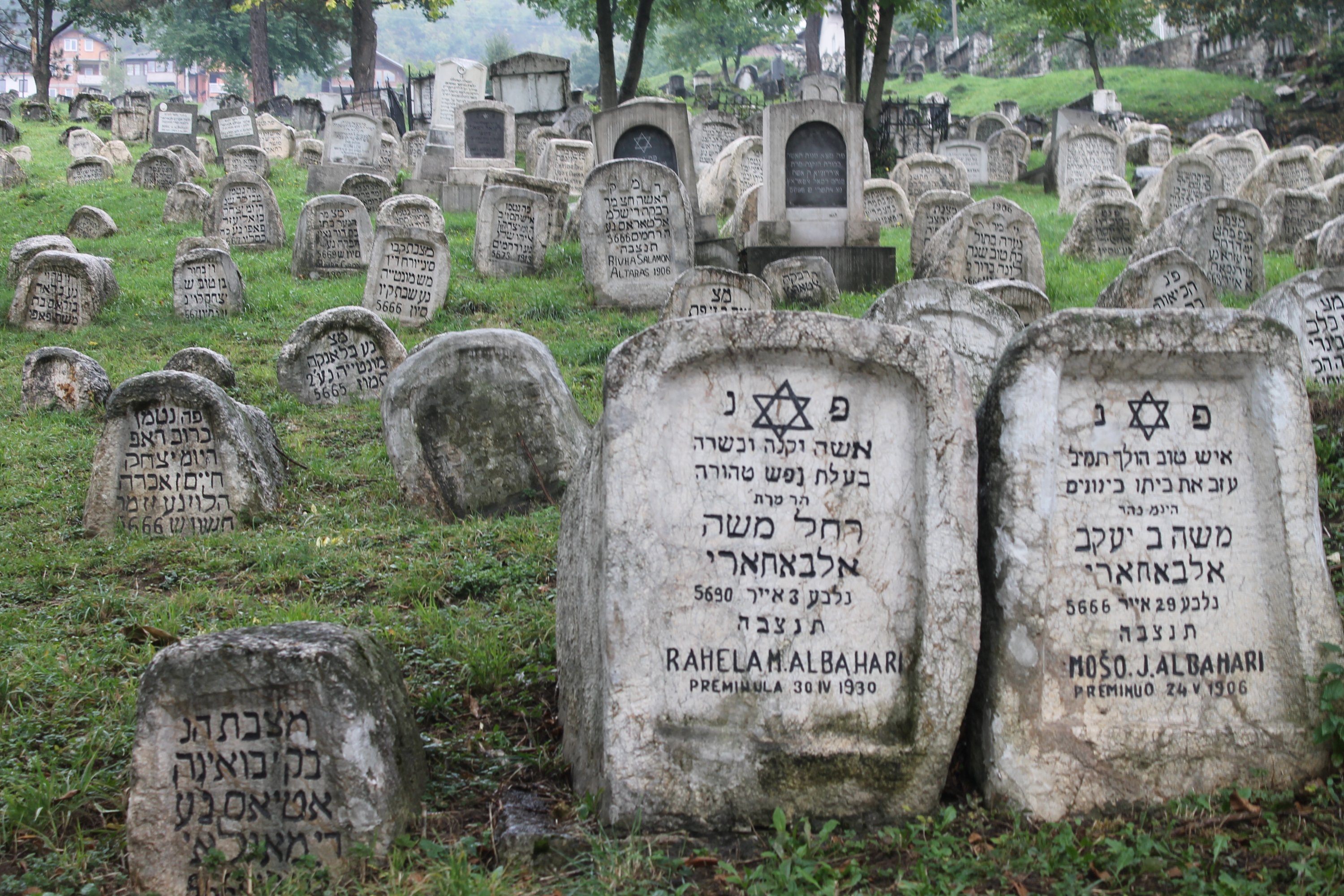
I grew up near the old Jewish cemetery in Sarajevo. Nestled in the Kovačići neighborhood, it is the largest Jewish cemetery in Southeast Europe and, after Prague Old Jewish Cemetery, the second-largest Jewish sepulchral complex on the continent. I passed it at least twice a day before I moved from my parents house.
During the Bosnian Serb aggression and the siege of Sarajevo in the 1990s, the cemetery was on the front line. Shells and sniper fire scarred its grounds, like so many other sacred monuments that were lucky not to be destroyed completely.
My father once told me about his close friend, David Kamhi, a Bosnian Jew, violinist and intellectual who fought alongside Bosnian soldiers during the war. When the conflict began, he said no Jew would leave Bosnia, especially the Sephardim, and even those who left would return. Bosnia was his home, as it had been for centuries. He died in Sarajevo in 2021.
His story, like the cemetery that watches over the city, is a testament to the shared destiny of Muslims, Christians and Jews in Sarajevo. The cemetery reminds me that, among all the places Jews were forced to leave, they remained in Sarajevo for more than 450 years.
The Jewish story in Bosnia began in the late 15th century, when Sephardic Jews fleeing the Spanish Inquisition found refuge under Ottoman rule.
What made that refuge possible was the remarkable openness the Ottoman Empire showed toward Jewish communities at a time when much of Europe was expelling them. Ottoman sultans offered protection, the right to worship and the freedom to rebuild communal life. Sephardic Jews were not only welcomed – they were encouraged to settle, open businesses, print books, practice medicine and contribute to the empire’s economic and cultural life. Sarajevo, under Ottoman rule, became one of the places where this coexistence flourished most vividly. This is why Jews fleeing persecution could put down roots here, not as strangers, but as neighbors – helping to shape the very character of the city that would later be known as “Little Jerusalem.”
Today, that legacy of coexistence is under attack. It is not coming from within but from an orchestrated campaign by the government in Tel Aviv, which, through proxies, seeks to portray Sarajevo as an anti-Semitic city. This campaign distorts history and threatens Bosnia-Herzegovina’s very identity as a multicultural society.
Attempts to frame Bosnia as hostile to Jews are perhaps the most dangerous assault on its multicultural spirit since the war. The backdrop is the genocide in Gaza and the policies of Israeli Prime Minister Benjamin Netanyahu’s government in the occupied West Bank. As Israel faces global condemnation, some officials and allies seek to delegitimize criticism by branding others as anti-Semitic. Importing that conflict into Bosnia is reckless and harmful, decades after the country endured its own bloody conflict.
In the early days of the Gaza war, Sarajevo’s Jewish community warned that the city must never become a stage from which genocide is justified. It never has been. In fact, Sarajevo has been among the loudest cities in Europe protesting the genocide. Jews and Muslims have stood side by side, calling on the world to act, just as their ancestors once stood together against fascism.
Tensions rose in June when Bosnian officials canceled a major meeting of the Conference of European Rabbis in Sarajevo. Political backlash and public pressure forced local authorities and the venue to withdraw, and the event was relocated to Munich. Jewish leaders called the cancellation "anti-Semitic."
In August, the director of the National Museum of Bosnia-Herzegovina decided to donate the proceeds from a publication about the Sarajevo Haggadah to help civilians in Gaza. The Haggadah, a 14th-century illuminated manuscript, is one of the country’s most valuable cultural treasures. Some global Jewish organizations criticized the gesture, and the Israeli ambassador in Bosnia warned that such actions could be “part of a broader trend.”
Helping people suffering in Gaza or criticizing Israeli policies is not anti-Semitic. Anti-Semitism is hatred or discrimination against Jews as a people or religion. Equating empathy for Palestinians with anti-Semitism undermines genuine humanitarianism and the fight against real anti-Semitism.
Then came sports. A basketball match between Israel’s Hapoel Tel Aviv and a team from Dubai, hosted in Sarajevo, became another flashpoint. The game was moved to Zetra Hall and played behind closed doors for “security reasons.”
Afterward, Israeli Bosnian investor Amir Gross Kabiri called Sarajevo “the most anti-Semitic city in this part of the world,” claiming it was “dangerous for an Israeli team.”
The real danger lies not in Sarajevo but in the importation of global conflicts into a country that has already suffered as a proxy battlefield. Ironically, statements like Kabiri’s have opened a domestic debate on anti-Semitism, a debate that risks being hijacked to distract from Bosnia’s real internal problems: political tensions, ethnic divisions and corruption.
Bosnia, an EU candidate country, must not allow its European future to be jeopardized by narratives that twist its history. Brussels understands how the Gaza war has reshaped global diplomacy, and left unchallenged, such accusations could alter Bosnia’s path to Europe.
After these incidents, Sarajevo witnessed its first-ever anti-Semitic graffiti. A Muslim woman with a scarf, a renowned designer whose dresses are worn in Hollywood, went out and cleaned the wall herself.
“Not in my city,” she said.
The people of Sarajevo, regardless of religion, have endured too much to allow their multicultural identity to be threatened. We already paid the price and are still recovering. Without that identity, Sarajevo would cease to exist as we know it.
The Jewish cemetery reminds me that Sarajevo’s story is not one of division but of endurance, of cultures intertwined and faiths coexisting. Attempting to rewrite that story for political purposes is false and extremely dangerous in a country still facing threats to its sovereignty.