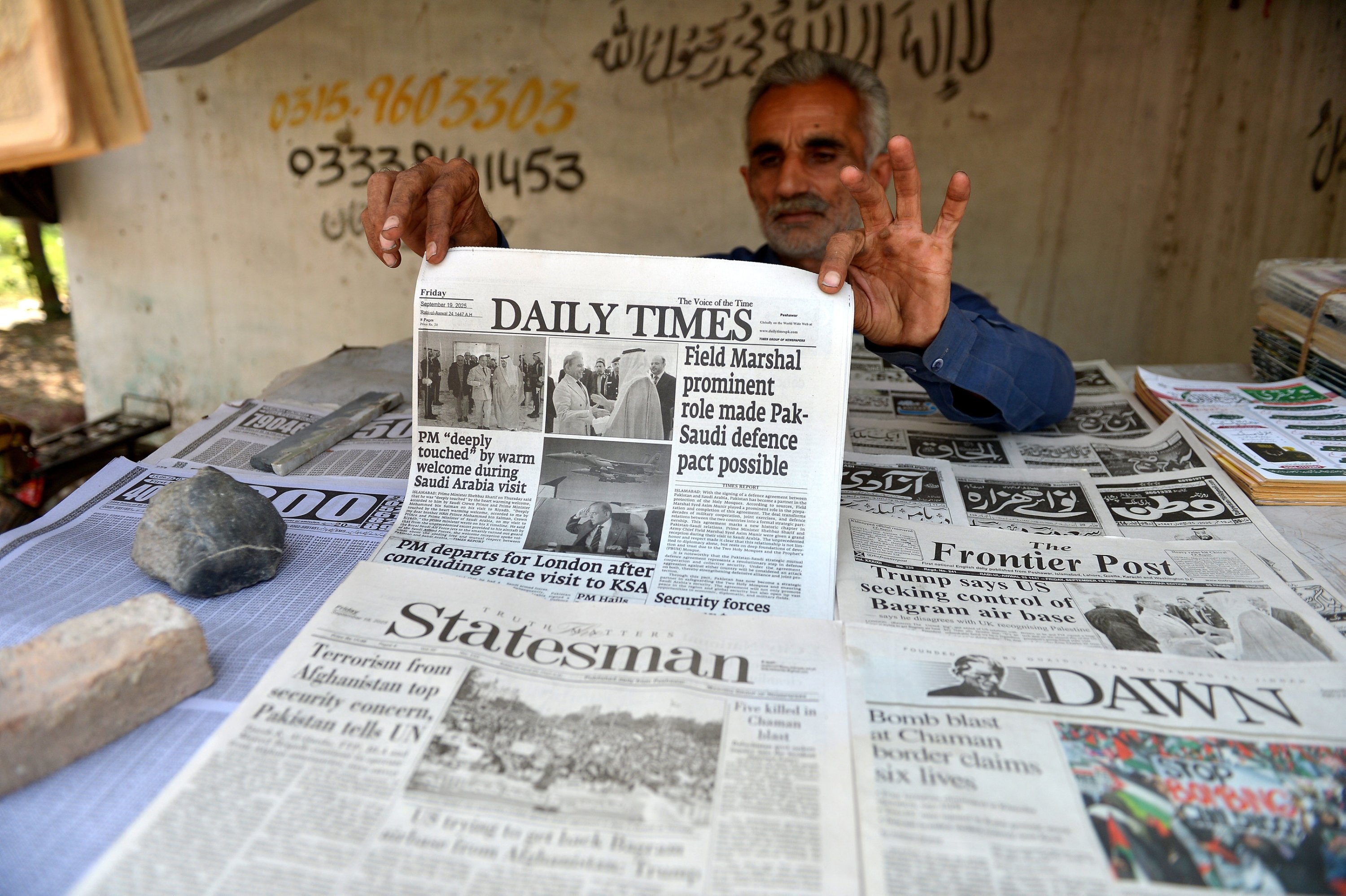
The recent Pak-Saudi defense pact has gathered extraordinary momentum in political circles, mainstream and digital media, social platforms and public spaces. Although the current strategic agreement represents a new development, it builds upon a history of military cooperation between Pakistan and Saudi Arabia.
Still, the deal has gained unusual momentum, drawing attention from many in the West and around the world. So, why does this defense pact matter? What does it mean for stakeholders in Europe, the Middle East and South Asia?
If you’ve ever watched the British romantic comedy-drama "About Time," which gives a young man the ability to travel through Time as he attempts to reshape his future, you’ll know it’s a story about hope and personal transformation. Unlike "About Time," however, the current defense pact is grounded in reality and tailored to confront tangible threats, namely, the "Greater Israel" project and the "Akhand Bharat" (Undivided India) mission. Evidently, both Israel and India are pursuing expansionist agendas aimed at extending their influence over vast surrounding territories.
Agreeably, the agreement divulges a "growing distrust of U.S.-led security architecture among Arab wealthy petrostates about the willingness of the U.S. to defend them against what they see as an increasingly unconstrained Israel," as Mohammad Salami, a research associate at the International Institute for Global Strategic Analysis, argues.
As an academic and media analyst, I began collecting and examining a range of media content, from traditional outlets to digital platforms. Correspondingly, I noticed wide-ranging debates and discussions emerging around the perceived, analyzed and, to some extent, genuine motives behind the original plan.
Surely, the Pak-Saudi Defense Pact triggers the same old narratives and discourse, albeit with a slightly new touch in this age of growing AI mania. It is about time we looked beneath the surface, not just at headlines and enunciated words, to understand the factual position rather than constructed discourses.
Several leading Western and Indian media outlets, including The Week, Newsweek, Sky News, DW, and The Times of India, branded the Pak-Saudi defense pact as “Islamic NATO,” while Firstpost, DD News (Doordarshan), and the South China Morning Post referred to it as “Arab NATO.”
Additionally, the sections of the western print and broadcast media reshape the same old discourses on Muslims, reflecting upon words and phrases like “Islamic Ummah,” “Islamic unity,” “Islamic bomb” and “Islamic army.” Strange though, the same media outlets in the West, Israel and India never use phrases such as “Christian bomb,” “Jewish bomb” or “Hindu bomb,” as Europe, Israel and India possess the nukes.
At times when entire Europe is on the verge of anti-Muslim riots, the colossal, systematic language is not a coincidence but a skilfully designed campaign to convince the rest of the world that Israel is (seemingly) defending itself.
Still, several leading Jewish and Israeli academics, analysts, historians and activists, including professor Amos Goldberg and Omer Bartov, argued that Israel is committing a genocide in Palestine.
The same Western media is reluctant to shed light on the role of NATO in escalating the war between Ukraine and Russia. Similarly, when the matter is defense pacts between European and the oil-rich Middle Eastern countries, the same media outlets remain silent. The contradictions are consciously made, and selective accusations are everywhere.
After reviewing the media commentary on the Pakistan-Saudi defense pact, a series of questions has arisen in my mind. Is this the beginning of a new wave of anti-Islam and anti-Muslim sentiment under the pretext of this agreement? Why is a section of the Western media seemingly facilitating Islamophobic narratives? Is the media attempting to build a case for potential aggression against other Muslim countries in the Middle East?
It is the Arab and the Muslim countries that are concerned about the Israeli regime’s expansionist "Greater Israel" project. U.S. President Donald Trump has recently tried to assure Muslim leaders that “he won’t let Israel annex the West Bank,” but what about Gaza and parts of Syria, Jordan and Lebanon that Israel has already annexed? Can Trump be trusted?
Several leading American and Israeli academics and analysts, like professor John Mearsheimer, have repeatedly revealed that Israel is the one country with real nukes and that the Middle East is facing a genuine nuclear strike threat posed by Israel.
For a long time, sections of the Indian media organizations have been crafting a narrative that “Pakistan is helping Türkiye to achieve nuclear weapons.” Such reporting replicates the Western media's portrayal of the illegal war on Iraq on the pretext of “weapons of mass destruction.”
Following the Israeli strikes on Qatar targeting Hamas leadership, many politicians, scholars and media experts have initiated a new debate: Is Türkiye next?
Türkiye is an active NATO member, but given Israeli Prime Minister Benjamin Netanyahu’s bloody past and apparent love for scheming to start wars, Ankara has increasingly been on high alert over Tel Aviv’s regional ambitions. For years, many leading pundits denied the possibility of an Israeli attack on Iran, yet eventually, it happened.
So, if Türkiye, as a NATO member, is worried about becoming Israel’s next target, it is not entirely surprising, because at this point, nothing seems unlikely. This concern is reinforced by past instances where Israeli forces conducted airstrikes and ground operations against Syrian regime positions backed and supported by Türkiye. Clearly, Israel increasingly views Türkiye as a "new rising threat," which could potentially reshape regional dynamics.
Among Muslim nations, Türkiye is widely perceived as a custodian of Islamic heritage, and its leadership has consistently stood in solidarity with oppressed Muslims in Kashmir, Myanmar, Palestine, Syria, Libya, Afghanistan and beyond.
Given Türkiye’s growing role in the Middle East, it is plausible that Israel could target Hamas leadership within its sphere of influence, or even attempt to initiate uprisings. Similarly, Netanyahu recently urged Iranians to "stand against the regime." The Israeli attack on Qatar further underscores that there is no limit to what the Israeli government can do.
In the current climate with Netanyahu’s ongoing military campaigns in the Middle East, and his unwavering support for Indian Prime Minister Narendra Modi in what appears to be the making of another round of conflict with Pakistan, nothing can be predicted with certainty.
It is also highly likely that in the coming days, Iran, Türkiye, Azerbaijan and Malaysia may enter into a defense treaty with Saudi Arabia and Pakistan for mutual protection. The most striking feature of this potential pact is the principle that any aggression against one member will be considered an attack on all.
Certainly, countries like Türkiye, Iran, and others facing a real threat from Israel would seriously consider joining such an alliance. Additionally, there is a possibility of reviving the Regional Cooperation for Development (RCD) among Türkiye, Pakistan and Iran.