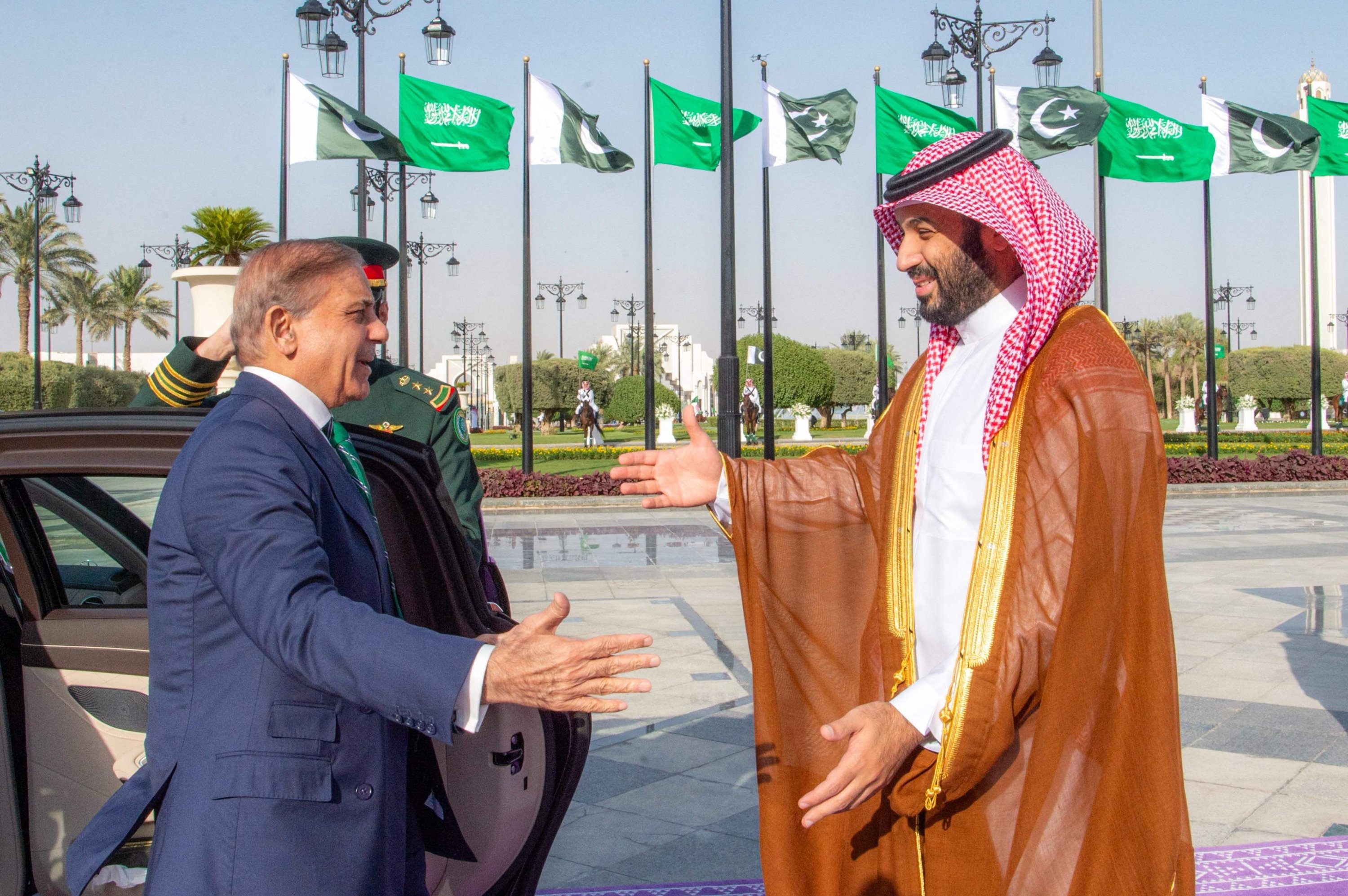
In a historic development with far-reaching implications for the Middle East and South Asia, Saudi Arabia and Pakistan have signed the Strategic Mutual Defense Agreement, taking their decades-long security partnership to a new level. The agreement was signed at Al-Yamamah Palace in Riyadh, where the Saudi Crown Prince and the Pakistani Prime Minister stood side by side, accompanied by Pakistan's Army chief, Field Marshal Asim Munir, in a rare display of military and political unity.
The timing of the agreement is as significant as its substance. It comes amid deepening Gulf uncertainty following Israel’s strike on Qatar and Washington’s muted response, which has shaken regional confidence in the reliability of traditional U.S. security guarantees. The pact’s central clause mirrors NATO’s Article 5, declaring that “any aggression against one country will be treated as aggression against both.”
This explicit commitment signals Riyadh’s willingness to diversify its security alliances and strengthen deterrence in a region increasingly defined by volatility and shifting power balances.
Saudi Arabia and Pakistan’s defense ties stretch back nearly six decades. Since 1967, Pakistan has trained more than 8,200 Saudi military personnel, provided senior military advisers and conducted numerous joint exercises. Over time, Pakistani officers have played key roles in shaping Riyadh’s defense institutions, fostering a unique trust between the two nations.
What sets this latest agreement apart is its formalization of what had long been an informal understanding. It shifts the relationship from transactional cooperation to a legalized collective defense, establishing mechanisms for consultation and coordinated military action.
The symbolism surrounding the signing was unmistakable. Prime Minister Shahbaz Sharif’s aircraft was escorted into Saudi airspace by F-15 fighter jets, and he was welcomed with a 21-gun salute, an honor reserved for the kingdom’s closest allies. The timing was also significant: the agreement followed a joint Arab League-Organisation of Islamic Cooperation (OIC) summit in Qatar, where member states condemned Israel’s attack on Doha and called for “mechanisms of mutual security and deterrence.” According to summit minutes, there was quiet but growing recognition that the region must take its security into its own hands.
The agreement lays out a framework for binding defense cooperation. In the event of external aggression, either country can request consultations and coordinated military action. It also expands collaboration in intelligence sharing, advanced weapons procurement and joint exercises.
Speculation has swirled on social media about whether the pact grants Saudi Arabia access to Pakistan’s nuclear deterrent, but officials have offered no evidence to support this. A senior Saudi official, speaking to Reuters, clarified that the agreement is “not a response to specific countries or events, but the institutionalization of a historic partnership.”
While the ambiguity may serve as a deterrent, there is no indication of a doctrinal change in Pakistan’s nuclear policy. As analysts note, ambiguity is often deliberate in defense diplomacy, adding psychological weight without triggering direct escalation.
Pakistan has a long history of defense agreements, dating back to its 1954 Mutual Defense Assistance Agreement with the U.S., as well as its participation in SEATO and the Baghdad Pact (CENTO) during the Cold War. None of those alliances ever transferred nuclear capabilities to other states.
Today, Pakistan’s nuclear doctrine remains India-centric, designed primarily to deter threats from its eastern border. As Rabia Akhtar, director of the Center for Security, Strategy and Policy Research (CSSPR), explains, defense cooperation does not equate to an automatic pledge to war. Similarly, signaling is not the same as extending a nuclear guarantee. The mere presence of Pakistan’s nuclear capabilities adds strategic weight to the pact, but there is no formal commitment to deploy them on Saudi Arabia’s behalf. The agreement should be viewed as a codification of solidarity, rather than a nuclear umbrella.
The geopolitical context makes this agreement especially consequential. Israel’s strike on Doha has raised fundamental questions about regional stability and the credibility of U.S. security guarantees. Many Gulf leaders now privately question whether Washington can or will act decisively to prevent unilateral actions that could ignite broader conflicts.
Saudi Arabia, historically dependent on U.S. protection, appears to be hedging its bets. By formalizing defense ties with Pakistan, Riyadh is signaling that it will not remain vulnerable or isolated. These defense commitments are likely to be complemented by increased Saudi investments in Pakistan’s energy and infrastructure projects, linking the pact to broader regional economic realignments such as China’s BRI 2.0 and Saudi Vision 2030.
This is about Saudi Arabia's efforts to diversify its security and defense partnerships, a move that comes at a time of mounting and escalating geopolitical instability and intensifying conflict dynamics in the Middle East. The Saudi-Pakistan alliance will reverberate across the region. The pact strengthens Gulf security architecture independent of U.S. guarantees. For the broader Middle East, it may signal a drift toward multipolar security arrangements. It could push other Gulf countries to consider similar pacts with regional players to offset declining trust in Washington.
The Qatar summit of Arab League and OIC leaders was a pivotal backdrop to this agreement. In the closed-door session, leaders openly debated the consequences of Israel’s actions and the West’s muted response. According to diplomats present, there was a growing sense that the region could no longer rely on external powers to provide its security.
The Israeli strike and Washington’s silence beg uncomfortable questions: Can Western states continue to champion an international rules-based order while supporting a state that so openly disregards those very norms? Does unwavering Western backing for Israel risk eroding its moral authority among non-Western nations?
In the summit corridors, a silent buzz circulated that this moment could spark a realignment of alliances in the Middle East. The Saudi-Pakistan pact may well be the first visible step toward that shift.
The Strategic Mutual Defense Agreement between Saudi Arabia and Pakistan represents more than a bilateral military pact; it is a strategic declaration of independence. For decades, Riyadh relied on U.S. guarantees, while Pakistan’s defense posture remained mainly focused on South Asia. This agreement rewrites that equation, institutionalizing Muslim-world solidarity and signaling a move toward a multipolar regional order.
It sends a message to Washington that Gulf states will hedge their bets and no longer rely exclusively on U.S. protection, which could affect the U.S. influence in the Middle East. To Israel, that unilateral actions will now face a collective response. To the broader Muslim world, unity is possible when core security interests are at stake. History may remember this pact as the moment the Gulf seized control of its destiny, forging a new security order shaped not in Washington or Brussels, but in Riyadh, Islamabad and Doha.