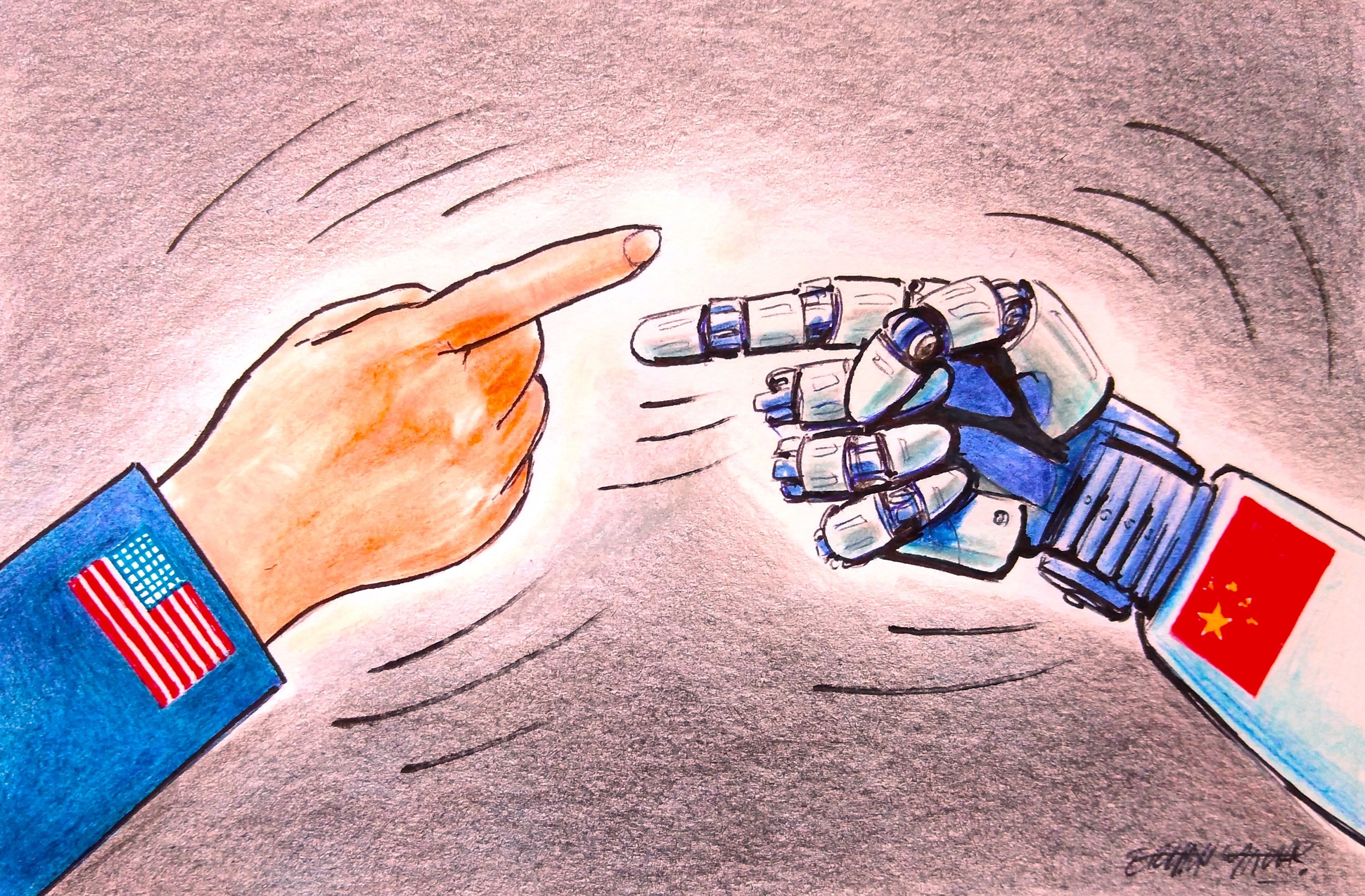
On June 8, 2026, the Pentagon expanded its “Chinese Military Companies” list from 134 to 188 firms. Among the newly added companies are Alibaba, one of the world’s largest e-commerce platform, BYD, a leader in the global electric vehicle market, and Baidu, China’s leading search and AI company. The list also includes robotics company Unitree, biotechnology firm WuXi AppTec, solar panel manufacturers JA Solar and Trina Solar, and battery producers CALB and EVE Energy. The significance of the 1260H list lies not only in the companies it names, but in the sectors it reclassifies: cloud computing, batteries, robotics, biotechnology, solar energy, artificial intelligence, and platform infrastructures are no longer treated as purely commercial domains.
This expansion is neither coincidental nor a one-off move. The so-called 1260H list (the legal basis for the Pentagon’s move is Section 1260H of the 2021 National Defense Authorization Act) is the latest and most comprehensive expression of the technological decoupling that has been systematically constructed between the U.S. and China over the past five years. This decoupling did not occur through a sudden rupture, but through a layered process of accumulation: first came semiconductor export restrictions, then screening mechanisms for AI investments, subsequently, the questioning of research partnerships seeped into the academic sphere. Now, with this list covering 188 companies, decoupling has come to encompass the entire commercial technology economy. Each step made the next one possible, each restriction transformed separation into an undeniable norm. If the Pentagon today designates BYD and Alibaba as military entities, this means one thing: Washington is now redefining which sectors count as “commercial.”
At the center of this redefinition lies the distinctive nature of AI. Unlike previous technological transformations, AI is not confined to a single sector or a specific field of use. The same model can perform medical diagnosis, optimize logistics, detect cyber vulnerabilities, and be integrated into targeting systems. This multi-layered capacity for use makes AI, by definition, a dual-use technology. China internalized this reality early on as a policy principle. The New Generation Artificial Intelligence Development Plan, which entered into force in 2017, and the subsequent deepening of military-civil fusion placed civilian technology companies within a broader framework of national defense, security, and strategic technological capacity. Therefore, Alibaba’s cloud infrastructure, Baidu’s AI models, and BYD’s battery technology cannot be assessed outside this framework.
Yet this is precisely where the core issue comes into view: the entanglement of civilian technology with military capacity to this degree is not a choice unique to China. It is a structural consequence of the nature of AI itself, accompanied by the pressure coming from the great-power competition. For example, the U.S. is fully embedded in this process as well. The transformation of Starlink into the backbone of battlefield communications in the Russia-Ukraine war, the use of OpenAI models in military logistics and intelligence analysis, and the operationalization of Anthropic’s Claude model on classified networks all demonstrate that AI companies are, in practice, becoming actors in the defense industry. The difference is this: In China, this transformation is mandated by the state and institutionalized at the level of doctrine. In the U.S., it takes shape through contracts, export restrictions, and legal mechanisms, often accompanied by debate and objection. The mechanisms differ, but the outcome is largely similar.
Against this backdrop, a fundamental question emerges: in a competitive environment where AI, autonomous systems, and advanced manufacturing technologies have become so decisive, is the boundary between the civilian and the military still a functional concept? The answer to this question will shape the international order of the coming decade.
As noted above, the U.S. is also drawing commercial technology companies into the orbit of national defense. Yet the cooperation with Anthropic is especially distinctive because it reveals not only the dynamics of U.S.-China technological rivalry, but also the future trajectory of the American state and geopolitics in the age of AI.
Anthropic had cooperated with the Pentagon by allowing Claude to be used on classified networks, but the relationship became strained when the company resisted demands to remove limits on mass surveillance and fully autonomous weapons use. The dispute escalated when Anthropic was designated a “supply chain security risk” by the Pentagon. The conflict then deepened in early June, when U.S. President Donald Trump signed an executive order opening the way for up to 30 days of federal pre-release review of frontier AI models. Shortly after, on the evening of June 12, Anthropic received an export-control directive from the Department of Commerce prohibiting access to Fable 5 and Mythos 5 by foreign nationals, including some of the company’s own employees. Since the only way to comply was to shut the models down entirely, an AI system made publicly available only days earlier became inaccessible overnight.
The Anthropic case matters here not because it replaces the China case, but because it shows that the collapse of the civilian-military boundary is not only a Chinese phenomenon, but it is becoming the operating logic of AI geopolitics itself. What begins as a dispute over one company’s models quickly becomes part of a broader decoupling dynamic, in which advanced AI systems, cloud infrastructures, chips, batteries and data architectures are pulled into competing strategic ecosystems. The result is not simply the restriction of a single technology, but the gradual fragmentation of the global technology market into zones of trust, exclusion and dependency. In this sense, the 1260H list and the Anthropic dispute point to the same geopolitical reality: In the age of AI, access to technology is increasingly determined not by commercial demand alone, but by where a company, a state, or an infrastructure sits within the emerging map of great-power rivalry.
This process reveals two fundamental transformations in global affairs.
First, dual use is no longer the exception; it is the rule. The boundary between civilian technology and military capacity has effectively disappeared. Cloud infrastructure can serve intelligence analysis. Autonomous vehicle systems can be transformed into unmanned combat platforms. Biotechnology firms may contain capacities for both pharmaceuticals and defense research. Cybersecurity models can function simultaneously as shields and weapons. From this perspective, the designation of Chinese companies such as Alibaba, Baidu, BYD, Unitree, and WuXi AppTec is not surprising: their technologies operate precisely in those strategic sectors where civilian innovation can rapidly become military capability. For this reason, it is also not surprising that Anthropic’s Mythos model triggered Treasury Department meetings and Wall Street alarms as soon as it was released: the model was capable of detecting software vulnerabilities that had remained undiscovered for decades. Is this a cybersecurity tool, or a cyber weapon? The answer is no longer technical, but political. The frameworks that separate technology into commercial and military categories have fallen behind reality.
Second, the relationship between the state and the private sector has become a defining fault line of great-power competition. The nature of a technology company’s relationship with a given state now directly determines whether the rest of the world can access that company’s products. For every country that uses, adopts, or integrates the technologies of the 188 companies on the 1260H list, this becomes a silent but weighty forced choice. A government that purchases BYD vehicles, uses Alibaba Cloud or integrates Baidu’s AI into public systems is not making merely a technical choice. The technology with which you build determines whose data architecture, whose regulatory framework, and whose security ecosystem you will belong to tomorrow. Technology procurement has become a new dimension of alliance politics.
The 1260H list can be read as a sanctions document. But a more accurate reading is this: The list is the official declaration that great powers no longer see technology as a sphere of commercial activity, but as a question of sovereignty. Alibaba’s denial, BYD’s objection and Anthropic’s court battle are three separate fronts of this transformation. A purely civilian AI company, a purely commercial manufacturer or a purely independent technology firm no longer exists in any meaningful sense. The states, companies and analysts that grasp this earliest will hold a decisive advantage in the competition of the next decade.