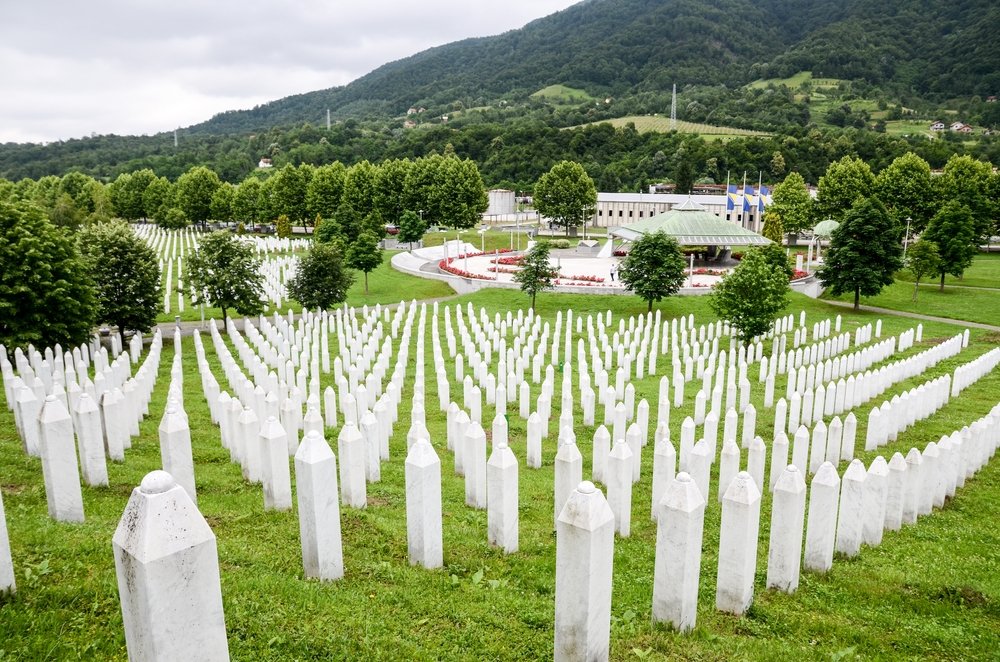
In December 2021, I traveled to the Srebrenica Memorial Center in Potocari. It was less a research visit than an ethical pilgrimage to one of the defining moral failures of contemporary Europe. As genocide scholar Kjell Anderson has argued, remembrance is not only about the past; it helps shape the ethical foundations of the future. Remembering Srebrenica, therefore, is not simply Bosnia-Herzegovina's responsibility. It is a measure of Europe's own moral credibility.
Upon arrival, we were welcomed by the remarkable team entrusted with preserving the memory of the more than 8,000 Bosniak men and boys murdered in July 1995. Among them was Emir Suljagic, himself a survivor of the genocide and today the director of the Srebrenica Memorial Center. His personal survival has become institutional resistance. Every archive, testimony, exhibition and educational program maintained by the center resists erasure.
Yet before we entered the center, I witnessed something that has remained with me ever since.
As our group, which included several women wearing the hijab, crossed the pedestrian crossing outside, a vehicle accelerated toward us. The women hurried across in alarm. I froze, assuming the driver had lost control. At the last moment, however, the vehicle swerved away. The driver thrust a fist from the window, screamed abuse and sped off.
Standing there, I realized that the Memorial Center itself had become an object of resentment. The rows of white gravestones, the preserved testimonies and the institution's very existence continue to confront those unwilling to acknowledge what occurred in July 1995. Memorials are not passive spaces. They force societies to confront responsibility, identity and denial.
Genocide scholars have long recognized denial as one of genocide's final stages. Denial does not simply dispute a crime; it seeks to strip victims of recognition and to weaken the historical record itself. Institutions such as the Srebrenica Memorial Center therefore do more than commemorate. They defend truth and preserve the dignity of those who were murdered.
Political pressure, genocide denial, investigations and institutional intimidation have surrounded the Srebrenica Memorial Center for years. But recent public warnings by Emir Suljagic are deeply troubling. He has expressed concern that authorities in Republika Srpska may be preparing coercive measures directed at the Memorial Center, including what he has described as the possibility of a police operation intended to intimidate the institution and undermine its leadership.
Suljagic has argued that transparency is now the center's greatest safeguard because secrecy benefits only those seeking to intimidate it.
All these mean that preservation of historical memory has become politically threatening for some. That makes protecting memories more important than ever.
Most recently, while attending meetings at the United Nations in New York, I watched testimony by Almasa Salihovic during an event. I had met her years earlier as a survivor of the Srebrenica genocide. Today she works as an educator at the Memorial Center. In her remarks, she spoke not only of unimaginable personal loss but also of the continuing responsibility borne by survivors to educate future generations and preserve the historical record.
Her testimony was a reminder that Srebrenica is not ancient history but a living memory.
There is no serious legal dispute over what occurred. The International Criminal Tribunal for the former Yugoslavia ruled in Prosecutor v. Radislav Krstic that genocide was committed in Srebrenica, a finding later reaffirmed by the International Court of Justice. The United Nations General Assembly designated July 11 as the International Day of Reflection and Commemoration of the 1995 Genocide in Srebrenica.
Legally, Srebrenica is settled history. Politically, it remains contested.
Recognition is insufficient if the institution entrusted with preserving that history remains vulnerable to intimidation. The assault on memorial institutions rarely begins with physical destruction. More often, it begins with efforts to delegitimize their work, intimidate their staff and erode public confidence in the historical record they preserve. Defending the Srebrenica Memorial Center is therefore not simply about protecting a building. It is about protecting the integrity of historical truth itself.
This raises profound questions about Europe's post-war moral order. Much of Europe's democratic identity has been built upon the promise that genocide would never again be permitted to occur or be forgotten.
If Europe truly regards Srebrenica as central to its post-war moral identity, protecting the institution entrusted with preserving that history cannot be optional. It must become a test of Europe's commitment to "Never Again."
So, two questions demand answers. What concrete measures is the European Union taking to ensure that institutions dedicated to genocide remembrance can operate freely and safely? And how will European institutions respond when those preserving internationally recognized historical truth become targets of political pressure?
The European Union has repeatedly condemned genocide denial, the glorification of convicted war criminals and historical revisionism. Those principles must now be matched by sustained institutional support.
The Srebrenica Memorial Center is not merely a museum. It is one of Europe's most important institutions of genocide documentation, preserving forensic evidence, survivor testimony, judicial archives and the historical record upon which international criminal accountability depends. It performs the work of scholarship, education, remembrance and democratic vigilance at the same time.
Every genocide unfolds in stages. The killings eventually end. Yet denial, distortion, intimidation and historical revisionism can continue for generations. Protecting institutions such as the Srebrenica Memorial Center is therefore not only about preserving the past. It is about safeguarding Europe's democratic future.
When I visited Srebrenica nearly five years ago, I left convinced that remembrance requires extraordinary courage. Today, that conviction has only deepened.
The international community should not wait for another crisis before responding. European institutions, democratic governments, universities, human rights organizations and civil society should publicly reaffirm their support for the Memorial Center and closely monitor any actions that threaten its independence or intimidate its staff.
The victims of Srebrenica deserved justice. The survivors deserve security.
When institutions of memory become targets, silence is no longer neutrality. And the institution entrusted with preserving one of Europe's darkest chapters deserves more than solemn commemorations each July.