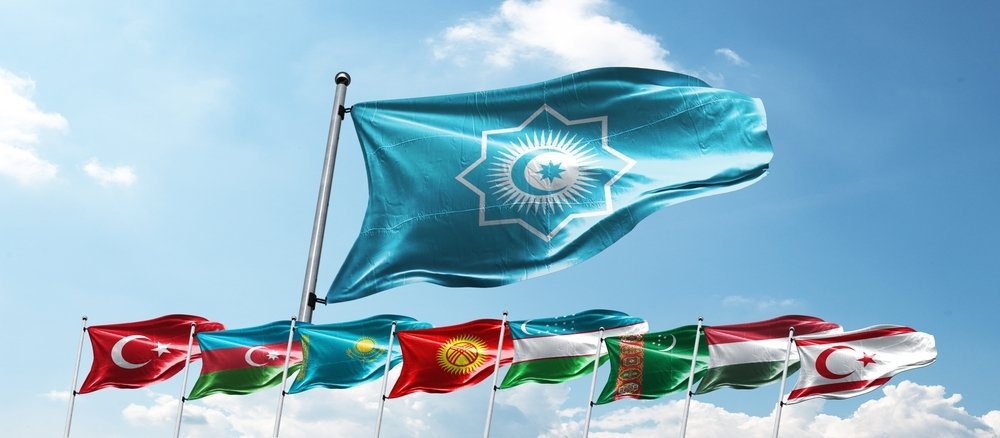
As competition grows between world powers, namely the U.S., Russia and China, a new player is quietly emerging in Eurasia. The main argument is that the “Turkic world” is becoming a distinct and influential bloc, surpassing its former identity of language and culture. With 166 million people, a $1.7 trillion gross domestic product (GDP) and a vast territory, it is now positioned as a key player in world affairs.
While some experts compare this bloc to the European Union with approximately 450 million inhabitants, others consider this comparison “meaningless.” Unlike the EU’s 27 member states, the Turkic world comprises only seven countries: Türkiye, Azerbaijan, Kazakhstan, Uzbekistan, Turkmenistan, Kyrgyzstan and the Turkish Republic of Northern Cyprus (TRNC), yet it has significant potential. This “concentrated power” offers geopolitical efficiency that could change the global balance.
The Turkic world stands out for its natural gas reserves, which total 25 trillion cubic meters, or 13% of the world's supply. This exceeds the combined reserves of the U.S. and Saudi Arabia.
However, the region's importance lies in its role as the “heart” of strategic energy corridors. Gas pipelines such as the Trans-Anatolian Natural Gas Pipeline (TANAP), the Trans Adriatic Pipeline (TAP), TurkStream, the Baku-Tbilisi-Ceyhan (BTC) pipeline and the Baku-Tbilisi-Erzurum (BTE) pipeline are essential to the current security of Europe's energy supply.
Despite the sanctions imposed on Russia after the war in Ukraine, more than half of Russian gas exports to Europe in 2023 passed through these pipelines.
In addition, the region holds approximately 1 million tons, or 16% of the world's uranium reserves. With nuclear energy expected to account for 30% of global electricity by 2050, the region's uranium positions it as a key player in future energy transitions. This underscores its importance to Europe's energy security.
Beyond energy, the Turkic world is redefining its role as a global trade hub, as evidenced by the Central Corridor's development and China's approach.
As global trade routes are being redrawn, the Turkic world finds itself at the very heart of this change with the “Central Corridor.” While China's Belt and Road Initiative (BRI) covers 70% of the world's population and 75% of global energy resources, Türkiye is an indispensable hub of this project.
Beijing is using this corridor not only as a trade route, but also to “circumvent” the U.S. containment strategy. With a potential annual trade volume of $600 billion, this route offers the shortest and least expensive link between London and Beijing, giving Turkic-speaking states a central authority in global logistics.
Another significant route for the Turkic world, the Zangezur corridor emerged from evolving security considerations. The process began following the July 2020 conflict in the Tovuz region on the Azerbaijani border.
Why Tovuz? All critical routes, such as BTC, BTE and the Baku-Tbilisi-Kars railway, pass through there. This attack was a “tipping point” for Ankara and Baku, leading to unprecedented military integration. After their victory in Karabakh, the Zangezur corridor became the key to the Turkic world's physical independence, providing Türkiye and Central Asia a direct connection without reliance on Iran, Armenia, Georgia or any third country.
Turkic states can be considered individual regional actors, but their collective capacity plays an important role in the global system. The Composite Index of National Capability (CINC), which measures a state's national power, assesses six essential elements: population, urban population, steel production, energy consumption, military expenditure and military personnel. In this equation, the total CINC for the Turkic world is 0.02287. This figure ranks the bloc eighth globally in cumulative capacity.
Türkiye, the driving force behind this bloc, ranks 17th in global GDP, 22nd in military spending and 15th in army size, reinforcing its image as a “rising power.”
The region is at the heart of the current geopolitical dynamics between Russia, China and the U.S., and Türkiye's increased engagement is challenging their policies in the area.
Türkiye pursues two main strategies in the Turkic world: leveraging emerging opportunities and taking advantage of major power competition. While Russia remains involved in Ukraine and China tackles its energy dependencies, the U.S. is engaging in C5+1 diplomacy. Türkiye, for its part, is strengthening its strategic autonomy through its role in the Turkic world.
The framework for integration was set out during the Turkic World Vision 2040, which was approved at the 8th OTS Summit in 2021. The document covers initiatives such as adopting a common alphabet and unified terminology, coordinating history teaching, and cooperating on defense, indicating a move toward deeper integration based on identity beyond the economy.
Once considered peripheral, the Turkic world is now becoming a central force within the global system. With its concentration of energy, trade and military resources, it has the potential to shift the balance of power between the West and the East.