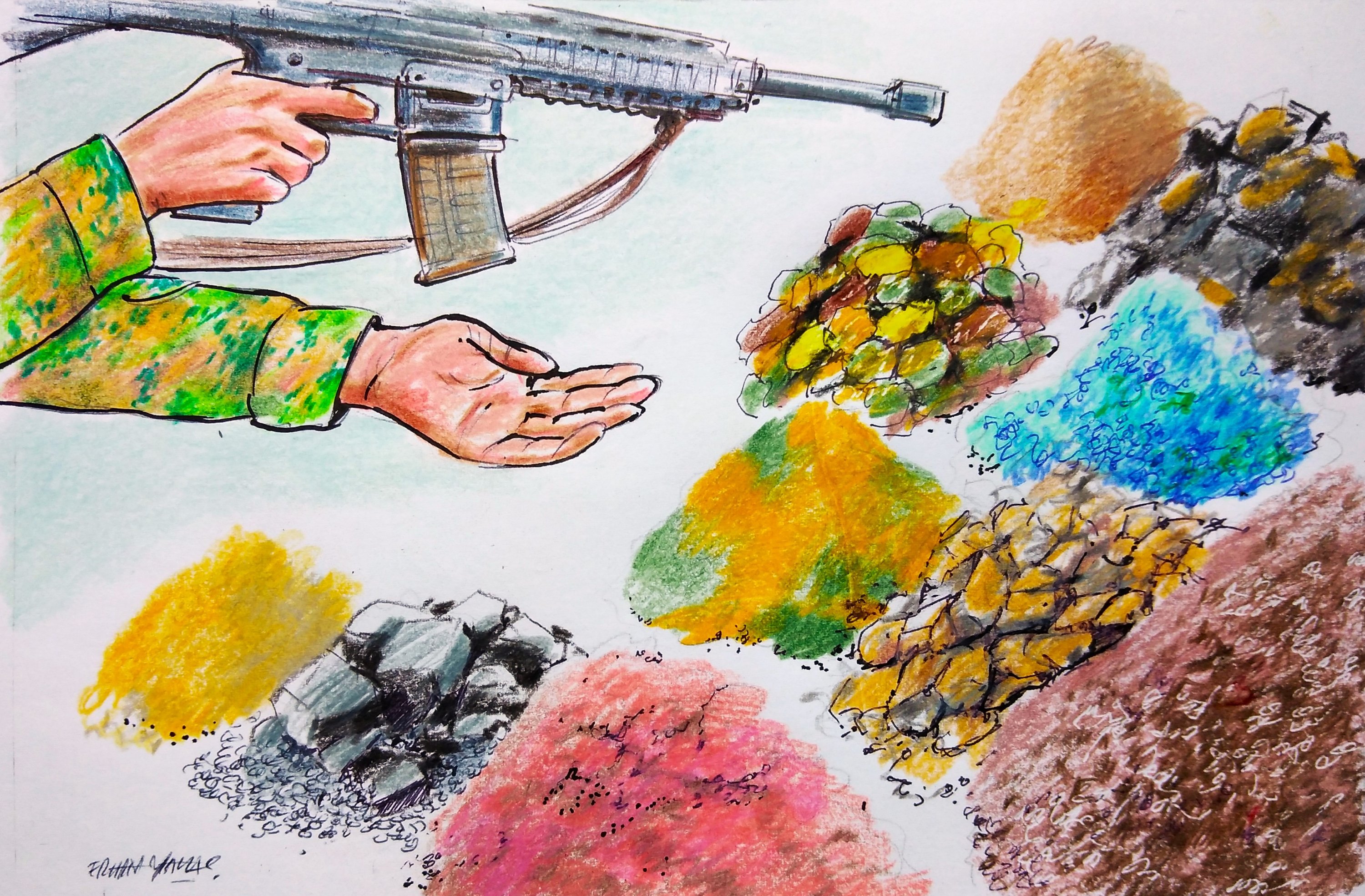
The global power struggle of the 21st century is evolving into a more complex arena of competition, moving beyond the hydrocarbon geopolitics that have long been at the center of international politics. The relatively predictable power balances of the oil and gas era have now given way to a new struggle for raw materials, legitimized by discourses of the “green transition,” “energy security” and “high technology.”
In this new era, the coordinates of the global power struggle are now defined by strategic minerals such as lithium, cobalt, copper and rare earth elements. A broad technological ecosystem, ranging from electric vehicles to the defence industry, from semiconductors to artificial intelligence infrastructure, has created absolute dependence on these elements. Consequently, critical minerals have acquired strategic importance in terms of establishing technological superiority and maintaining military deterrence.
This outlook brings Central Asia, which Halford Mackinder defined as the “Heartland of Eurasia” a century ago, back to the center of global politics. However, this time the issue is not land supremacy in the classical sense, but access to the most strategic elements of the periodic table. Kazakhstan's rare earth elements, Uzbekistan's copper and uranium deposits, and the region's overall mineral potential make Central Asia indispensable in the competition between major powers.
From the perspective of the U.S., this process is clearly being addressed from a national security perspective. Washington now defines access to critical minerals not as an extension of free trade but as a direct strategic security issue. This approach is clearly evident in the fundamental strategic documents published by the U.S. in recent years. Indeed, the Presidential Executive Order titled “America's Supply Chains” (Executive Order 14017, Feb. 24, 2021) explicitly defines dependence on China in key sectors, including critical minerals, as a national security risk.
In this context, the question of why Central Asia should be cautious towards Washington should be approached as a rational geopolitical calculation aimed at preserving sovereignty and strategic autonomy, rather than as ideological opposition to the U.S.
For the U.S., critical minerals have become an element that defines the basis of military capacity, technological leadership and the claim to global hegemony, alongside their role as fundamental inputs for industrial production today. President Donald Trump's Executive Order entitled “A Federal Strategy to Ensure Secure and Reliable Supplies of Critical Minerals” (Executive Order 13817, Dec. 20, 2017), issued during his first term, explicitly included critical minerals in the national security category for the first time in U.S. history. Thus, a wide range of minerals, from rare earth elements to lithium, has been removed from the realm of classical economic-political debates and placed at the center of the security discourse.
This securitization process has gained a more systematic and comprehensive framework under the Biden administration. The U.S. National Security Strategy 2022 defines critical minerals and advanced technology inputs as central elements of the “strategic competition” with China, explicitly acknowledging that supply chains have become a geopolitical weapon. The document emphasises that economic interdependence does not produce stability but rather creates strategic fragility.
When these three documents are considered together (Executive Order 13817, Executive Order 14017, National Security Strategy 2022), it is evident that the U.S. has entered a new era in its foreign policy where trade and investment are entirely securitized. The meaning of this new paradigm for Central Asia is extremely clear: the region is the target not only of promises of economic cooperation but also of the harsh pressure tools of great power competition.
Washington's engagement with Central Asia, while presented on the surface as investment, technology transfer and an “alternative supply chain” narrative, is fundamentally aimed at limiting China's economic and strategic influence in the region. This situation inevitably leaves Central Asian states caught between two centers of pressure: China's powerful economic pull and the U.S.' capacity for sanctions and normative pressure tools. Critical minerals in this equation are becoming a strategic bargaining chip for the region's countries rather than a means of prosperity.
The example of Venezuela provides a current and functional warning model for assessing the risks facing Central Asia based on its critical mineral wealth. The economic, political and institutional collapse experienced by Caracas over the past decade demonstrates that possessing strategic natural resources does not in itself generate development, stability or power within the international system. On the contrary, when these resources conflict with global hegemonic interests, they can rapidly push the country into a position of exclusion and fragility. The freezing of oil revenues, the limitation of state capacity through financial sanctions, and the severe restriction of Venezuela's access to the global financial system indicate that the phenomenon defined in the literature as the “resource curse” has taken on a more complex and multi-layered appearance in today's geopolitics.
As of January 2026, the breakdown in U.S.-Venezuela relations has taken this process to a qualitatively new stage. The abduction of Nicolas Maduro from Caracas by U.S. special forces and his subsequent transfer to New York have heightened tensions between the principle of state sovereignty and the exercise of extraterritorial jurisdiction through military force. In academic circles, this method is regarded as a “hybrid sovereignty erosion model” in which military, legal and economic instruments of intervention are used simultaneously.
When the justification for the intervention is considered alongside subsequent political statements, it becomes clear that the operation is not limited to a purely security or legal framework. The U.S. President's explicit emphasis on Venezuela's energy resources and the statements by American energy companies that they will restructure the country's infrastructure reveal that natural resources are no longer seen as elements that generate economic value, but are positioned as the financial and strategic basis for external interventions.
In this context, the example of Venezuela should be seen as an early reflection of a broader methodology that could be applied in Central Asia in the age of critical minerals. The possibility that the pressure and intervention mechanisms currently operating through oil will be adapted to the Central Asian geography tomorrow through lithium, rare earth elements and strategic metals cannot be ignored.
It is structurally possible that governments prioritizing resource nationalism, seeking autonomy in pricing and export policies, or establishing deepening economic relations with non-Western actors will face normative pressure mechanisms. The example of Venezuela demonstrates that these pressures may not be limited to the diplomatic or economic sphere, but under the right conditions, they can directly encroach on the sphere of sovereignty.
In addition to external pressure dynamics, Central Asia's internal economic and institutional vulnerabilities also deepen these risks. The failure to manage mining revenues through a transparent and inclusive development strategy, the neglect of the manufacturing industry, and the economic structure's excessive dependence on raw material exports increase the risk of “Dutch Disease.” These structural imbalances deepen social inequalities while creating a terrain that facilitates external actors' influence over internal political dynamics.
Therefore, the fundamental issue for Central Asia is not to make a short-term choice between the U.S. and China. The real strategic goal is to build the institutional capacity and regional solidarity mechanisms that can preserve room for maneuver between these two global powers. The regional states' sitting at individual bargaining tables with the great powers produces lasting vulnerabilities due to structural power asymmetries. In contrast, regional coordination and joint policy-making in the field of critical minerals (e.g., a "Critical Minerals Council" or similar institutional framework) offers a more rational path to strengthening Central Asia's strategic autonomy.