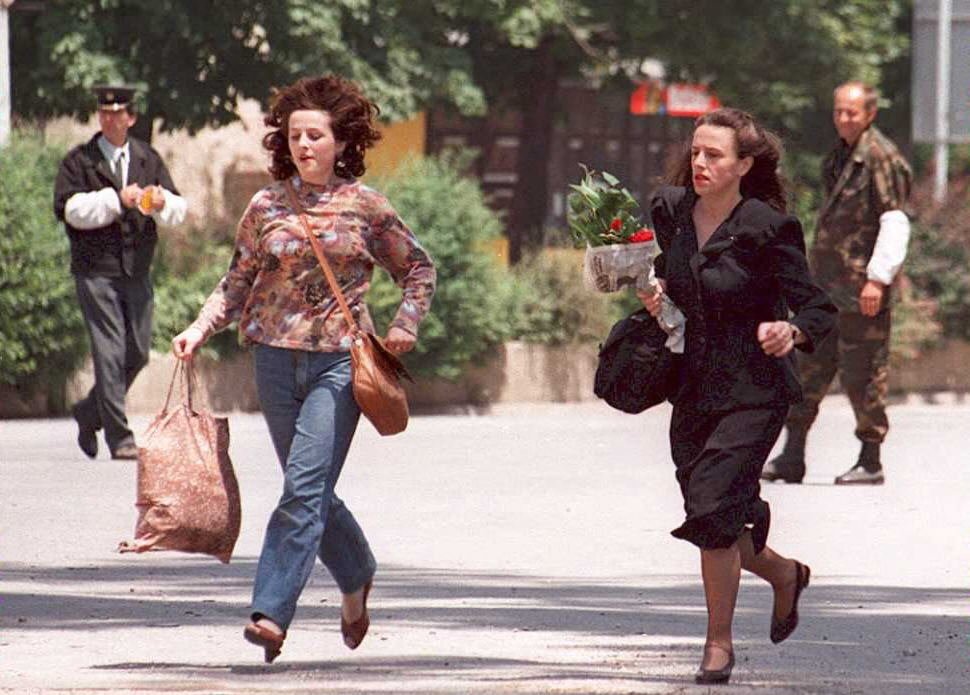
As a Bosnian Muslim, one question has followed me my entire life, a question I still cannot answer. Why were our lives considered so irrelevant during the war and genocide of the 1990s?
The world watched as thousands of us were erased: murdered, brutalized, raped, tortured and scattered in pieces across our country. For decades, I have tried to understand what happens in the human mind when it sees others not as people, but as prey, as objects so stripped of humanity that killing them becomes so easy.
And now, reports and mounting evidence suggest that Bosnian Serb nationalists were not the only ones who saw us as less than human.
There are serious allegations, some supported by testimonies before the International Criminal Tribunal for the Former Yugoslavia, that wealthy foreign men paid to shoot at civilians in Sarajevo, treating our besieged city as if it were a hunting ground.
This is where privilege becomes lethal. When someone with money, power and the comfort of distance arrives in a city starving, freezing and bombed, and believes he has the right to pull a trigger for “fun” or as a twisted form of training – that is the purest expression of dehumanization.
The story resurfaced globally after Miran Zupanic’s documentary "Sarajevo Safari." But for many who survived the siege, none of this comes as a surprise. Sarajevo whispered about it for years: how sniper activity mysteriously intensified on weekends and holidays; how someone was helping the Serb forces to sharpen their aim on people running for water or bread.
One of the most haunting cases is that of 1-year-old Irina Cisic, killed by a sniper while on a short walk with her mother in one of Sarajevo’s neighborhoods. She had just learned to walk. Her parents still ask why the adult next to her was spared. Who decided that a toddler taking one of her first steps outside a shelter was a suitable target?
Now, as these allegations move from rumor to legal scrutiny, with prosecutors in Milan opening investigations, families are demanding to know: who pulled the trigger? Did someone pay for it? Who enabled it?
Several local and regional outlets report that investigators are examining possible involvement from nationals of at least four countries. Italian prosecutors have already launched a formal probe into “sniper tourism.” Reporting and legal filings suggest that participants may have come not only from Italy but possibly from Canada, the United States and Russia. In Washington, a member of Congress has publicly pledged to investigate whether any Americans took part, a rare acknowledgment that these allegations deserve global attention, not silence.
These developments reopen painful questions about international complicity, privilege and impunity. For too long, the world has treated Bosnians as if we were a footnote of history rather than survivors of Europe’s worst atrocity since the Holocaust.
And this is where the international community must finally do what it failed to do in the nineties: stand with us, treat us as equals, and support a full, transparent, cross-border investigation, so this chapter can finally close with truth, not rumors.
After everything Bosnia has been through, it is time the world recognized that our lives mattered and still matter.
Because the cruelty we experienced is not confined to the past. When I watch the destruction in Gaza today, the killing, the starvation, the deliberate targeting of civilians, I recognize the logic that once justified violence against us. Privilege is dangerous. The idea that some lives are disposable because of their religion, nationality, or the color of their passport is dangerous.
"Sarajevo Safari" is not just a Bosnian story. It is a global warning: that entire communities can be redefined, labelled and stripped of humanity until killing them feels permissible, even pleasurable, to those who hold power.
How monstrous must a person be to fly into a besieged city, where people are dodging bullets for a piece of bread, and choose to fire on them? If these allegations prove true, what kind of moral abyss must one inhabit to pay money for the chance to kill a child? This is what happens when the world allows some to feel untouchable and others to feel disposable.
And if anyone understands what is happening in Gaza today, it is us, Bosnian Muslims. We recognize the language of dehumanization. We have heard it before: that we were smaller, less relevant, less human.
Social science research is detailed. Dehumanization, the psychological process of denying full humanity to others, enables mass violence by eroding empathy and moral restraint. It turns killing into an acceptable act.
Whether in Sarajevo in the 1990s or Gaza today, the cost is always borne by civilians.
The international community must ensure that these “human safari” allegations are fully investigated, prosecuted and exposed, not only for justice, but to reaffirm a principle we were long denied: our humanity is equal to everyone else’s. Only truth, accountability, and an insistence on shared humanity can prevent the recurrence of such horrors.