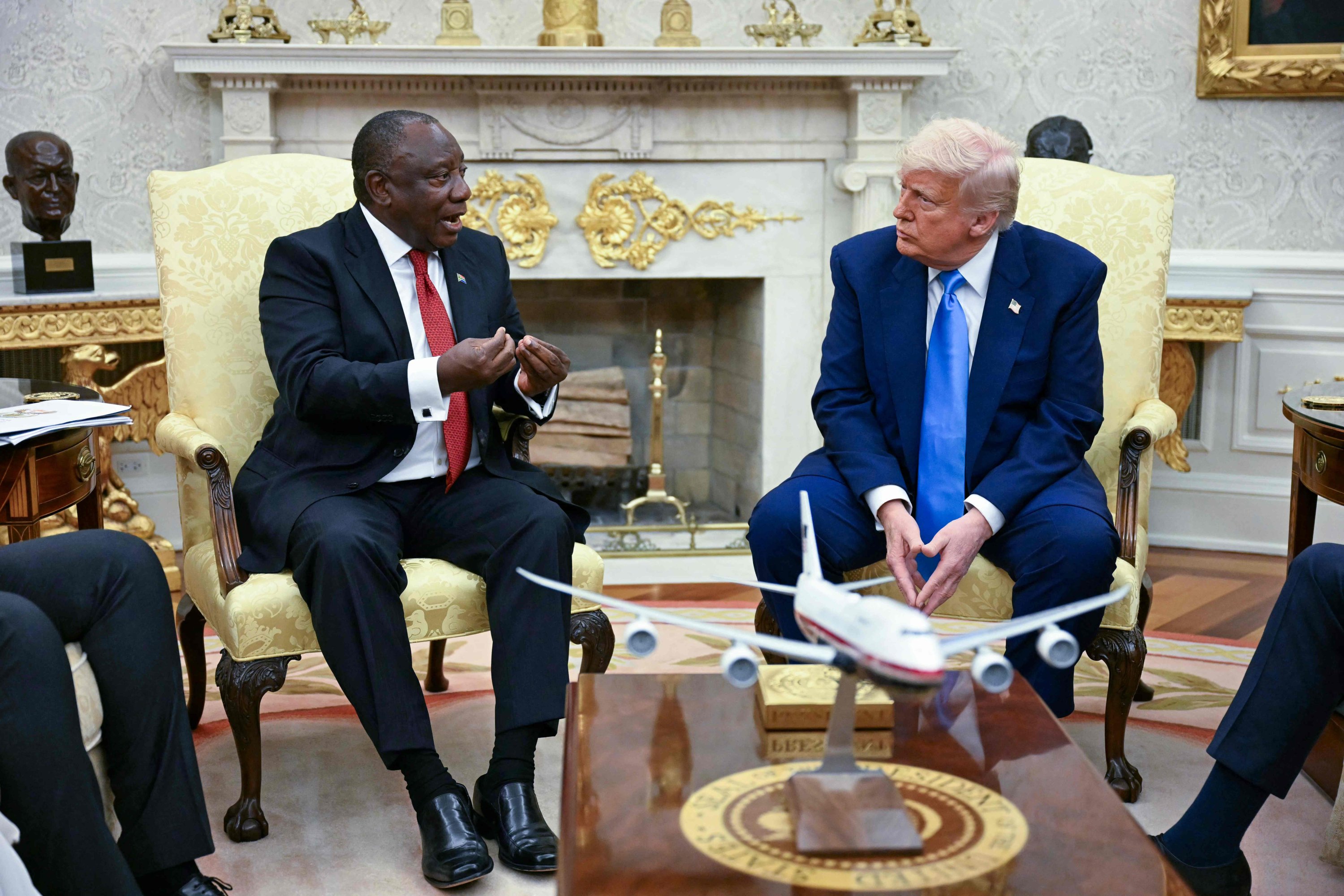
U.S. President Donald Trump added another entry to his growing catalogue of antagonistic encounters with foreign leaders at the White House – this time with South African President Cyril Ramaphosa. The meeting attracted attention due to Trump’s promotion of a strange and incendiary narrative of “white genocide” in South Africa, a claim initially amplified by Elon Musk, a “South African” himself. The allegation has since gained considerable traction among white nationalist circles in the West, bolstered by a coalition of fanatics whose unwavering priority, however, remains the defense of Israel and its irredeemable sins instead.
During his meeting with Ramaphosa, Trump played a series of video clips intended to enforce this bizarre narrative. He had already publicly described the killings of farmers in South Africa as a “genocide” whose victims “happen to be white.” Many have plausibly interpreted this extraordinary behavior as a cynical effort to undermine South Africa’s credibility following its initiation of genocide proceedings against Israel at the International Court of Justice (ICJ). Even if one were to accept everything that Musk and his ilk claim, any comparison of the killings of farmers in South Africa to the scale and severity of devastation unfolding in Gaza since Oct. 7, 2023, would be, frankly, a travesty. And it is particularly grotesque, though perhaps fitting, when such comparisons come from those who shamelessly deny or, at any rate, downplay the gravity of the systematic and deliberate destruction of the Palestinian people.
To be sure, the “white genocide” discourse is not merely part of the reactive political maneuver against South Africa’s ICJ filing. It is rather a broader and concerted effort to dilute and trivialize the concept of genocide itself, demonstrating that allegations of genocide can be made arbitrarily, regardless of substance and scale. In other words, the ultimate aim is to foster cynicism – to render allegations of genocide subjective and easily contestable, so that when Israel is accused of the same, the accusation can be framed simply as a matter of interpretation – no different, for example, from Trump’s allegation of a white genocide in South Africa.
In a sane world, this would hardly be worth discussing, of course. Yet, unfortunately, we live in a world where the ostensibly most powerful politicians prove to be utterly powerless in the face of the most horrific real atrocities. They are so powerless that they feel the need to resort to such absurd tactics. And those who would dare to show minimal sympathy for human suffering appear to be replaced by these political robots.
The phrase is accurate: Many of the world’s most powerful states appear to be run by political robots today – politicians whose speech patterns are quite literally indistinguishable from those of a carefully programmed robot. They would fail even the simplest version of the Turing test. For example, one can easily imagine a chatbot, far less “intelligent” than ChatGPT, convincing us that it, rather than British Prime Minister Kier Starmer, is the human in the other room in an imitation game.
Is this Trump’s appeal, then, that he would at least be able to pass that test thanks to his unique style of speech? Is the bar really that low? His “anti-establishment” rhetoric has been taken to be a sign of sentience – but could it rather be a sign of how advanced modern chatbots have become? Or perhaps, what people mistake for authenticity in Trump is really the output of a poorly designed large language model. His chaotic persona may not be the opposite of political robotism, but it's erratic parody – a glitch in the system mistaken for revolt.
The populist obsession with authenticity is no less hollow than the liberal obsession with decorum. Both can be fed by carefully designed chatbots in the form of “world leaders.” The notion that artificial intelligence will destroy jobs must be taken seriously, especially in this context, for if this is truly what people on both sides of the political aisle demand, then a tech mogul like Peter Thiel could give them a better product, presumably in the shape of U.S. Vice President JD Vance.