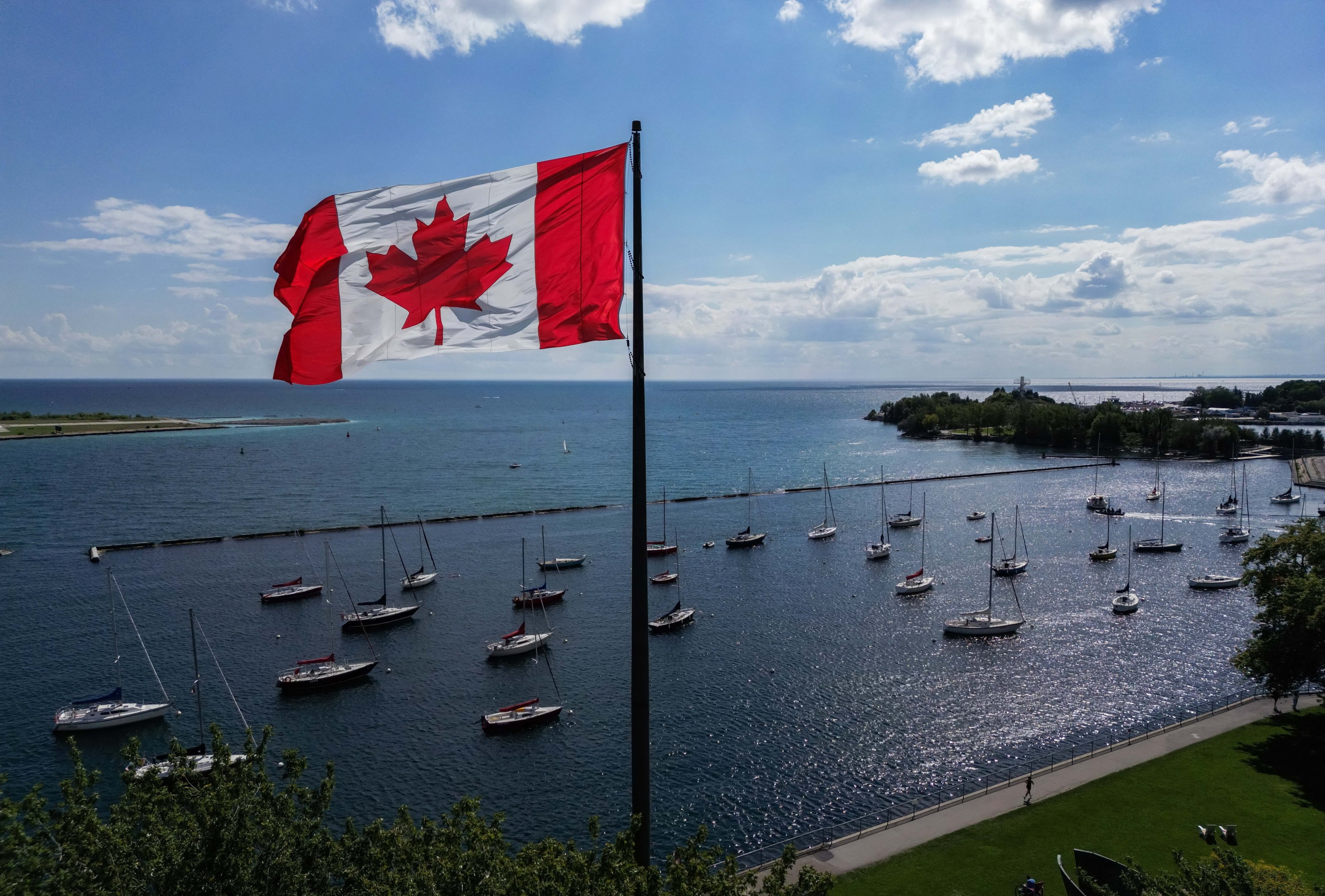
Put an American and a Canadian side by side while traveling abroad, and it is highly likely that most foreigners would struggle to tell them apart. They speak the same language, consume much of the same culture and often have more in common with each other than with almost anyone else.
This is one of the things that make the growing quarrel between Washington and Ottawa so bizarre. Few countries have more in common than the U.S. and Canada, yet President Donald Trump's increasingly aggressive stance toward its northern neighbor is turning one of America's closest friends into something resembling a foe.
And this is about much more than a trade war or another provocative remark from the U.S. president. Canada is not an enemy challenging American power. It is a NATO ally, a fellow G-7 member and one of Washington's closest economic and security partners. The two countries have closely linked industries, energy ties and supply chains, as well as a shared culture, similar lifestyles and a long history of cooperation along their border.
Damaging that relationship would be relatively easy. Finding a strategic benefit for the U.S. is much harder.
Yet Washington increasingly treats Ottawa as if America's greater power gives it the right to dictate the relationship, reflecting Trump's tendency to see power as a right to impose his will. That is a dangerous approach: might is not always right.
Trump has once again opted for tariffs as his preferred policy tool. After trade talks failed, the U.S. imposed 50% tariffs on about $20 billion of Canadian goods. Canada responded with tariffs on about $20 billion of U.S. goods.
There are legitimate disputes to negotiate. The Trump administration is entitled to protect American industries and challenge Canadian policies it deems unfair.
However, there is a big difference between tough negotiation and turning economic interdependence into a weapon.
Few relationships illustrate that distinction better than the one between the U.S. and Canada.
Consider automobiles. North American manufacturing does not neatly stop at the border. Components can cross between Canada and the U.S. several times before a finished vehicle reaches a dealership. Toyota and Honda, for example, have major Canadian production operations serving the broader North American market.
A tariff intended to punish Canada can therefore travel through the supply chain and eventually land on manufacturers, suppliers, dealerships, workers and consumers in the U.S. This is perhaps one of the weaknesses of Trump's approach: his administration treats interdependence as dependence, even though the two are completely different.
The U.S., with an economy many times larger than Canada's, undoubtedly has much greater bargaining power. But having power does not make every use of it intelligent. As the saying goes, when the U.S. sneezes, Canada catches a cold. But both sides can still get hurt.
Then came the "Lake America" provocation.
Tariffs showed the economic risks of Trump's approach, while "Lake America" showed its growing preference for symbolism over substance.
On Aug. 27, Trump signed an executive order directing the federal government to use "Lake America" instead of Lake Ontario in official U.S. references. The change was adopted by major U.S. mapping platforms, including Apple Maps and Google Maps, for users in the U.S.
The order cannot make Canadians stop calling it Lake Ontario. Nor can Washington unilaterally determine what the rest of the world calls a body of water shared by two sovereign countries, especially when the name "Ontario" itself has Indigenous roots that predate European colonization.
At precisely the moment when Washington and Ottawa needed to lower the temperature, the White House chose to place America's name on a lake it shares with Canada.
It is difficult to imagine a gesture better designed to irritate Canadians while accomplishing almost nothing for Americans.
The absurdity becomes clearer when the decision is separated from the political spectacle surrounding it. The U.S. faces strategic competition with China, instability in Europe and the Middle East, questions over the future of global trade and significant economic challenges at home.
And amid a serious confrontation with its closest northern neighbor, renaming Lake Ontario somehow became presidential business.
The episode would be amusing if the deterioration in the relationship were not so consequential.
The real problem is not what appears on a federal map. It is the message.
Foreign policy is partly about interests, but it is also about trust, status and respect. Deliberately provocative symbolism may sometimes serve a purpose against an adversary. Its strategic value is much harder to identify when directed at a friendly neighboring democracy.
Trump's earlier rhetoric about Canada becoming the "51st state" had already angered many Canadians. "Lake America" reinforces the same impression: partnership being replaced by hierarchy. What comes next? Lake Ontario is hardly the only major body of water tied to both countries. Could Lake Huron, Lake Erie and Lake Superior be next? Even Lake Michigan, whose name derives from the Ojibwe word "mishigami," meaning "large water" or "great lake," could become a target if this approach continues.
This is not only offensive to Canadians but also deeply disrespectful to the Indigenous peoples whose history, cultures and connection to these lands predate the modern borders of Canada and the U.S.
Imagine the situation reversed. If a Canadian prime minister announced that Ottawa would give a major shared geographical landmark an exclusively Canadian name, Americans would hardly see it as harmless. They would consider it a political provocation.
Canadians are entitled to the same consideration.
And Canadian public opinion suggests that the accumulation of such provocations is having consequences.
Recent polling by the Angus Reid Institute found that 79% of Canadians held an unfavorable view of Trump. More strikingly, attitudes toward Americans themselves have also deteriorated: 48% viewed Americans unfavorably, while 45% retained a favorable view.
Political disagreements with an American president come and go. Resentment toward the U.S. as a country is something considerably more difficult to reverse.
Canadian attitudes toward the trade dispute are telling. In July, 62% favored responding to U.S. tariffs with counter-tariffs, while only 7% preferred concessions.
There is a clear lesson: Pressure meant to expose Canada's weakness may instead be strengthening its resolve.
Canada is already looking elsewhere. Statistics Canada data showed the U.S. share of Canadian exports fell to about 66% in July, while exports to other markets increased. One month does not signal a major shift, and the U.S. will likely remain Canada's main economic partner.
Consumers have also started taking action, with calls in Canada to boycott U.S. products and buy Canadian instead. Many grocery stores and retailers are encouraging shoppers to choose Canadian-made goods over American ones with signs and posters. What started as political frustration can quickly turn into changing consumer habits.
Canada gets another reason to diversify each time the U.S. exploits trade as political leverage.
Washington may therefore be creating the problem it actually wants to avoid. The more it reminds Canadians how dependent they are on the U.S. market, the more Canadians are encouraged to diversify.
The damage could go beyond trade. The two countries share one of the world's longest peaceful borders, closely linked economies and deep security ties. That relationship is a strategic asset, not a weakness.
Canada is unlikely to turn its back on the U.S. But it may learn to distance itself.
If Washington wins a few concessions while jeopardizing the trust of its closest neighbor, calling Lake Ontario "Lake America" will not make the U.S. any stronger.