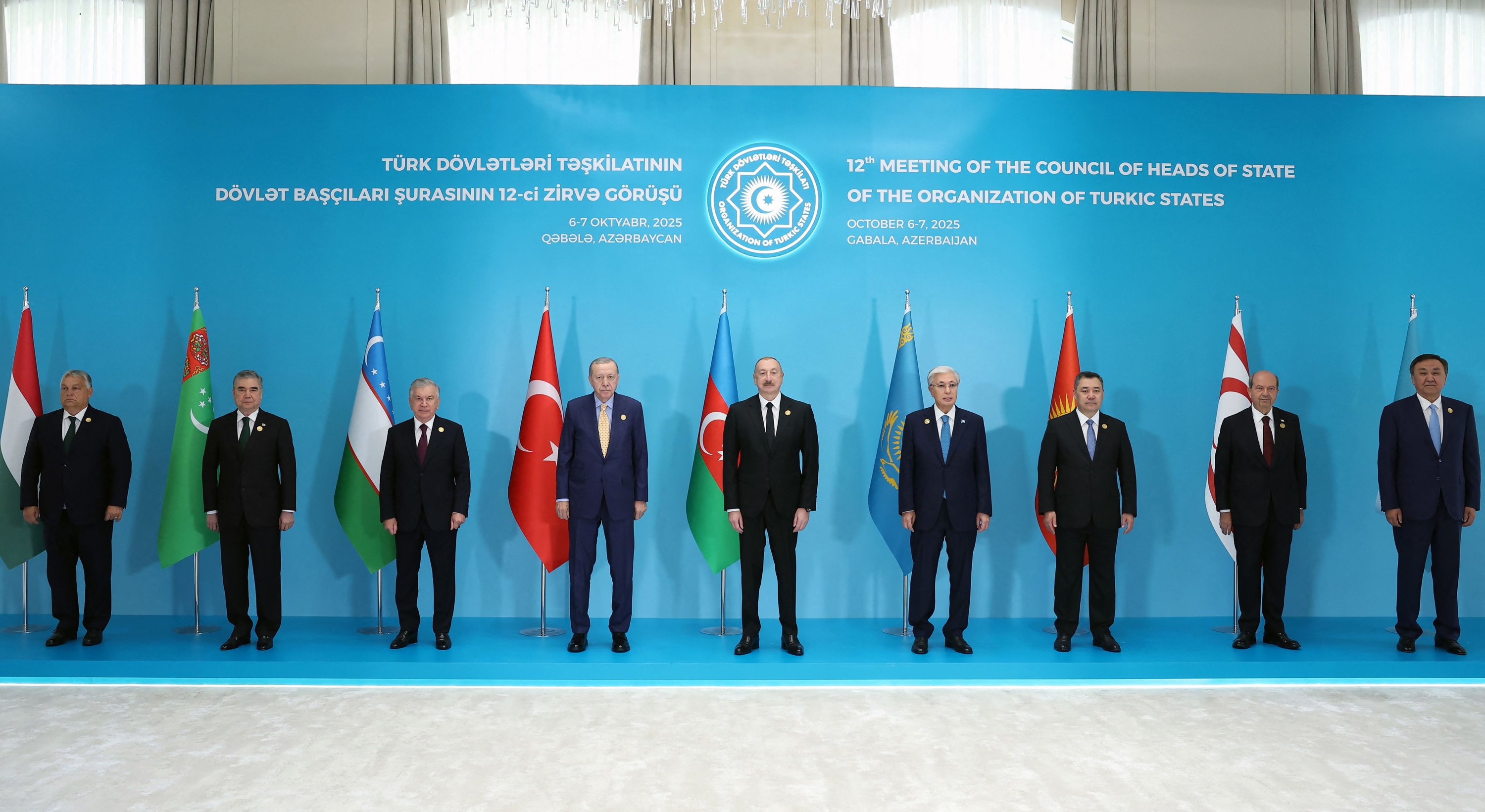
The 12th Summit of the Organization of Turkic States (OTS), held on Oct. 7, 2025, in Gebele, Azerbaijan, with the theme of “Regional Peace and Security,” is a strategic milestone that shows that the Turkic world has reached the level of institutional maturity.
The summit, hosted by President of Azerbaijan Ilham Aliyev, was attended by the leaders of Kazakhstan, Kyrgyzstan, Uzbekistan, Turkmenistan, Hungary and the Turkish Republic of Northern Cyprus (TRNC), including President Recep Tayyip Erdoğan, and the “Gebele Declaration” issued at the end of the meeting put forward the geopolitical vision of the Turkic world in a holistic framework.
Today, at a time when the international system is being reshaped, the Turkic world is in the process of transforming cultural solidarity into institutional capacity and economic cooperation into strategic integration. It is precisely at this point that the Gebele Summit, as both a symbolic and structural expression of this transformation, reinforced the rapidly strengthening identity of the OTS.
The Gebele Summit represents a shift in the OTS's security approach from a quantitative cooperation to a qualitative strategic depth. Multidimensional threats such as counterterrorism, border security, illegal migration, cyber threats and regional instability are now at the center of the security agenda of the member states. This situation shows the institutionalization of the Turkic world's quest to manage security based on its own regional capacity, without leaving it to the intervention of external actors.
One of the most remarkable initiatives at the summit was the first joint military exercise planned to be held in 2026. This step embodies the will of the Turkic states to increase coordination in the field of defense, test their ability to act together and develop common operational reflexes. In the future, the Turkic world is expected to gain the capacity for joint action in crisis management, peacekeeping and response to cross-border threats. The agreed “OTS Plus format” is likely to breathe new life into the organization's cooperation with third parties.
Likewise, the proposal for a Cybersecurity Council of Turkic States led by Kazakhstan shows that the understanding of security is being expanded in line with the requirements of the digital age. Addressing new generation threats such as cyber attacks, disinformation campaigns and data security breaches with a common security policy adds a modern dimension to the OTS' security vision.
The summit also agreed to finalize the draft “Treaty on Strategic Partnership, Eternal Friendship and Brotherhood of the Turkic States,” which aims to put the strategic relations between the member states into a permanent legal framework. This step aims to move the cooperation mechanisms of the OTS from a symbolic level to a binding basis. This agreement has the potential to strengthen the common security and foreign policy coordination of the Turkic world with international law.
Another noteworthy decision is the plan to establish a Turkic Strategic Foresight Network to increase the capacity for joint analysis and policymaking among think tanks and academic institutions. With the decision taken, this structure will contribute to the collective assessment of the geopolitical risks faced by the Turkic states, the development of strategic foresight and the creation of long-term policy scenarios. Thus, security will not only be a military issue, but will also become a field of intellectual and diplomatic coordination.
This institutional integrity displayed at the level of leaders was also reflected in the approach to regional crises. From the Palestinian issue to the rights of the Turkish Cypriot people, from the instability in Syria and Afghanistan to the peace process in the South Caucasus, the Turkic world has emphasized its determination to pursue a balanced line of diplomacy based on international law and humanitarian values. This approach of the organization proves that the OTS has become a responsible actor in regional peace and mediation.
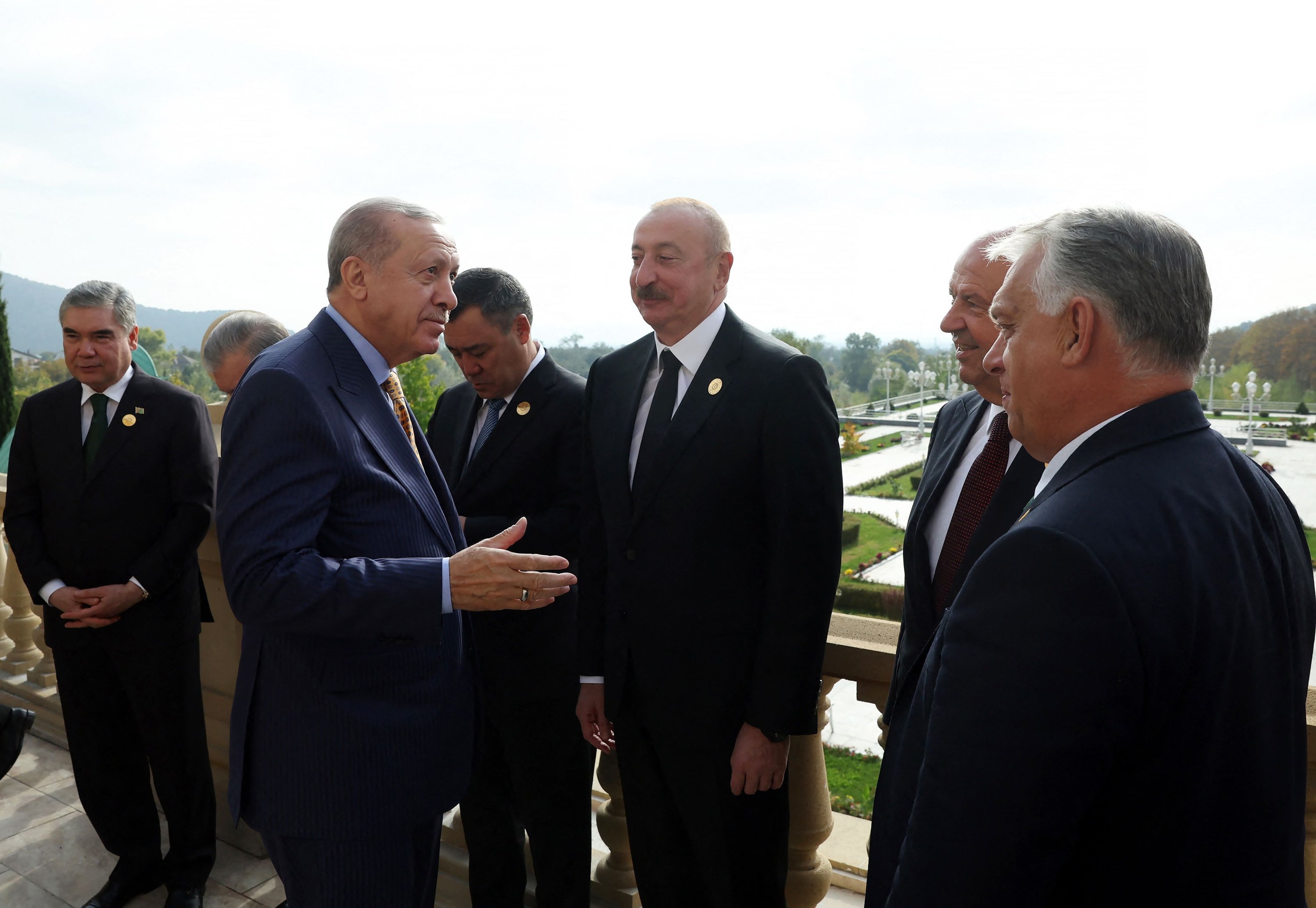
The Gebele Summit revealed that the Turkic world is moving toward a new integration model that complements each other in economic, technological and cultural fields. The OTS is now transforming into a multidimensional structure that is at the center of not only political coordination but also economic cooperation, digital transformation and cultural harmony. This change is a sign of the Turkic world moving from being a passive observer in the global system to becoming an active actor in regional development and technological production processes.
One of the most important concrete steps that came to the fore at the summit is the launch of the Turkic Investment Fund. This fund aims to support small and medium-sized enterprises, as well as infrastructure, energy and technology investments by institutionalizing the economic solidarity between Turkic states. At the same time, projects such as the digitalization of the Middle Corridor and the facilitation of data sharing in customs and transport processes aim to bring the transport and trade networks of the Turkic world to 21st-century standards.
In this framework, the expansion of Caspian and trans-Caspian transport routes is considered as one of the most critical strategic steps that will increase the geo-economic weight of the Turkic states in the Eurasian trade routes.
Another element that complements economic cooperation is the common vision put forward in the green transformation process. Regional projects developed in the fields of renewable energy generation, energy efficiency, waste management and green financing harmonize the sustainable development approach of the Turkic world with global standards. In particular, the green energy cooperation between Azerbaijan, Kazakhstan and Uzbekistan and the Turkish Green Finance Council initiative developed under the leadership of Türkiye offer an innovative model that combines energy security with environmental responsibility.
In addition to all these economic and technological transformation moves, the common cultural identity of the Turkic world is also being established on solid ground. The Common Turkic Alphabet initiative, which strengthens cultural integrity, is one of the most strategic links in this process. The common alphabet initiative represents a vision that promotes not only language unity but also standardization in the fields of common knowledge production, digital networks, media, academia and education. Türkiye, on the other hand, took the first step in this direction and presented a work on Chinghiz Aitmatov printed in the common alphabet and Oğuznames to the leaders at the summit.
The Turkic world is now connected not only by the common memories of the past but also by the strategic goals of the future. In this respect, Gebele represents a new beginning in the OTS's journey from cultural unity to strategic power and strongly reminds us that the Turkic world can now shape the future together.