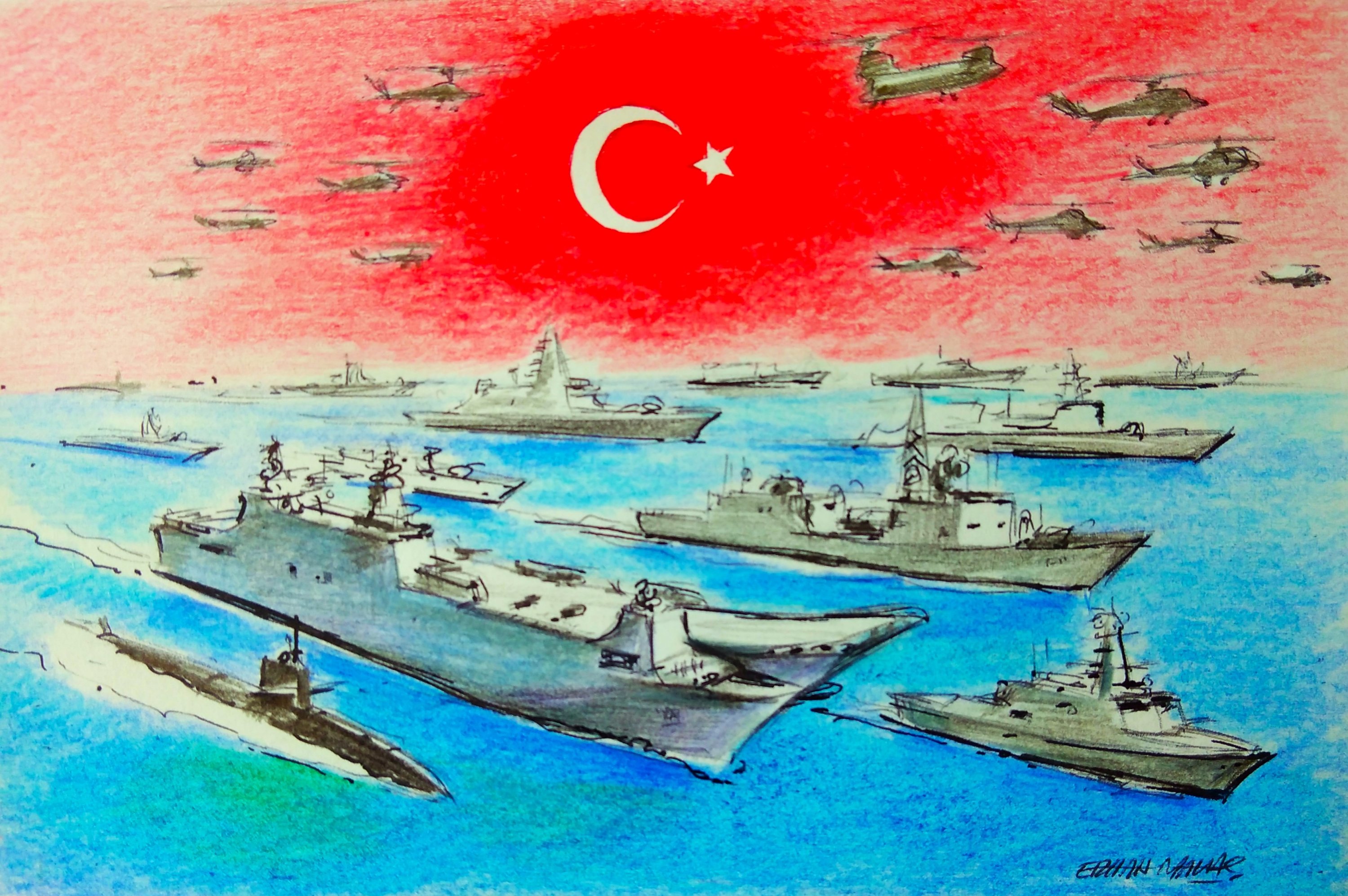
The Turkish Armed Forces (TSK) conducted the Blue Homeland-26 Exercise in the Black Sea, the Aegean Sea and the Eastern Mediterranean between April 3 and April 9, with the participation of 120 vessels, 50 aircraft and 15,000 personnel. While the Russia-Ukraine war and the U.S.-Israel-Iran war have shaken regional and global balances, the TSK demonstrated through the Blue Homeland-26 exercise that they are continuing to fulfil their role as a regional "balancing force."
The Blue Homeland doctrine is of critical importance for understanding Türkiye’s Black Sea security equation. The doctrine strongly reflects Türkiye’s resolve to protect its maritime zones and ensure maritime security. It is also a strategic stance aimed at safeguarding sovereignty rights within the framework of international law, contrary to the interpretations of administrations such as Greece and Southern Cyprus, which are considered hostile by Türkiye.
The Blue Homeland doctrine ensures that Türkiye maintains a strong position in the Black Sea, both legally and militarily, when considered in conjunction with the Montreux Convention.
Georgia in 2008, Crimea in 2014 and Ukraine in 2022, these three turning points have clearly demonstrated that the Black Sea is no longer merely a regional sea but has become one of the focal points of global power competition.
Particularly following the Russia-Ukraine war, the Black Sea has become one of the hottest flashpoints of geopolitical tension between NATO and Russia. It has, in effect, been redefined as a critical area in terms of energy, trade and military mobility. In this new equation, Türkiye has demonstrated that it is a decisive actor, not only due to its geographical location but also thanks to its military capabilities and diplomatic flexibility.
Russia’s attempts to undermine the established order in the Black Sea, as enshrined in the Montreux Convention, are in fact the result of a gradual transformation. The military intervention in Georgia in 2008 was the first sign that Moscow would not hesitate to use force in the region it regards as its immediate “hinterland”.
The 2014 annexation of Crimea, however, revealed that this approach had evolved into a permanent strategy. With Crimea, Russia has significantly reinforced its military presence in the Black Sea, strengthened its navy and enhanced its anti-access/area-denial (A2/AD) capabilities.
With the 2022 invasion of Ukraine, this military build-up in the Black Sea has now become an indisputable geopolitical reality. However, throughout this process, a significant portion of the international community has tended to view these developments not as signs of a fundamental systemic transformation, but rather as manageable and limited crises. However, the current stage clearly demonstrates that this approach contains a serious strategic and analytical fallacy and error. Today, the Black Sea faces the threat of transforming not merely into a transit route, but into a direct arena of military competition.
Just five days after the start of the Russia-Ukraine war, Türkiye declared that it was applying the wartime provisions of the Montreux Convention on the traits, having defined Russia’s intervention, which Russia had declared a “special military operation” as a “war”. In doing so, Türkiye closed the Straits to the passage of warships belonging to both the warring parties and non-regional countries, thereby once again demonstrating the strategic value of this legal instrument in concrete terms.
Türkiye’s role in this context is of the utmost importance. Unlike other Black Sea littoral states, Türkiye is one of the few actors that is both a NATO member and able to maintain direct channels of communication with Russia. However, the sustainability of this balancing act depends not only on diplomatic maneuvering but also on a robust military capability. The TSK is positioned not merely as a security provider in the Black Sea, but also as a “balancing force.” Türkiye plays a decisive role in keeping military activity in the region under control, ensuring deterrence and preventing the escalation of tensions. In this sense, Türkiye is not merely a littoral state but the main pillar of the strategic balance in the Black Sea.
Türkiye is shaping security in the Black Sea not only through military balances but also through regional and multi-layered cooperation mechanisms. The “Black Sea Mine Countermeasures Task Group (MCM Black Sea)” memorandum of understanding, signed in Istanbul on Jan. 11, 2024, between Türkiye, Romania and Bulgaria, is one of the most concrete examples of this approach. This initiative aims to clear mines drifting in the Black Sea following the war and to ensure the security of maritime trade routes.
However, the security architecture in the Black Sea is not limited to coastal states alone. The initiative to establish a Naval Component Command in Beykoz, Istanbul, as part of the “Ukraine Volunteers Coalition” currently being formed to support Ukraine, demonstrates that Black Sea security has evolved into a new dimension. This structure aims to enhance Ukraine’s maritime security capabilities and strengthen coordination in the region.
During the Russia-Ukraine war, global food security centered on grain products came under serious threat. In response to this crisis, the “Black Sea Grain Initiative,” signed in Istanbul on July 22, 2022, under Türkiye’s mediation and the coordination of the United Nations, has been one of the war’s most critical diplomatic successes. Thanks to this mechanism, established through Türkiye’s constructive diplomatic role, the safe transport of grain and food products from Ukraine’s ports of Odesa, Chornomorsk and Yuzhny was ensured. Ships were inspected via the Joint Coordination Centre established in Istanbul, thereby guaranteeing safe shipments.
Türkiye’s approach to Black Sea security, shaped by intensifying geopolitical competition and fragile regional balances, rests on a strategy that avoids escalation while maintaining robust deterrence. While Ankara remains cautious toward initiatives within NATO aimed at establishing a permanent naval presence in the Black Sea, it assesses that such steps could undermine stability under Russia’s A2/AD capabilities.
Instead, Türkiye adopts a multidimensional deterrence posture encompassing land, air, naval, cyber and space domains, placing particular emphasis on submarine capabilities, unmanned systems and advanced intelligence capacities. At the same time, this approach, centered on escalation management, seeks to prevent uncontrolled military activity in a sensitive region like the Black Sea from evolving into broader conflicts.
Security is no longer confined to the military domain. It t has acquired a multilayered character that includes energy corridors, subsea cables, trade routes and port infrastructure. Recent developments in the context of the Russia-Ukraine war, particularly Ukraine’s attempts to target tankers in the Black Sea, clearly illustrate this transformation. In the face of such asymmetric warfare methods that risk undermining freedom of navigation, Türkiye continues its diplomatic engagements with all relevant actors, calling on the parties to refrain from actions that could jeopardize maritime safety and security, in line with the imperative to preserve international maritime stability.
In this environment, Türkiye is emerging not merely as a balancing actor but as a security-generating power, thanks to its military capabilities, diplomatic flexibility and strategic vision. While the Montreux Straits Convention forms the foundation of this role, the Blue Homeland doctrine and multi-layered cooperation mechanisms are further strengthening Türkiye’s position in the Black Sea. The fundamental reality emerging within the framework of intensifying global competitive dynamics is that the establishment of a sustainable stability and security architecture in the Black Sea does not appear feasible without Türkiye’s active and decisive role.