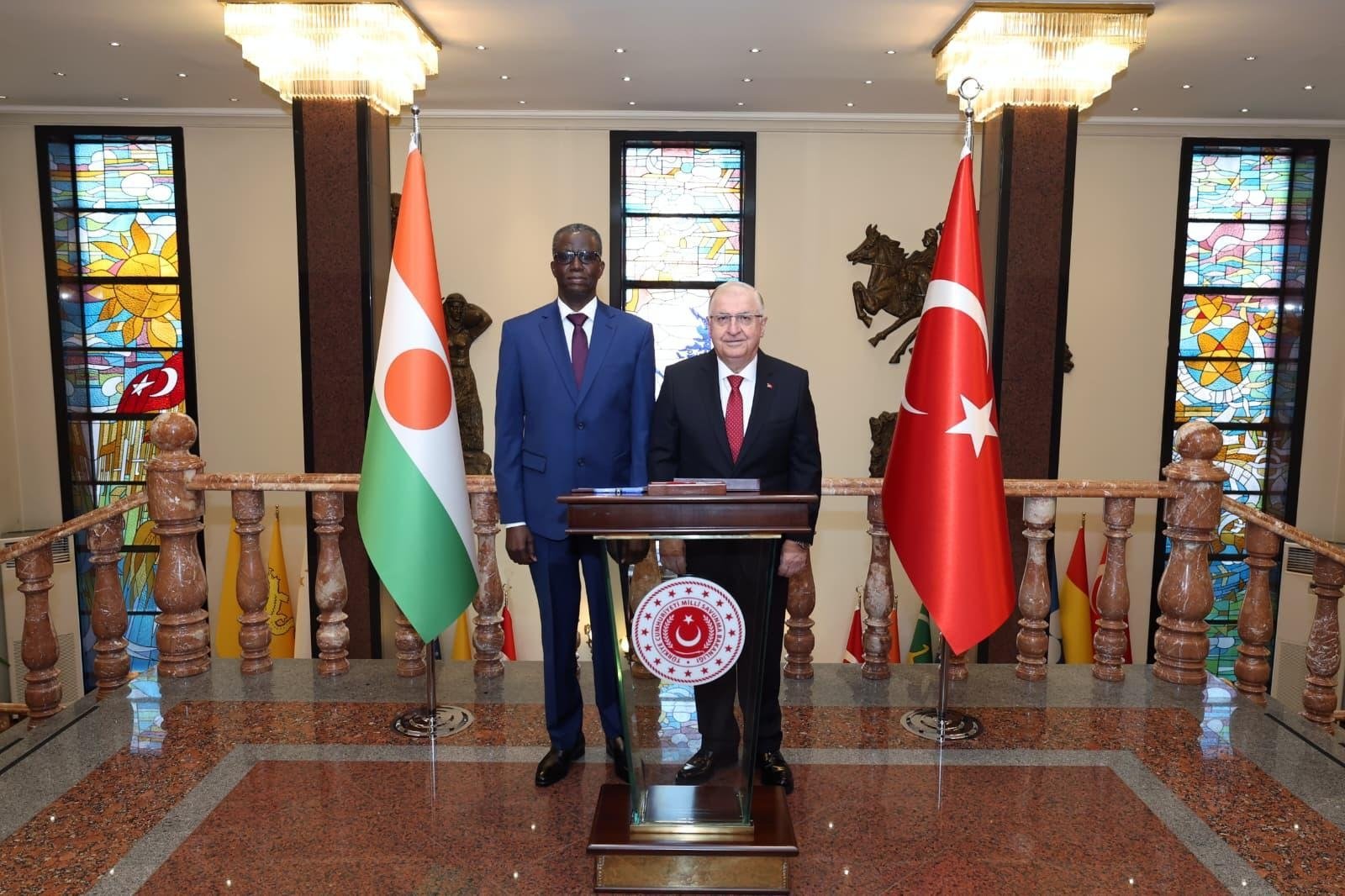
Defense Minister Yaşar Güler received Nigerien Defense Minister General Salifou Mody in Ankara on April 7, and the two sides signed a new protocol on on-site training support. In practice, it means Turkish military instructors will no longer stay on the margins of this relationship. They are expected to work inside Niger, on Nigerien bases, with Nigerien units, instead of keeping defense cooperation limited to courses far from the battlefield.
This is more than a diplomatic gesture. In the Sahel, security partnerships are rarely assessed through the language of agreements or the choreography of handshakes. People rely on simpler indicators. Which road remains open after dark? Which convoy reaches its destination? Which military outpost still functions a week after an attack? In Niamey, this new phase of cooperation will be read through those signs.
For Niger’s military leadership, the concern is very straightforward. Can a new partner help strengthen the state’s security reach while avoiding a return to a model that much of the country has already rejected? For Ankara, the move points to something larger. Türkiye is moving beyond a Sahel policy built mainly on diplomacy and development. It is stepping into a more structured security role.
Türkiye’s rise in Niger began with embassies, trade links, aid projects and a style of presence that tried to answer concrete needs. Over the last decade, Ankara expanded across Africa through airlines, construction, education, health initiatives and humanitarian outreach. In Niger, that produced familiarity before it produced defense intimacy.
Turkish firms' entry into sectors tied to infrastructure and services was the earlier layer. Scholarships and educational links widened contact with local elites and younger generations. The Turkish Cooperation and Coordination Agency (TIKA) projects and commercial engagement helped Ankara build an image of a partner interested in sustained access and routine cooperation, rather than short bursts of visibility, which changed the tone of the relationship.
Then came the defense layer. Military cooperation agreements signed in 2020 opened the legal and political space for training, logistics and arms transfers. By 2022, Turkish-made systems had started to change Niger’s inventory, especially with the arrival of Bayraktar TB2 drones. Beyond hardware, the package included maintenance, operational instruction and the habits that make such systems usable in rough conditions.
In Africa, Ankara often allows different tracks to overlap rather than keeping them neatly separated. Economic and humanitarian footprints create visibility. Air links make it easier to move people and equipment. Political trust built in those areas can later smooth the path for defense cooperation. The Sahel, where governments operate under constant pressure and reassess their partners frequently, is a region where that layered method gives Türkiye more flexibility than a purely military entry would.
The new protocol takes that process one step further. Instead of focusing mainly on instruction in Türkiye or in classroom environments, training is moving closer to the places where Nigerien troops actually deploy. Turkish personnel are expected to work directly with Nigerien troops on their own terrain, in conditions far closer to those their units face in daily operations.
This is framed as a training and advisory effort, rather than a combat deployment. On-site training carries a weight compared to courses run abroad. It allows direct work on reconnaissance, field mobility, border surveillance, small-unit coordination, drone use and the everyday logistics of survival in a theater where distance, heat and poor infrastructure often shape outcomes more than firepower alone.
For Niger, this is the practical appeal. A drone, an aircraft or an armored vehicle means little if the unit using it lacks the discipline or support chain to keep it effective. Sahel warfare punishes gaps fast. Militants exploit weak coordination, poor intelligence flow and delayed response times. Therefore, the value of Turkish support lies in training and adjustment to field habits.
This comes at a time when the regional security map is being redrawn. Since the 2023 coup, Niger has pushed out French forces and stepped away from the security structure that defined its ties with Western partners for years. At the same time, Niger moved closer to Mali and Burkina Faso under the Alliance of Sahel States, seeking a looser and more sovereign strategic space.
In that setting, Türkiye enters as a partner that brings military value without evoking the same historical memories as former colonial powers or long-standing Western missions.
Niger’s rulers want immediate stability in governance after the coup, stronger control over exposed border zones and a better answer to extremist violence in the west and south. They also want options since, after years of dependence on outside powers whose support often came with political pressure, diversification now looks less like a preference.
Türkiye fits that search rather well. It brings military training, a flexible defense industry and an approach that usually speaks the language of partnership instead of tutelage. None of this resolves Niger’s structural problems on its own. Yet it gives the junta space to argue that a new security network is being built on terms closer to its own priorities.
Ankara, for its part, is testing the next phase of its Africa policy. The years of embassy openings, summit diplomacy and economic outreach built visibility. What comes now is consolidation. Türkiye wants a durable influence in places where security, trade routes, migration pressures and political change intersect. The Sahel sits right at that intersection.
Public perception, though, will remain decisive. Türkiye enters with a softer profile than some other external actors. It escapes the colonial lens that shapes views of certain Western states, and its cultural visibility has grown through business links, scholarships and even popular media. But goodwill has limits. People tend to support outside partnerships when daily life becomes safer or at least more predictable. If roads stay unsafe, markets unstable and military abuses go unaddressed, the identity of the external partner will fade behind the shared sense of disappointment.
That is when the more difficult part of this story begins. The Sahel is full of foreign plans that looked coherent on paper and frayed in practice. Training missions can strengthen armies. They can also deepen the distance between armed forces and local communities if accountability and civilian protection slip down the list of priorities. So, the success of this partnership will be measured in Tillaberi, in Diffa, in rural checkpoints and in villages where people decide whether the state is returning or merely passing through with more equipment.
If Turkish training helps Nigerien forces operate with greater precision, fewer abuses and better coordination, this cooperation could become a model others watch closely. It would show that a middle power can combine civilian presence with security engagement in a region where old formulas have worn-out. That would be a meaningful shift.
If violence keeps spreading, governance remains brittle and the population sees little improvement in everyday security, the partnership will face the same judgment that has met many outside actors before it.
Türkiye is trying to turn years of African engagement into something more strategic and more durable. Niger, under pressure and short on trust, is willing to test that offer. Whether this becomes a turning point or just another episode in the Sahel’s long search for workable security will depend on what happens after the ceremony, out where the dust, distance and danger decide everything.