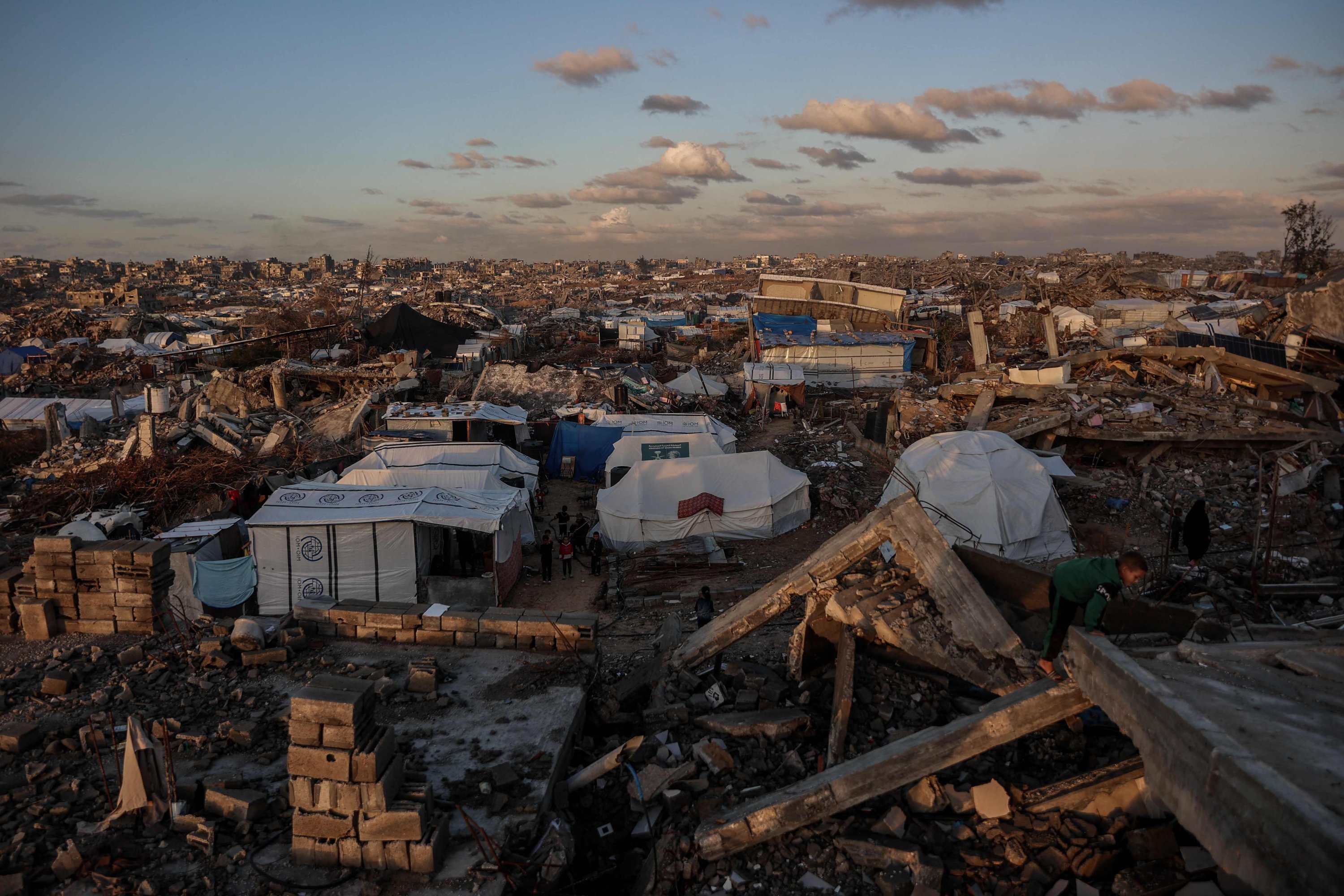
The Gaza war, and the already fragile cease-fire attempts repeatedly breached by Israeli aggression, have shown how elusive a real and stable peace can be under the pressure of a settler-colonial regime. Nonetheless, even though more than 200 Gazans were killed in the meantime, the chief architecture of “the day after” in Gaza – U.S. President Donald Trump’s 20-point peace plan – is still in effect. There is, however, a long way to go on this path: the creation of an International Stabilization Force (ISF) designed to end active hostilities, a phased withdrawal of Israeli troops, and a transitional administration backed by foreign security guarantees.
No matter how much this architecture is promoted as comprehensive or denounced as being in bad faith, in practice, it suffers from an all too familiar deficit: the plan is conceived around Israeli hegemonic objectives disguised as security concerns and Western diplomatic convenience, while the essential rights and existential needs of the people of Gaza are ignored. On a pragmatic level, the most important step taken in the latest cease-fire has been Washington’s willingness to work with regional partners to “take responsibility” for the future postwar order in Gaza. And Türkiye is not just one of those partners; it stands at the core of this plan.
The reason behind both Trump’s and U.S. special envoy Steve Witkoff’s praise for Türkiye’s effective role during the recent Gaza cease-fire negotiations is directly related to this fact. The relative success of the latest peace process was achieved with Türkiye’s unique contributions, which were fully incorporated into the diplomatic framework for the first time since Oct. 7.
It is notable, however, that Türkiye is precisely the actor Israel insists on excluding. And that tension is the central strategic contradiction of the entire plan: The real choice between a stable, sustained peace, and Israel’s insistence on occupation and elimination of any possibility of a Palestinian state.
Conversely, from the perspective of Palestinians, Türkiye is not just another foreign power operating in their homeland. It is the only large regional state that has consistently paired diplomatic support with visible political, economic and humanitarian commitments. In a 2010 poll by the Palestinian Center for Policy and Survey Research, 43% of Palestinians named Türkiye as the regional country most supportive of their cause – more than triple the share for Egypt, Iran or Saudi Arabia. For a population that has suffered under Western double standards and Arab ambivalence, this matters a great deal: Ankara is perceived as a pro-Palestinian, non-Western protector, not as a remote manager of “occupation.”
President Recep Tayyip Erdoğan has always framed support for Gaza as an ethical obligation, denouncing Israeli actions as crimes against humanity, suspending trade, and portraying Palestinian statehood as a test of international conscience rather than a matter of geopolitical bargaining. This approach is backed by concrete policy. Turkish agencies such as the Turkish Cooperation and Coordination Agency (TIKA), the Disaster and Emergency Management Authority (AFAD) and the Turkish Red Crescent (Kızılay) have been active in Gaza for years, funding hospitals, schools and emergency relief, and now coordinating reconstruction, housing and humanitarian aid on an unprecedented scale.
Equally crucial is Türkiye’s relationship with Hamas. Unlike the U.S. and EU, Ankara does not list Hamas as a terrorist organization and sees it as a legitimate Palestinian actor with which it agrees on the principle of liberation and the right of the Palestinian people to self-determination. This has allowed Turkish officials to maintain direct and indirect channels to Hamas’s political leadership when Western mediators have little or no meaningful access. This capacity to “persuade Hamas to agree and to behave,” as one recent analysis put it, is not a theoretical asset; it is the indispensable political precondition for any stabilization mission. If no actor within that force is trusted by Hamas and by the broader Palestinian public, enforcement will slide either into renewed confrontation or into a de facto protectorate sustained only by Western backing. Türkiye’s inclusion as a guarantor for the Palestinian side is the only realistic way to avoid that trap.
As a long-standing NATO member, Türkiye has built extensive experience in complex peace operations. Turkish troops have played core roles in Bosnia-Herzegovina, Kosovo and Afghanistan, where they combined security tasks with engagement with local communities and institutions. The Turkish Armed Forces (TSK) worked hand in hand with civilian agencies to rebuild infrastructure, train local security forces and restore basic services. When TIKA or Kızılay build clinics and schools in parallel to Turkish-led security deployments, they reinforce the same message: the mission exists to restore normal life, not to sustain the status quo. The real trap in the process is nothing but a rebranded occupation.
This combination of military competence, state-building capacity and local legitimacy is precisely what is needed in Gaza. Ankara has already sketched this horizon in conceptual terms. Turkish Foreign Minister Hakan Fidan has repeatedly proposed a multi-country guarantor system, in which different states assume responsibility for different parties, and has explicitly stated that Türkiye is ready to act as a de facto guarantor for the Palestinians in the context of a two-state framework. This is a major political commitment. It means that Türkiye is prepared to tie its reputation and resources to ensuring that Palestinian rights, security and political space are recognized and realized.
It is precisely this readiness that alarms Israel. Foreign Minister Gideon Sa’ar has insisted that only countries “impartial to Israel” should participate in the stabilization force – a criterion that, in practice, excludes any actor prepared to act as a meaningful guarantor for Palestinians. Behind the rhetoric lies a familiar doctrine: Israel’s security elite equates control with safety and views any independent regional power with empathy for Palestinian claims as a strategic threat. Allowing Turkish forces into Gaza would, from this perspective, dilute Israel’s freedom of military action and erode its regional primacy.
Here lies the core contradiction. A peace architecture shaped entirely around Israel’s security doctrine is unlikely to produce sustainable security. Without a credible guarantor on the Palestinian side, any mechanism of enforcement will be asymmetrical and therefore unstable. Excluding Türkiye might satisfy Israel’s short-term preferences, but it strips the mission of the one actor capable of making it realizable and acceptable in Gaza.
Türkiye’s moral stance, deep ties with the Palestinian people, and proven capacity in security and state-building make it uniquely suited to play this guarantor role. If the goal is not merely to stop this war, but to prevent the next one, Türkiye cannot remain at the door of Gaza’s future. It has to be part of the architecture that holds that future together.