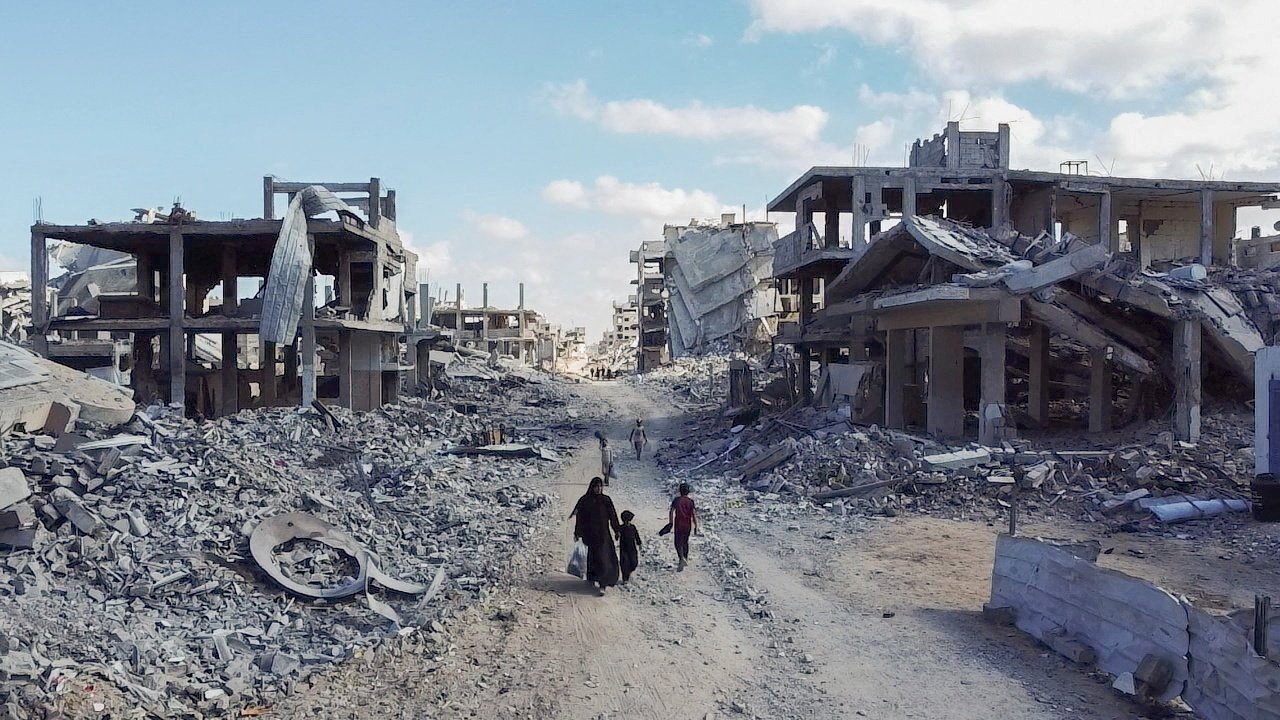
Foreign Minister Hakan Fidan signaled that Türkiye may take up the mantle of de facto guarantor in another dispute, just like it did for Turkish Cypriots, as a cease-fire between Israel and Hamas continues despite reported Israeli attacks on Sunday.
Fidan told broadcaster Ulke TV that they are prepared to assume the role if the two-state solution is implemented in Palestine.
He said Türkiye has so far acted as a mediator in efforts to bring the Gaza war to an end, promoting peace through its close ties and longstanding support for Palestinian causes.
"If an agreement acceptable to the Palestinians is reached, we are ready to do our part," Fidan said.
He said expecting "full trust" in Israel is unrealistic, emphasizing instead the importance of international pressure to ensure accountability.
Fidan said an "early task force" has been formed to address operational issues during the cease-fire process in Gaza, including problems related to the exchange of hostages and bodies.
He added that the group's work aims to maintain communication and coordination on the ground.
The Turkish foreign minister said discussions are continuing on three institutional mechanisms outlined in U.S. President Donald Trump's cease-fire plan for Gaza: A task force, a peace council and a stabilization force. However, their mandates and composition are not yet finalized.
Fidan stressed that Türkiye's defense and intelligence coordination demonstrates its willingness to accept greater responsibility if peace is achieved.
"If a two-state solution based on the 1967 borders is implemented, and Palestinians gain a sovereign and equal state, we are ready to act as a guarantor," Fidan said. "This is a major commitment, one not every state can undertake."
A summit was held last Monday in the Egyptian resort town of Sharm el-Sheikh, where U.S. President Donald Trump and Egyptian President Abdel-Fattah el-Sissi hosted more than 20 world leaders, including President Recep Tayyip Erdoğan, to sign a document formalizing the Gaza cease-fire.
Erdoğan, Trump, el-Sissi and Qatari Emir Sheikh Tamim bin Hamad Al Thani formally signed the agreement supporting the truce and a lasting peace in Gaza.
Fidan described the agreement reached at the Sharm el-Sheikh peace summit as a "historic signature," because it marked a turning point for the Gaza Strip and the broader Middle East.
"It was a historic signature. It was extremely important for Gaza, for the region, and for the reassertion of our president's global leadership," he said.
Fidan warned that the collapse of the cease-fire would not lead to a conventional war but to "a renewed genocide."
"The breakdown of the cease-fire means that Israel is using its overwhelming superiority in weapons to kill defenseless Palestinians. It's not war that will begin, but genocide that will begin again," he said, stressing that Israel's military operations no longer resemble conventional warfare.
"This is not a traditional conflict where both sides fight on equal footing. What continues in Gaza is systematic extermination," added Fidan.
He emphasized that the absence of a lasting political settlement would only postpone future violence. "If there is no permanent two-state solution, we may stop this war now, but another one will erupt in a few years. As long as occupation and oppression persist, resistance will continue," he said.
Fidan underlined that Türkiye's strategic goals are to end the mass killings in Gaza, as well as alleviatıng the suffering of over 2 million civilians and preventıng a second large-scale displacement of Palestinians.
"Everything has not ended, it has just begun," he said. "Our priority is to stop the ongoing genocide, to ensure the Palestinian people are not uprooted again and to bring immediate relief to Gaza's civilians."
He said the cease-fire must pave the way for continued humanitarian aid and the transfer of administrative responsibility in Gaza to the Palestinian Authority. "Our next target is ensuring that this agreement results in uninterrupted aid, Palestinian governance in Gaza and concrete steps toward a two-state solution," he noted.
The foreign minister said the actual number of Palestinians killed in Gaza may be significantly higher than reported.
"I truly believe the number exceeds 70,000. Given the nature of destruction, precise data is hard to obtain, but from how this war has unfolded, I know many massacres and executions have occurred beyond the view of cameras," he said.
Fidan added that the humanitarian catastrophe has deeply shaken the global conscience and eroded moral credibility in Western capitals.
"Those who once claimed moral superiority are now turning a blind eye to barbarity. In the 1940s, they were on the wrong side of history and in 2025, they are again," he said.
Fidan said Türkiye is prepared to play a leading role in Gaza's reconstruction once stability is ensured.
"After the Feb. 6, 2023, earthquake, the world saw the professionalism of our rapid rebuilding. There is no reason the same cannot be done in Gaza," he said, emphasizing that the process will require coordinated international funding.
He said Türkiye is ready to mobilize its companies, institutions and financial mechanisms for reconstruction efforts, but stressed that "a lasting cease-fire" is essential.
Fidan also said Israel must be held accountable for damages, adding that "compensation must be on the agenda as a matter of justice."
According to Fidan, the longstanding "illusion" created by Israel about its conduct has now been exposed. He said the Gaza war has revealed the deep contradictions in Western policy and morality.
"Humanity's conscience cannot bear this. The illusion Israel has built over the years has been shattered. Stopping the genocide will only be possible once this illusion fully disappears," he said.
Fidan noted that Türkiye has pursued an active and moral diplomacy from the beginning of the war, seeking to unify Muslim-majority nations through coordinated action.
He said the meeting between President Erdoğan, seven Muslim leaders and U.S. President Donald Trump in New York accelerated the diplomatic process, shifting Washington's position from "unconditional support for Israel to an emerging mediating role."
The minister also commented on relations with Greece, which are still affected by the hostile stance of Athens despite the recent rapprochement.
"No political legitimacy in Greece is strong enough to resolve its problems with Türkiye,” Fidan said.
He urged dialogue and restraint in relations while criticizing Athens' recurring use of anti-Türkiye rhetoric for domestic politics.
Fidan said Greek politics have long relied on portraying Türkiye as an adversary to manage internal crises.
"Greek politics feed on anti-Türkiye narratives. Whenever there is a corruption scandal or domestic unrest, they bring up Türkiye. This has to stop," he said on a television program.
"I want to remind our Greek neighbors: Turks and Greeks are ancient peoples of this region. We must find a way out of this deadlock together. The future is waiting for us," he said. "If you continue producing a language of threats, Türkiye can respond tenfold. There is no need for this. Let's not base politics on hostility."
Fidan said the Turkish government never builds its domestic policy on "anti-Greek positions" and urged Athens to show the same maturity. "When you come with the language of peace, Türkiye responds with peace. But if another tone is used, we have the capacity to answer accordingly. Still, we never start such rhetoric. Our first language is peace," he said.
On the European Union's security policies, Fidan criticized Greece's attempt to exclude Türkiye from the SAFE (Security Action Framework for Europe) mechanism, describing it as an example of how "certain EU members hijack Europe's security system."
"These countries are not acting for Europe's security," he said, noting that Greece had left NATO's military structure in 1974 and rejoined in 1980, with Türkiye's consent. "Ankara could have objected, but chose not to. We expect the same level of maturity from Greece today," he said.
Fidan confirmed that he will attend the EU Foreign Affairs Council meeting in Luxembourg, where a meeting with Greek Foreign Minister George Gerapetritis is planned. "Our Greek counterparts are not fully comfortable with this situation, but dialogue is the only way forward," he said.
The foreign minister warned against the Greek Cypriot administration's growing defense cooperation with Israel, saying it carries "the risk of provoking instability" in the Eastern Mediterranean. "We have seen Cyprus serve as a logistical base during the Gaza war. Now, they are trying to repair their image by organizing humanitarian aid flights. We hope this effort serves as atonement," he said.
Fidan underlined that Türkiye's first preference is a peaceful resolution of disputes.
"Let's not waste more time. An enduring peace between Türkiye and Greece in the Aegean is possible; let's make it possible. In the Mediterranean, it is possible; let's make it possible. And on Cyprus, peaceful coexistence between Turkish Cypriots and Greek Cypriots as equal partners is possible; let's make it possible," he said.
Fidan also warned against “the biggest current risk in the region that is Israeli expansionism through Syria," adding that Ankara continues consultations with the U.S. and other partners to prevent further destabilization.
He underlined that Türkiye maintains structured communication channels with Damascus to manage political, security and humanitarian files.
"We are carrying out the Syria issue in a very systematic and institutional manner," he said.
"There is a high-level strategic board chaired by Vice President Cevdet Yılmaz and a technical coordination committee led by Deputy Foreign Minister Nuh Yılmaz. All detailed issues, from refugees to trade and energy, are handled within this framework."
Fidan said the unification of the armed groups under one military structure in Syria was progressing, calling it "a major transition" that was "largely achieved." He added that the March priority under the March 10 understanding is the withdrawal of the U.S.-backed YPG, the Syrian wing of the PKK terrorist group, from Arab-majority areas. "Everyone expects this to happen soon. Otherwise, serious clashes could occur," he said.
The Syrian presidency announced an agreement on March 10 to integrate the YPG into state institutions, stressing the country's territorial integrity and rejecting any separatist designs. The group, however, has violated the agreement more than once.
He warned that the YPG's "occupation-minded and colonial attitude" must end, stressing that such approaches obstruct the normalization process.
Fidan noted that recent incidents in Latakia and Sweida had temporarily disrupted state-building and institutional capacity efforts.
Fighting erupted in the Latakia and Sweida provinces in the summer, drawing regional attention to renewed tensions within Syria.
"Crisis areas must be managed well, and significant progress has been made," he said. "However, the main danger lies in Israel's policy of creating security through others' weakness – a risky and unsustainable strategy. Syria should threaten no one, but no one should threaten Syria either."
Fidan described the Syrian issue as "a first-degree national security matter" for Türkiye. "Everything that happens there affects our territorial integrity and citizens' safety. Our position reflects that reality," he said.
He said Türkiye remains in close contact with Washington and the Trump administration is "bringing back its comprehensive approach to Syria."
"We see that the Trump administration is applying its own full-scale approach again, as in other regions. Our constructive stance in this process is crucial," he said.
Fidan noted that U.S. envoy Tom Barrack now plays an expanded role, including engagement on Syria and Lebanon. He confirmed diplomatic coordination and said a trilateral meeting with the U.S., Türkiye and Syria is being planned.
On refugee returns, Fidan said nearly 500,000 Syrians have returned from Türkiye through various routes. "Returns are continuing as stability improves. For the economy to function, for institutions to operate, this returning population is essential," he said.
Fidan reiterated that YPG-linked structures still pose a threat to Türkiye. "For us, this is a national security issue. The YPG has yet to make any declaration or take any step showing it no longer threatens Türkiye," he said.
He added that Türkiye's policy is based on equality and justice for all Syrians, regardless of identity. "We defend the rights of every community, Kurd, Arab, Turk, Sunni, Shiite, Christian, Yazidi, but we cannot tolerate any organization whose existence is built on harming Türkiye," he said.