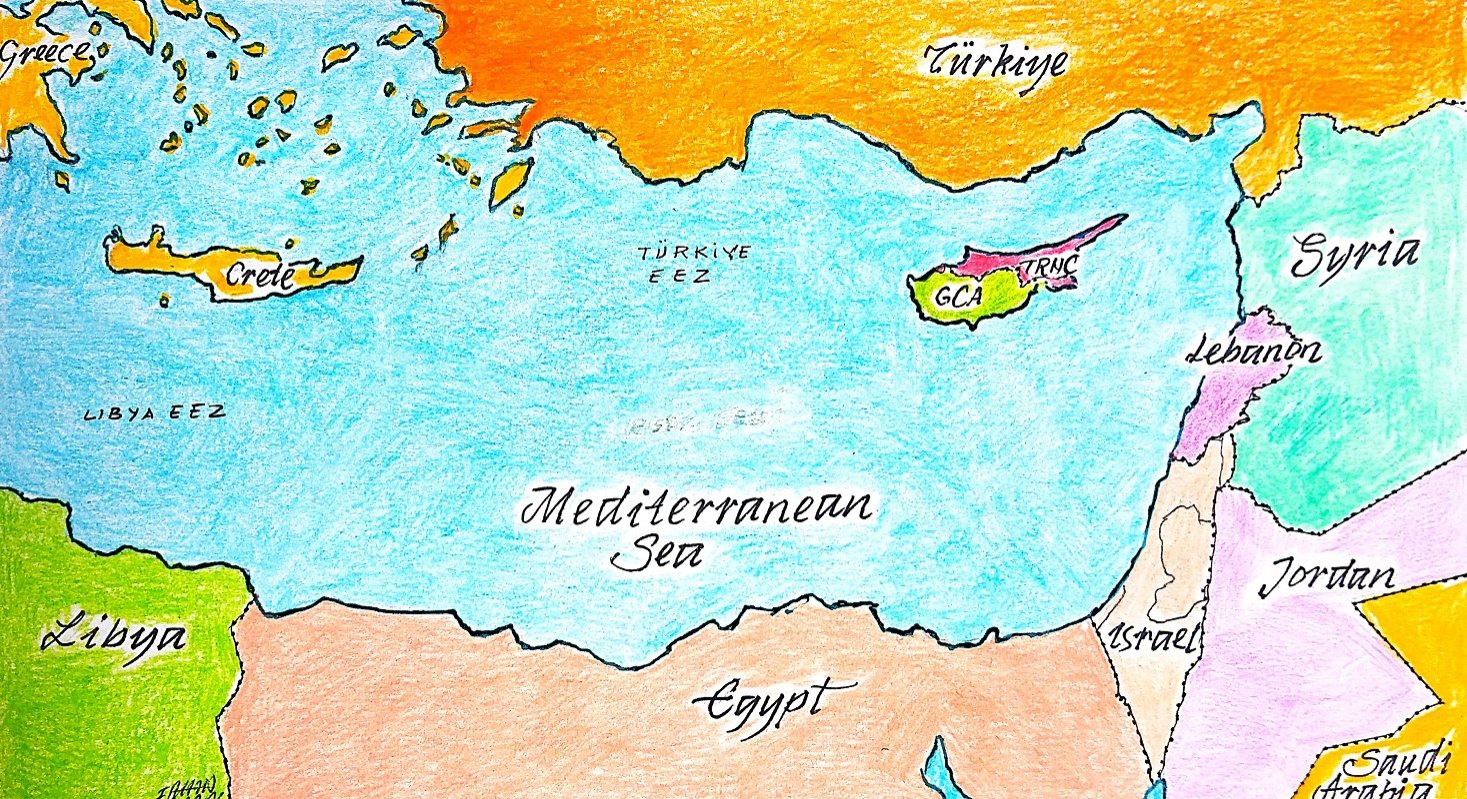
Following the collapse of Bashar Assad’s Baath regime in Syria, the necessity to establish an Exclusive Economic Zone (EEZ) agreement between Türkiye and Syria became one of the key issues of the political agenda. Such an agreement could be instrumental in further cooperation on trade, communication, energy and defense, which is needed most for Syria, which is "under construction."
The proposed maritime demarcation agreement which was modeled after the Turkish-Libyan agreement in 2019, would enable both countries for gas and oil exploration in the Eastern Mediterranean. In this respect, Syria will greatly benefit from Türkiye’s technology, infrastructure and experience. Therefore, the implementation of this agreement will not remain restricted by a delimitation. It will have ramifications in other areas, including restoring Syria’s collapsed infrastructure.
Türkiye’s focus on direct negotiations, as in the case of Syria, ensures faster and more effective results for mutual benefit. In other words, Türkiye provides a model of how cooperation in the region can be satisfied not just by words but by actions. This proposed agreement could open the way for other bilateral agreements between Türkiye and Egypt, Lebanon and Palestine to fulfill the shared interests based on regional realities. In the long term, such bilateral agreements could offer much more than just sorting out the current disputes.
This initiative alarmed Greece and the Greek Cypriot administration (GCA), which distorted the interpretation of the United Nations Convention on the Law of the Sea (UNCLOS). Despite its limited population, land, military and economic power, Greece follows an expansionist policy in the Eastern Mediterranean by using its’ islands. According to international law, although the mainlands are considered the basis of delimitations and maritime jurisdiction, the areas of the islands are limited to the territorial waters. Greece wants to discard this fundamental principle for its expansionist objectives.
In contrast, Turkish legal arguments in the Eastern Mediterranean are based upon strong and well-founded principles of international law, including the domination of land, proportionality, economic activity, demographic situation and non-encroachment/non-closure.
Greece and GCA also try to exclude Türkiye, the country with the longest shore in the Eastern Mediterranean, from the regional energy equilibrium through initiatives such as the Euro-Med Forum. These nebulous tactics are also designed to legitimize the defunct state of the so-called Republic of Cyprus, which collapsed in 1963 and is represented only by Greek Cypriots. However, the maritime jurisdiction area limitations in the Eastern Mediterranean, which has the status of a semi-enclosed sea according to international law, should only be determined by agreements based on the principle of “equitability” between all relevant countries. In other words, the problems should be settled in a way that considers the rights and interests of all parties without marginalizing any country in the region.
Greece and GCA's arbitrary policies and unilateral actions at the expense of underestimation of Türkiye’s power and importance in the region lead to extensive legal, economic and political crises in the region. The Eastern Mediterranean Sea is surrounded by Greece, Türkiye, Syria, Lebanon, Israel, Palestine, Egypt, Libya, the “Republic of Cyprus” and the Turkish Republic of Northern Cyprus (TRNC). The TRNC is a de facto state recognized by Türkiye. There is a TRNC reality on land, at sea and in the air. According to international law, Turkish Cypriots are people who are entitled to the right of self-determination, and the TRNC has a legitimate structure that meets all the related criteria for statehood.
On the other hand, Palestine is a U.N. observer state recognized by 146 U.N. member states. Therefore, both the TRNC and the state of Palestine are de facto legal entities that have rights in the Eastern Mediterranean. By ignoring these factual realities on the ground, a sustainable solution to the maritime jurisdiction areas in the Eastern Mediterranean is not possible.
Secondly, the Greek side’s expansionist policies endanger not only the continental shelf, EEZ, airspace, strategic defense depth and energy strategy of Türkiye but also the interests of the other shareholders, including Syria, Lebanon, Egypt and Libya. This is due to the hijacked state of Greek Cypriot's maximalist claims over EEZ that shrink, Lebanon, Egypt and Libya’s EEZ by a significant degree. If all these coastal states take Türkiye’s strong legal arguments in the Eastern Mediterranean into account, they would benefit from the new outcome.
The war in Ukraine and the Middle East threatens not only the region but the entire international system. These and similar developments cause political and economic instability and endanger the secure transfer of energy resources to Europe. Therefore, regional energy initiatives and diversification are vital for the economic stability of the countries in the Eastern Mediterranean. However, having said this, attempting to deter East Med’s regional economic potential by the Greek sides also clashes with the energy objectives of the European Union. As the EU seeks to reduce its reliance on Russian gas, the reserves in the Eastern Mediterranean offer a critical alternative for Europe’s energy diversification.
In this respect, as put forward by almost all the experts on the issue, the safest and most profitable way for hydrocarbon resources in the Eastern Mediterranean to reach the European market is to transport these sources via Türkiye. The most feasible routes to Europe are the already existing pipelines passing via Türkiye including the Turkish Stream, Nabucco Western, The Trans-Anatolian Natural Gas Pipeline (TANAP) and The Baku–Tbilisi–Ceyhan (BTC), which would maximize the energy efficiency of the hydrocarbon supplies. Therefore, by disrupting the flow of the hydrocarbons to Europe from this most viable route, Greek sides undermine regional cooperation and weaken the ability, reliability, and prospects of the EU to be a regional power.
In response to Greek confrontational tactics and outdated narratives, Türkiye put a broader vision for the region, as evidenced by the proposed maritime demarcation agreement with Syria. Türkiye is implementing a comprehensive strategy that integrates regional partnerships and investments in energy, which is key to stability in the Eastern Mediterranean. Accordingly, Türkiye’s policy, which is based upon direct negotiation and mutual agreements, is the most effective way of solving the contested issues in this volatile region. The critical question at the heart of the issue is when the other regional countries will be ready for direct negotiation and bilateral agreements for multidimensional cooperation, economic prosperity and stability in the Eastern Mediterranean.