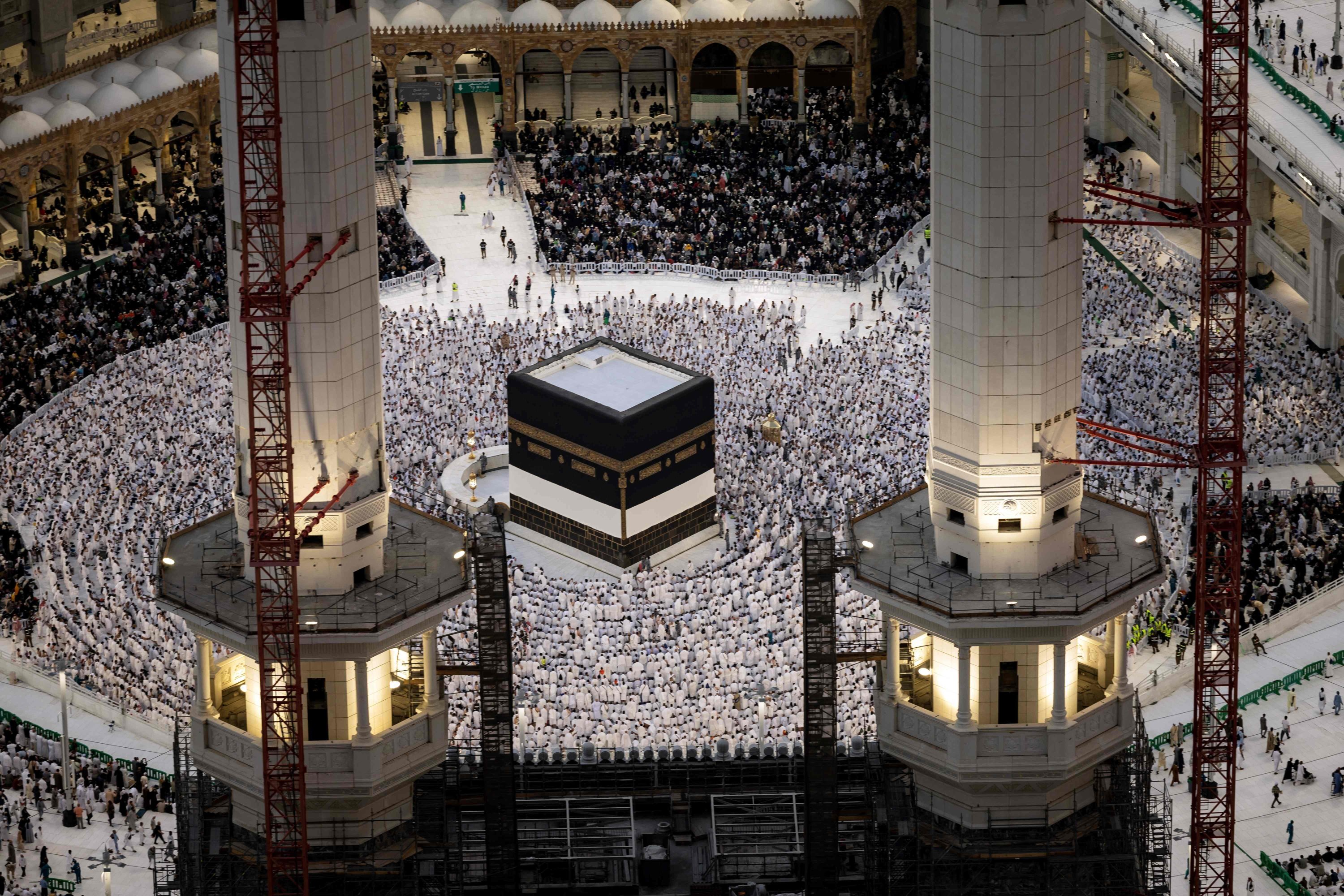
One of the auspicious months in the Islamic calendar and a unique time for worship is the month of Dhu al-Hijjah. The first 10 days of this month are the most virtuous days of the year in which Muslims make sincere efforts aiming at maximizing different acts of worship that include fasting, "dhikr" and prayer, or dua, (thorough remembrance and supplications), recitation of the Quran, "nafl prayers" (supererogatory prayers), "sadaqah" (voluntary charity), "tawbah" (repentance), "Eid salah" and "qurban" (ritual animal sacrifice). Dhu al-Hijjah not only marks the final month of the year but also marks the realization of Hajj, the fifth and last pillar of Islam, and that is why it is also known as “the month of the pilgrimage.”
Literally, Hajj means “preparation to or towards a person ... or toward an object of reverence, veneration, respect, or honor or to intend a journey.” Technically, it means the performance of certain recognized practices and rituals at the specified places of Mecca, Mount Arafat and Mina during the second week of “Dhu al-Hijjah.” Millions of Muslims from all over the world will once again congregate this year in the holy city of Mecca in Saudi Arabia to perform the Hajj. The Quran and the traditions of the Prophet Muhammad outline the sanctity and importance of Hajj. For example, God declares Hajj as an incumbent religious duty in the Quran as: "And proclaim to mankind the Hajj (pilgrimage). They will come to you on foot and on every lean camel, they will come from every deep and distant (wide) mountain highway (to perform Hajj)” (Surah al-Ḥajj: 27).
The tradition of the Prophet Muhammad also states that performing Hajj is an obligatory duty for the Muslims.
“Abu Hurayrah reported that the Messenger of Allah’s (the Prophet Muhammad) addressed us and said: O people, Allah has made hajj obligatory for you; so perform Hajj.”
Ḥajj is an obligatory activity once in life for all Muslims but only for those who are sound – mentally, physically and financially. While carrying out this obligation, the pilgrims are required to abandon relations, status, country, home, business and even normal clothing. While Hajj marks the pinnacle of the individual’s spiritual life, it also strengthens the idea of the “ummah” as a cohesive community that prioritizes faith and brotherhood over limiting ideas of race, nation, color or tongue. It is in this regard the Muslims don a special dress known as “iḥram,” which signifies a transition from the worldly life to the spiritual life. The attire also represents the rejection of material and social disparities and the equality and humility of all Muslims before God.
Some of the important practices in the Ḥajj are “tawaf,” “sa'y,” “wuquf-i-Arafat,” “wuquf-i-Muzdalifah,” “rami̇ al-Jimar,” and “qurban.” The first and foremost rite of the Hajj or "tawaf" entails circumambulating the Kaaba seven times in a counterclockwise direction, the first three at a fast pace and the final four at a normal speed. In Sahih Muslim, the second hadith collection of the Six Books of Sunni Islam, it is reported by Nafi̇ al-Madani on the authority of Ibn Umar that the Prophet Muhammad while doing “tawaf” walked at a brisk pace during the first three circumambulations and then at a normal pace in the remaining four.
“Sa'y” immediately follows “tawaf” during, which the pilgrims run back and forth between the two hills of Safa and Marwah seven times. This ritual renews the wife of the Prophet Abraham's frantic search for water after she and her son Ishmael were left in the desert by the Prophet Abraham at the command of God.
The next very important ritual that follows “sa'y” and represents the climax of the Ḥajj is “wuquf-i-Arafat.” An integral ritual in the Hajj, the practice involves the en masse “procession” and “standing” of all the pilgrims at Mount Arafat on the ninth day of "Dhul Ḥijjah" and failure in performing it invalidates the entire pilgrimage. It is the perfect time for pilgrims to pray, meditate and experience close communion with God.
Following “wuquf” at Mount Arafat, the pilgrims make their way toward Muzdalifah, an open and level area near Mecca, at the time of sunset, combine Maghrib and Isha prayers (at the time of Isha in the form Qasr) and spend the night in the open air. The pilgrims then set off from Muzdalifah at sunrise on the tenth day of "Dhul Hijjah" in order to travel to Mina, a valley located 8 kilometers (5 miles) southeast of the city of Mecca. For the pilgrims, it is particularly a busy day since they have to complete four very significant acts of devotion: “rami̇ al-Jimar” (throwing pebbles at the “Jamrah” (“Stoning of the Devil”), “qurban” (slaughtering the animal), shaving the head and performing the “tawaf al-Ifada.” At Mina, the pilgrims refresh the story about the Prophet Abraham, who was tempted by Satan to disobey God’s command to sacrifice his son Ishmael. Despite Satan’s attempt, the Prophet Abraham and his son were completely determined to carry out God’s instructions. “Rami̇ al-Jimar” symbolizes their rejection of Satan’s temptation.
Once these obligatory devotional acts are finished, the pilgrims feel relaxed with a flexible schedule that allows them to conduct additional rituals like six more “Rami̇” at Mina, “tawaf” and “sa’y.” Once the Hajj is completed, the pilgrims begin to dress in their regular attire, signifying a gradual reentry into the mundane world but with a profuse spiritual and moral change. During the Hajj, the pilgrims rise above their daily concerns and think beyond what people generally cherish. Experiencing the spiritual life on a deeper level, the Hajj embodies equality, brotherhood and togetherness among the believers, and prioritizes obedience to God’s call over all other calls.