
The recent start of the PKK terrorist organization’s disarmament has generated considerable discussion across the region, yet its implications for Iraq are far more immediate and complex than often acknowledged. While widely seen as a security issue for Türkiye, it is Iraq, particularly its northern territories, that has witnessed the PKK presence. From the Qandil Mountains in the far northeast to Sinjar in the northwest, the PKK has established a de facto corridor of control across Iraqi territory, extending beyond rural strongholds to include cities, undermining Iraqi sovereignty and fueling local tensions. As such, the disarmament decision marks not just a turning point in Türkiye’s security landscape but a critical juncture for Iraq’s internal security and stability.
The PKK’s disarmament on Iraqi territory would mark a profound shift in the country’s internal security landscape. Over the past decades, the terrorist organization has maintained a broad presence stretching from the Qandil Mountains to the Sinjar region, effectively forming a corridor that bypassed the authority of both the federal government in Baghdad and the Iraqi Kurdish Regional Government (KRG) in Irbil. The dismantling of this network raises critical questions about who will fill the resulting vacuum, and under what terms.
In areas such as Sinjar and Makhmur, which lie outside the formal boundaries of the KRG but are disputed under Article 140 of the Iraqi Constitution, control is already contested. If the PKK withdraws from these positions, a new round of competition could emerge between Iraqi federal forces and KRG Peshmerga units, each claiming legitimacy. This issue is further complicated by the limited trust and coordination between Baghdad and Irbil, particularly in sensitive security zones such as the disputed territories.
Moreover, the potential for rivalry between the Popular Mobilization Forces (PMF), particularly Iran-aligned factions, and the KRG’s Peshmerga forces cannot be overlooked. In Sinjar, where PMF units have gained a foothold under the pretext of counterterrorism, the PKK’s departure could provide an opportunity for these groups to consolidate their control. Conversely, the Kurdistan Democratic Party (KDP)-aligned Peshmerga may seek to reassert dominance in what it views as historically Kurdish territory.
Within the KRG itself, the end of the PKK’s influence may reshape internal security dynamics. In Patriotic Union of Kurdistan (PUK)-controlled zones, where PKK fighters have operated with relative ease, their absence could prompt a reevaluation of local power structures. Meanwhile, the KDP is likely to capitalize on the opportunity to extend tighter security control over its territories, potentially deepening intra-Kurdish polarization.
The PKK’s decision to lay down arms has the potential to substantially alter the political balance within the KRG, particularly between the KDP and the PUK. The KDP, which has long perceived the PKK as a disruptive force within its zones of influence, especially along the Duhok corridor, may seize this moment to consolidate its authority. With PKK forces retreating, previously contested or destabilized areas may fall more firmly under KDP control, allowing the party to tighten its grip on both security and administrative structures. This would reinforce the KDP's political dominance, particularly in its dealings with Baghdad regarding federal issues such as the budget, salaries and hydrocarbon law.
Conversely, the PUK stands to lose an informal but critical balancing factor in its regional power structure. The PKK’s presence in areas around Sulaymaniyah has indirectly served to counterbalance the KDP’s superior resources and diplomatic ties. Without this buffer, the PUK may face increased pressure to either restructure internally or deepen its reliance on external actors, most notably Iran, in a bid to preserve its strategic leverage. Such shifts could further polarize intra-Kurdish politics and widen the ideological and geographic rift between the two dominant parties of the KRG.
Meanwhile, the ideological vacuum left by the PKK’s disarmament could be exploited by rising anti-establishment forces such as the New Generation Movement and the Gorran Movement. These groups, which appeal to younger and disillusioned voters, may benefit from the PKK’s retreat by offering a new outlet for political expression. The possibility of subtle ideological alignment or informal coordination between these actors and remnants of PKK networks poses an additional variable in an already fragmented political landscape.
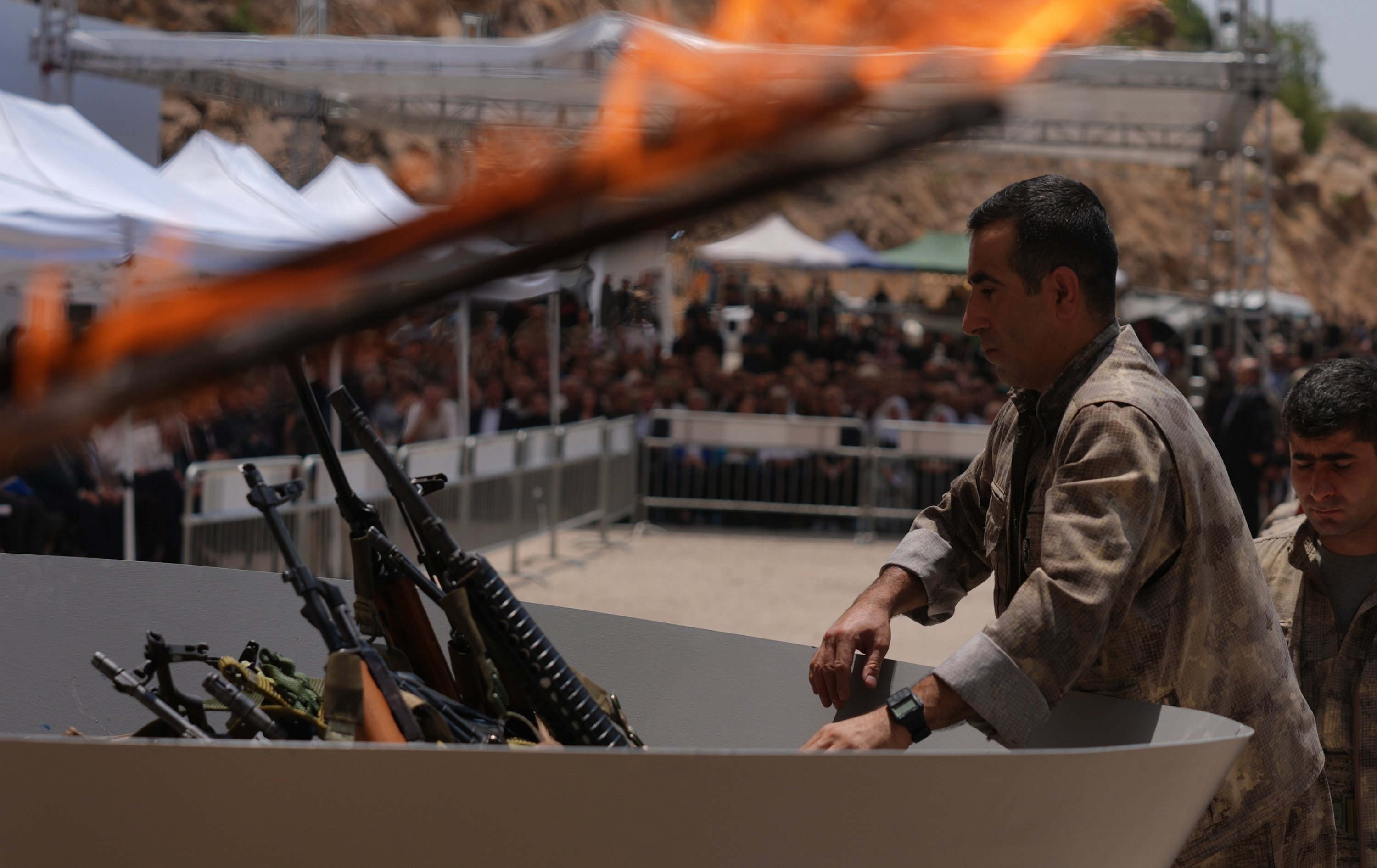
The PKK’s disarmament marks a critical inflection point for Iraq in terms of security stabilization and political recalibration across various levels of governance. Far from being a peripheral development, the terrorist organization’s disarmament creates both opportunities and challenges for Iraqi actors. On one hand, it offers Baghdad and Irbil a rare window to reassert state authority in long-contested areas such as Sinjar and Makhmur, potentially reviving dormant agreements like the 2020 Sinjar Agreement. On the other hand, the vacuum left behind may trigger new rounds of rivalry between the PMF and the Peshmerga, particularly in zones where neither side has uncontested legitimacy.
At the intra-Kurdish level, the KDP may strengthen its position, while the PUK must navigate a rapidly shifting landscape without the strategic buffer once offered by the PKK. Simultaneously, rising anti-establishment movements such as the New Generation Movement and the Gorran Movement may gain traction in this period, further reshaping the KRG’s political future. Moreover, the shift opens space for recalibrating regional power dynamics beyond pure security concerns.
Regionally, the disarmament of the PKK could serve as a gateway to reframing Türkiye-Iraq-KRG relations around economic cooperation and development initiatives rather than security issues. In particular, the removal of the PKK from the Iraqi landscape might help depoliticize previously securitized areas and redirect political attention to shared interests such as trade corridors, infrastructure investment, and energy cooperation.
However, these positive trajectories are far from guaranteed. The lingering ideological footprint of the PKK, the fragility of Iraqi and KRG internal cohesion, and the entrenched presence of armed actors like the PMF mean the post-PKK era will not be free of contention. For Iraq to transform this moment into a long-term gain, it must combine institutional resilience with inclusive political dialogue and vigilance against new forms of non-state armed actors.


