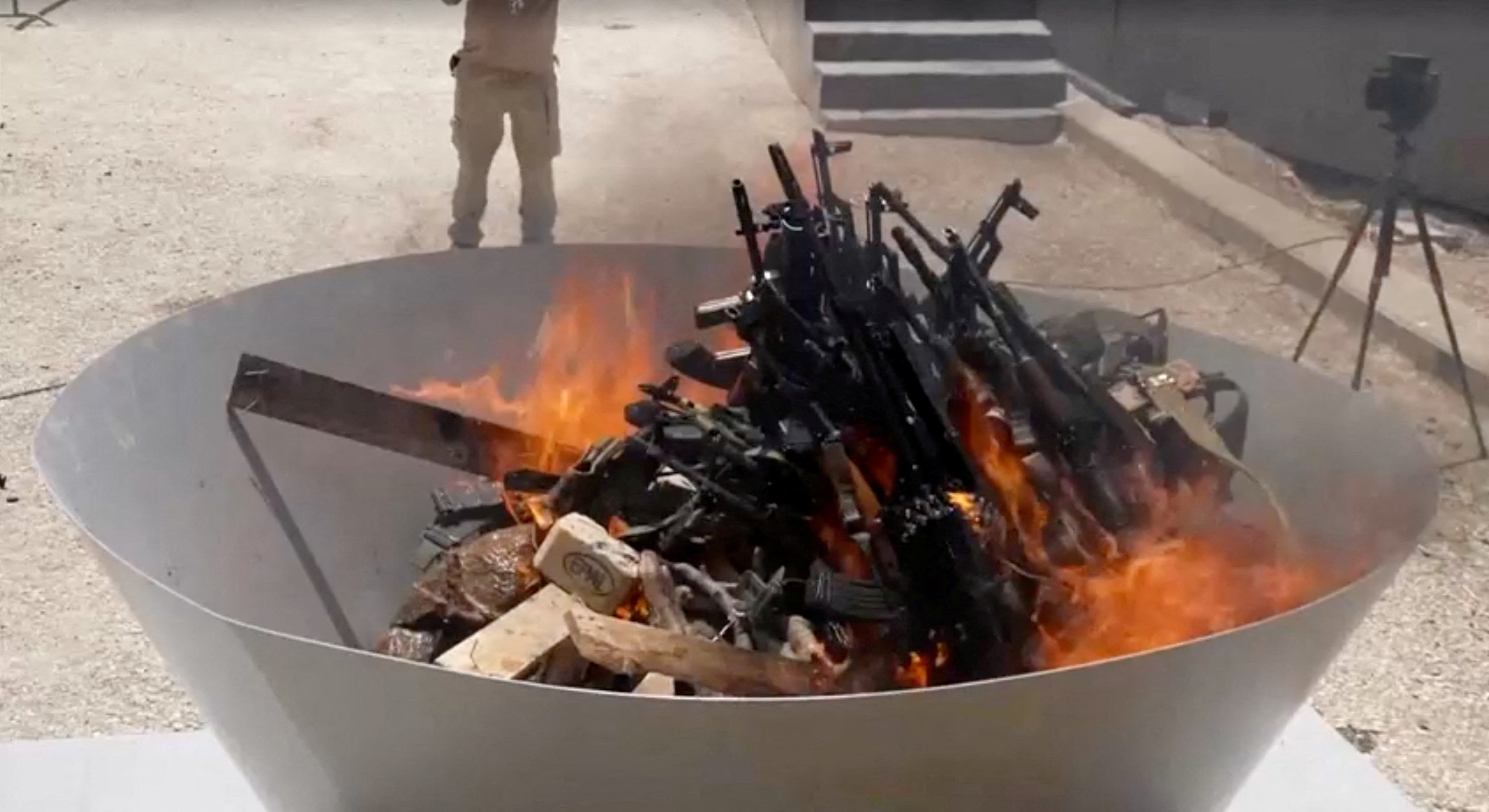
As Türkiye advances toward what may become one of the most significant security turning points in its modern history, the disarmament of the PKK, the framework guiding this transformation requires careful conceptual and strategic interpretation. The terror-free Türkiye process does not follow the conventional models of negotiated settlement or reconciliation. Instead, it is a Turkish-specific formulation, rooted in a new operational paradigm, shaped by geopolitical disruptions, and reinforced by national consensus. The disarmament of the PKK, far from being the culmination of concessions, is emerging as a strategic necessity, driven by the transformation of Türkiye’s military capabilities, security doctrine and the diminishing strategic value of armed “struggle” for non-state actors and terrorist organizations in the region.
The process was made possible through Türkiye’s transition from area control-based counterterrorism to an effect-based operational approach. Since 2016, Türkiye has pursued a systematic degradation of the PKK’s organizational capacity through targeted kinetic actions and multidomain intelligence operations. The National Intelligence Organization (MIT) has played a pivotal role in decapitating the PKK's executive leadership, with operations in Qandil, Sinjar, and even across Europe. The state’s increasing use of SIGINT/ELINT, target identification and armed drones has reduced the survivability of the PKK's leadership cadre, weakening its command structure and decision-making processes. The operational tempo was not only maintained but intensified after neutralizing key figures such as PKK member Cemil Bayık’s inner circle, pointing to a long-term attritional strategy rather than reactive deterrence. The “cadre vacuum” began to alter the internal calculus of the terrorist organization, especially under conditions of regional instability and isolation.
The regional context has played a decisive role in transforming the structural foundations that once enabled the PKK’s persistence. The Oct. 7 Hamas incursion led to a regional security recalibration, where the prioritization of state-centric stability re-emerged as a dominant trend. This development, followed by the Dec. 8 regime change in Syria, shattered the PKK’s long-standing expectation of maintaining semiautonomous safe havens in northeast Syria. This fragmentation of the terrorist group’s regional architecture not only undermined its strategic depth but also exposed its affiliates to state-centric stabilization pressures. The PKK has been rendered increasingly disconnected from the political realities of the region, with little leverage and few functional alliances remaining.
One of the process’s most notable features is its departure from the expansive demands historically made under the guise of a “Kurdish question.” Instead of framing the disarmament as the outcome of a broader ethno-political resolution process, both the state and segments within the Kurdish political space have prioritized a concrete and achievable objective: the deactivation of an armed “struggle.” This represents a strategic minimalism based on the recognition that disarmament is not the product of political bargaining but a prerequisite for any future political inclusion. This diverges from the dominant narratives in conflict resolution literature, which often posit demobilization as the final phase of a peace agreement. Türkiye’s model inverts this logic; disarmament is the entry point, not the exit.
Notably, Abdullah Öcalan’s rhetoric in his latest calls supports this sequencing. He frames disarmament not as a concession, but as a response to historically and geopolitically altered conditions. This discursive strategy has allowed the Turkish government to control the narrative while maintaining political legitimacy and national unity.
Contrary to earlier initiatives that were obstructed by nationalist political forces, the 2025 process has been marked by active support from figures, particularly Devlet Bahçeli and other members of the Nationalist Movement Party (MHP). These figures have become institutional monitors and proactive contributors, ensuring it stays within the framework and avoids the pitfalls of earlier attempts. This political convergence represents a paradigm shift in Türkiye’s internal cohesion on national security matters. Where previous peace initiatives failed due to partisan polarization, the current process is marked by a rare cross-party alignment on national integrity, strategic deterrence and the non-negotiability of armed “struggle.”
The terror-free Türkiye process can be analytically divided into two main phases: Phase I, disarmament and organizational demobilization; and Phase II, neutralizing the structural conditions that once allowed the PKK to claim representation over Kurdish grievances.
This initial stage involves structured political and security consultations between the Turkish government, Abdullah Öcalan and segments of the PKK’s leadership. However, this is not a negotiation in the traditional sense; it is a managed disengagement process, coordinated through intelligence channels, with a focus on safe surrender, weapons decommissioning and deactivation. Unlike the 2013–2015 resolution process, there are no legislative preconditions or public dialogues. The objective is clear: the complete termination of the PKK’s armed presence, regardless of ideological evolution or political positions.
Once disarmament is achieved, the second phase will focus on stabilizing affected regions, confidence-building and fostering a more inclusive political environment.The process seeks to prevent re-radicalization and sustain a post-conflict order that is locally owned and nationally aligned.
The process has already begun to reshape Türkiye’s broader strategic orientation in several dimensions. In terms of its security doctrine, the country has shifted from a reactive defense posture to one centered on preemptive deterrence, increasingly integrating technological capabilities such as drone warfare, electronic intelligence, and satellite-based surveillance into a unified and anticipatory national security strategy. This evolution has simultaneously bolstered the military-industrial complex; the operational success of domestically produced systems ranging from armed UAVs to advanced ISR platforms has reinforced Türkiye’s defense ecosystem, expanded its export capacity, and elevated its position as a model for regional counterterrorism.
Diplomatically, the disarmament of the PKK enhances Türkiye’s geopolitical leverage within NATO by showcasing its proficiency in hybrid warfare and counterterrorism operations. Moreover, it opens new avenues for normalized and cooperative security arrangements with neighboring states such as Iraq and Syria, where shared concerns over non-state armed groups and terrorist organizations create a foundation for renewed engagement.
In conclusion, the terror-free Türkiye process is not a peace process in the traditional sense. It is a strategically sequenced national security initiative, designed to eliminate armed “struggle” as a political instrument and to create the space for long-term social and political stabilization. By placing disarmament at the beginning, not the end, of the process, Türkiye is proposing a new model of conflict termination, one that is grounded in realism, driven by institutional consensus and backed by technological superiority. This model does not legitimize terrorism; it renders it obsolete.