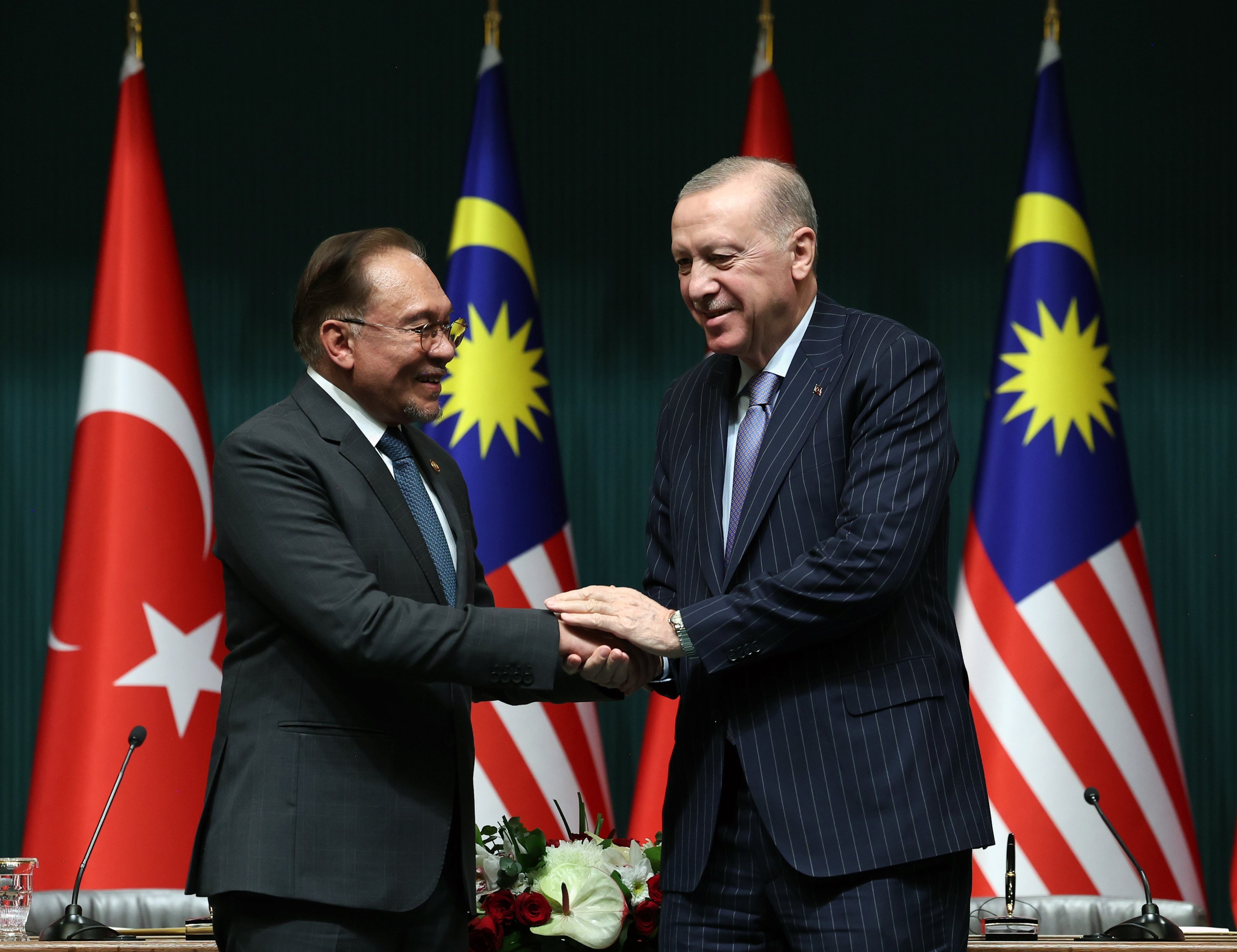
As the world drifts into a state of chaotic order and geopolitical developments shift toward an increasingly lawless landscape, the strategic neutrality of regional powers plays a more critical role than ever. No longer merely defensive, these stances are being reshaped by long-term strategic objectives rather than temporary interests. It is within this uncertain conjecture that Malaysian Prime Minister Anwar Ibrahim’s visit to Türkiye took place. It is a significant moment, as regional powers find that the only way to manage geopolitical crises is through the calculated implementation of active neutrality.
The inaugural meeting of the Türkiye-Malaysia High-Level Strategic Cooperation Council (HLSCC) in Ankara represents more than just a diplomatic milestone; it is a structural transformation of bilateral relations. Taking place a year after President Recep Tayyip Erdoğan’s Asia tour, Anwar’s visit solidifies a partnership driven by a shared vision of strategic autonomy. In an era defined by Great Power rivalry, these two nations are demonstrating that regional power can prioritize national interest and moral consistency over unquestioning loyalty to hegemonic blocs. The official visit underscores Malaysia’s ongoing commitment to deepening ties with the Republic of Türkiye, following the elevation of bilateral relations to a Comprehensive Strategic Partnership in July 2022.
Both Türkiye and Malaysia occupy critical geographic and political locations. Türkiye acts as a transcontinental bridge between Europe, the Middle East and Indo-Pacific, commanding the strategic Bosporus while charting an increasingly autonomous foreign policy. Meanwhile, Malaysia sits at the heart of maritime Southeast Asia, guarding the Strait of Malacca, the world’s most important shipping lane and functioning as a vital member of the Association of Southeast Asian Nations (ASEAN). The visit must be viewed through the lens of regional strategy. For Türkiye, Malaysia is the linchpin of its “Asia Anew” initiative; for Malaysia, Türkiye is a gateway to Europe and the Mediterranean.
For this reason, as reflected in the outcomes of this visit, Türkiye and Malaysia seek to establish a corridor of influence, enriching each other’s geographic and political leverage through strategic cooperation in the fields of defense, economy and diplomacy.
Malaysia maintains close links with Türkiye, particularly in the defense industry and aerospace, and is interested in maritime defense products produced by Turkish companies. Unlike United States or Japanese vessels, Turkish ships do not carry the geopolitical baggage of the “Free and Open Indo-Pacific” strategy, which China views as containment. Malaysia can deploy Turkish ships to defend its sovereignty with less risk of immediate escalation from Beijing. The technical capabilities of Turkish-based systems such as Anka-S drones can significantly enhance Malaysia’s ability to monitor and assert control over its exclusive economic zone (EEZ).
This rapprochement demonstrates that Muslim-majority nations can build a self-sufficient defense ecosystem. The collaboration between Turkish and Malaysian defense firms fosters an “Islamic Defense Industrial Base” that is less susceptible to Western sanctions or embargoes. For ASEAN neighbors, moreover, the Malaysia-Türkiye defense axis introduces a new variable. It brings advanced NATO-grade technology into the region via a non-resident power that has no territorial ambitions in Southeast Asia, thereby enhancing regional capacity without intensifying Great Power tensions.
Launched in 2019, the “Asia Anew” initiative aims to revitalize Türkiye’s ties with the Asian continent. Malaysia, with its central role in ASEAN and shared Islamic identity, is the natural anchor for this policy. President Recep Tayyip Erdoğan explicitly stated that Türkiye attaches “particular importance” to cooperation with ASEAN and regional countries. By strengthening ties with Kuala Lumpur immediately after Malaysia’s chairmanship, Ankara ensures it remains a priority dialogue partner for the bloc.
Likewise, Malaysia seeks to leverage Türkiye’s unique geopolitical standing as a bridge to the West, positioning Ankara as a reliable partner within an increasingly constrained global order while aiming to broaden the scope of their bilateral economic relations. In 2024, Türkiye was Malaysia’s third-largest trading partner, largest export destination and fourth-largest source of imports among West Asian countries, with total trade valued at $5.28 billion (TL 227.32 billion). As emphasized during both last year’s visit and the current visit, the shared objective is to elevate the bilateral trade volume to $10 billion.
Ankara and Kuala Lumpur represent a shared geopolitical perspective regarding the humanitarian tragedy in Gaza. This alignment is rooted in Anwar’s assertion that the "international system and order has failed," a sentiment fueled by the perceived "contradiction and hypocrisy" of Western powers toward democracy and human rights. This critique resonates deeply across the Global South, where the glaring double standards applied to the conflict in Ukraine versus the devastation in Gaza have become a source of profound complaint. Echoing this stance, Erdoğan has reaffirmed Türkiye’s commitment to justice, underscoring that the two nations will continue to act in unison to bring the plight of Gaza to the global forefront. Ultimately, this common front serves as a powerful reaffirmation of a constructive, peace-oriented, and ethical posture, standing in stark contrast to the confrontational and destabilizing agendas currently fracturing the international landscape.
In conclusion, Anwar’s visit to Türkiye represents a meaningful step in regional diplomacy. Moving beyond official ceremonies, the visit resulted in practical agreements aimed at supporting the security and economic interests of both nations. By formalizing relations through the High-Level Strategic Cooperation Council (HLSCC) and expanding defense cooperation, Malaysia and Türkiye are working toward more independent foreign policies and creating a resilient axis of autonomy.
This partnership helps both countries better manage modern challenges, such as economic shifts and great power competition, on more stable ground. Ultimately, the events of January 2026 show that the international order is increasingly influenced by middle powers. Capitals like Ankara and Kuala Lumpur are demonstrating that regional stability and national interests can be effectively pursued through balanced cooperation and a focus on mutual goals.